First, an update on the Uncle Sam billboard sale we wrote about a few weeks ago. We now know the seller: the Seattle Times reports that the Confederated Tribes of the Chehalis Reservation bought the property holding the billboard. For nearly half a century the eccentric/crazy/political owners posted messages that captivated drivers along I-5. This seems a fitting conclusion to the billboard, whose messages, as we wrote, were increasingly mean spirited. We do not know what kinds of messages the Chehalis will post, whether they will be measured statements, crazy thoughts of another political persuasion or advertisements for their business interests. But the long reign by the conservative farmer and his family is over.
Perhaps the billboard, if it could speak on its own, would thank the Chehalis falettinme be mice elf agin, but not as much as we thank Sly Stone who passed away this week, for the immeasurable pleasure and grooves he provided to us. Musicologists will speak to Sly’s pioneering sound and influence on countless musicians. Others will analyze the troubled life Sly led after a short burst of brilliance that still lights our cultural skies. We can only say that few songs get our body moving like Dance to the Music, or lift our spirits like Everyday People, and few albums provoke our thoughts like There’s a Riot Goin’ On. It must have seemed like the funkiest space aliens ever landed when audiences first saw Sly and the Family Stone performing. Just watch the audience, mostly sitting, in the video below take in the incredible performance in Ohio in 1968–perhaps the audience was just starting to learn to Stand.
RIP to a great one and hello to the Critical and Emerging Technologies Index, greetings to solar power and batteries now dominating Pakistan and hello/goodbye to China exports. It’s this week’s International Need to Know, taking you higher on international information, and having hot fun with global data.
Without further ado, here’s what you need to know.
Critical and Emerging Technologies Index
The two T’s of today’s great power games are territory and technology. Russia wants Ukraine and then likely after that the Baltics and perhaps more. China wants Taiwan and the South China Sea. The United States wants, and we can’t believe we are writing this, Greenland and Canada. But girding any territorial ambitions is technology. We see that with battery-powered drones in Ukraine and Russia, for example. So which countries are leading in which technologies? The Harvard Kennedy School created a Critical and Emerging Technology Index to attempt to answer this question. They built it using “public and commercial data” to assess the strengths of 25 countries across “Artificial Intelligence, Biotechnology, Semiconductors, Space, and Quantum.* You can see below the U.S. is the overall leader, followed by China with the E.U. a distant third. China is not far behind in most categories, but the Index asserts that “China has the most immediate opportunity to overtake the United States in biotechnology.” This is likely to be even more the case given the current gutting of the National Institutes of Health. The Index also notes that “no country has complete, end-to-end control of a supply chain for advanced semiconductors.” The semiconductor battle will be fascinating to watch—we are unsure of what strategies make sense in this domain (including export controls and tariffs) and of who will win. In a better world, a diffuse semiconductor industry would be most efficient—no country needs to nor should control the whole supply chain. Alas, we don’t live in that world and so the battle will rage on.
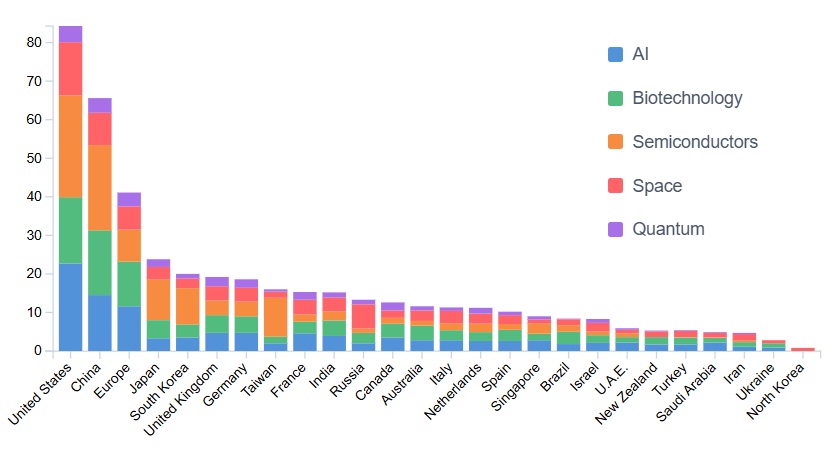
*We’re no Harvard academic but we would have included batteries in this index—it will drive drones, robots and more. FYI China is way ahead in this technology
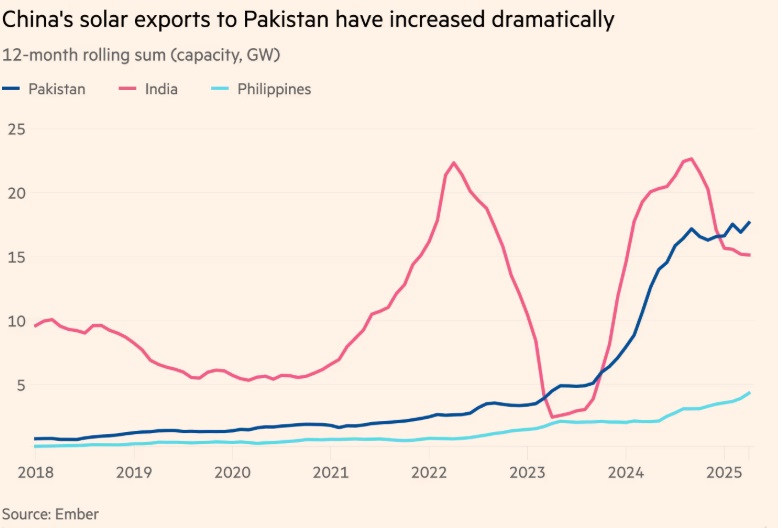
Solar & Batteries Win: Pakistan Edition
Almost since the beginning of International Need to Know we’ve pointed out that solar wins on the economics. In recent years, batteries have become cheaper and better. The combination means the world will be electrified via solar and battery storage. Pakistan, which probably doesn’t come to mind as a clean energy magnet, offers a prime example. The Financial Times recently chronicled, “Chinese solar panel prices have plummeted in recent years as the cost of electricity from Pakistan’s grid has surged, prompting the country of 240mn people to import solar panels with the capacity to generate about 19GW last year, according to Jenny Chase, BloombergNEF lead solar analyst.” Pakistan’s energy system was unreliable with frequent blackouts. That’s hard on households and on factories. But with battery storage costs falling and solar panels more efficient, now factories can run on solar-powered electricity stored in batteries, even at night. And as for households? The FT notes, “For households, hooking up to a battery is a way to store enough energy to cope with spontaneous blackouts and avoid higher rates for energy from the grid during peak usage times in the evenings.” Companies now recoup their solar and battery investments within two years. Pakistan is just more evidence of our battery and solar future.
China Corner: Trading Places
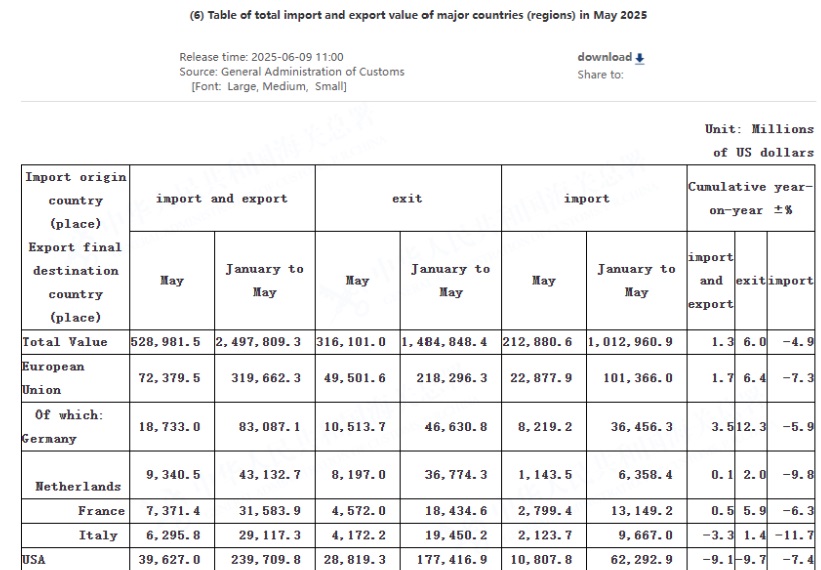
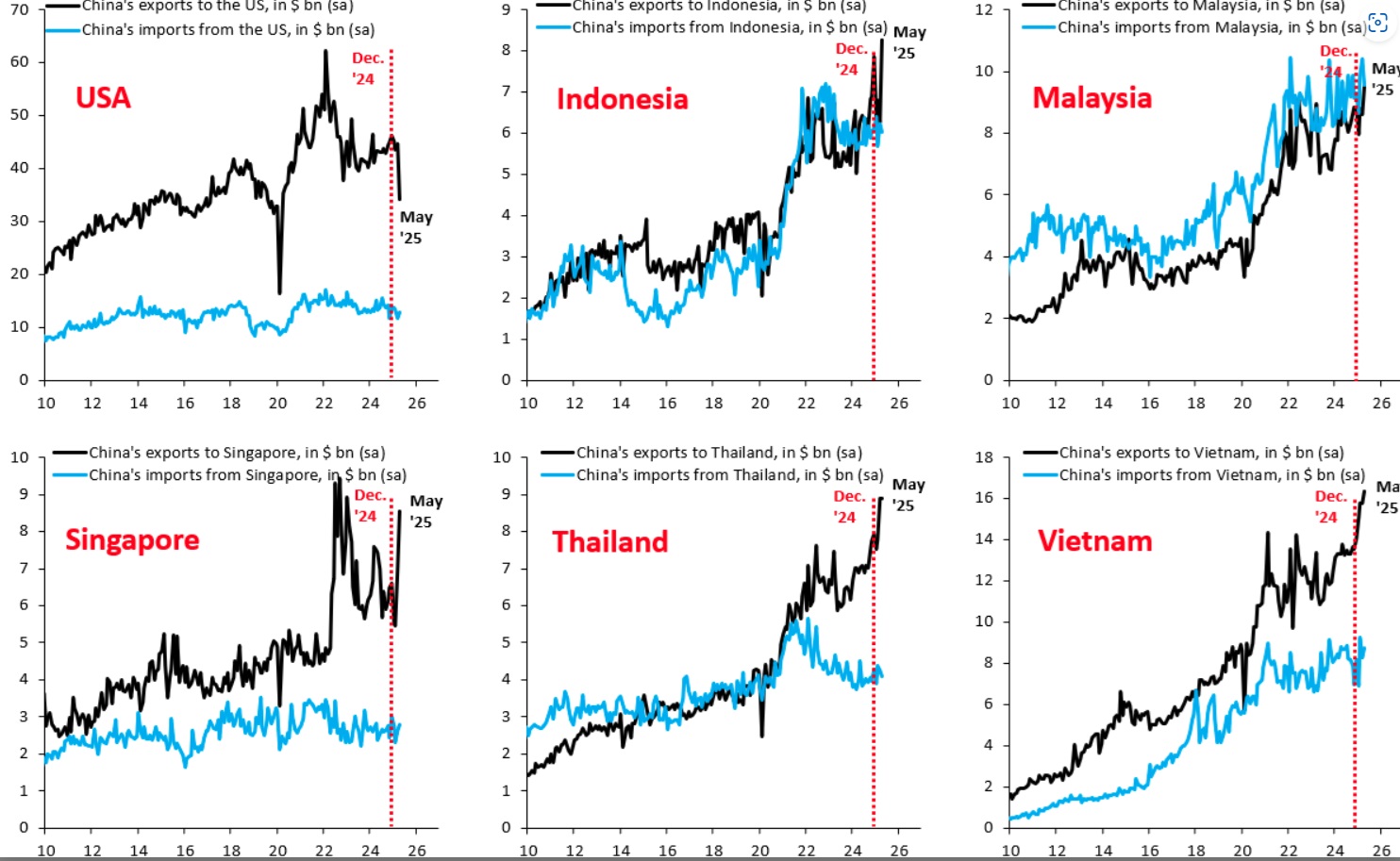
If you stand on a dock in Shenzhen long enough, you can hear the cargo containers whispering, like sirens of the sea. Lately they’re murmuring in French, German and Vietnamese more than English. According to the latest data from China’s General Administration of Customs, China’s exports to the United States fell 9.7% year-over-year in May. But while the U.S. is importing fewer Chinese goods, the European Union is stepping into the breach. Exports from China to the E.U. rose 6.4% year-over-year, driven by machinery, electric vehicles, and green tech components. That EV you see whirring down a Paris boulevard may well have arrived via the Yangtze. This is one short-term outcome of the tariff war. Before Taco Time*, China needed to find other export destinations, as it continued to pursue GDP targets like a hungry dog chases burritos. Europe was a safety valve. At the same time, China is also exporting more to Asia, including to Vietnam. We continue to see analysts claim this is all transshipment but that is not likely. Value is being added in these Asian countries to goods that are than exported. In addition, China is unloading a bunch of cheap goods on these countries, which many of them are complaining about. The big question is will the countries importing more Chinese goods, who are worried about these increases, band together to leverage their collective market power and push back against China? Will even the E.U. do this? The Great Game is afoot.
*Chinese exports to the U.S. are again increasing as Trump reduced tariffs to 55%
Second chart below from Robin Brooks