Yeah, yeah, we get it, lots of data provides reason to worry about Generation Z. They struggle with anxiety, aren’t reading much, and apparently aren’t having much sex either. All worthy things to worry about. But our interactions with Generation Z are almost uniformly positive. Rather than worried, we’re impressed with them. We interact with young college students all the time and usually we are amazed at how much better they are than we were at that age. Last weekend we attended a wedding of two Zoomers. The bride, groom and their friends could not have been more impressive. Their toasts were inspiring. They cared for each other and their families. The bride handwrote personalized notes for each of the 100+ wedding attendees.
At the same time, the last two weeks we’ve been watching the NBA Finals. I know you probably didn’t pay attention but two good teams with really nice players were competing for the championship. This was the highest level of competition but these mostly early to mid-twenties players were respectful of each other before and post games. They complimented each other’s skills and attributes. When the Indiana Pacers’ best player, Tyrese Haliburton, tragically ruptured his achilles tendon early in Game 7, the Oklahoma Thunder’s best player, Shai Gilgeous-Alexander, went over to see if Haliburton was okay. We even occasionally saw opposing players help each other off the floor when they fell.
For forty years, the sports ethos was win by any manner and don’t give your opponent respect—certainly you would never help a player off the floor. Since Muhammad Ali, sports has mostly been about the loudest athletes voguing for attention. But a new ethos seems to be in the air, epitomized by the Pacers and Thunders, team over individual, competence over loudness–and it’s all coming from the young generation. So sure, there are plenty of things Generation Z’ers need to improve upon. But, c’mon everybody, the kids are alright. However, Boomers still rule the world, even as solar might propel young Africans, and China should have democratized. It’s this week’s International Need to Know, the Gus Williams of international information, the Downtown Freddy Brown of global data.
Without further ado, here’s what you need to know.
Rage Against The Dying Darkness
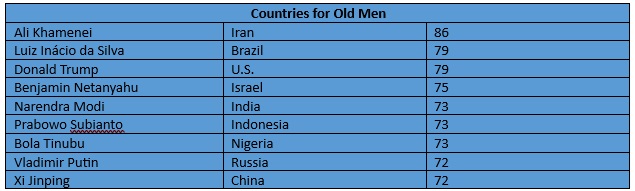
Speaking of the kids are alright, we’re not sure we can say the same about their grandparents, or in some cases, great grandparents. And by that we mean the old people ruling over us. They are not nearly as courteous and well-meaning as the young’ns at the wedding or the Thunder or Pacers. Below is a list of some of the rulers of the most consequential and largest countries in the world, all in their 70s or even older. Ali Khamenei, or Al as I like to think he’s called, like anybody named Al sporting a stained white tank top, slinging pizzas, is 86-years-old. Benjamin Netanyahu, with Al-like tendencies, is no spring chicken at 75. Our own Donald Trump is a year out from 80. In the latter two cases, old leaders were the choices of the electorate. Xi Jinping is 72 and is the choice of, well, himself. Same for 72-year-old Vladimir Putin who rigs elections so well David Stern admires him from the afterworld. Of course, the largest democracy in the world, India, recently re-elected Narendra Modi, who is 73-years-old. These ancient rulers are perhaps a consequence of aging demographics and medical advances. But people do not live forever even in the age of Ozempic, CRISPR and MRNA. We are curious what the 2030s will be like. How many of these rulers will still reign? Or will they have been replaced? And will they be replaced by other old people? And by what means? Ten years from now might be a very different ruling landscape.
African Power
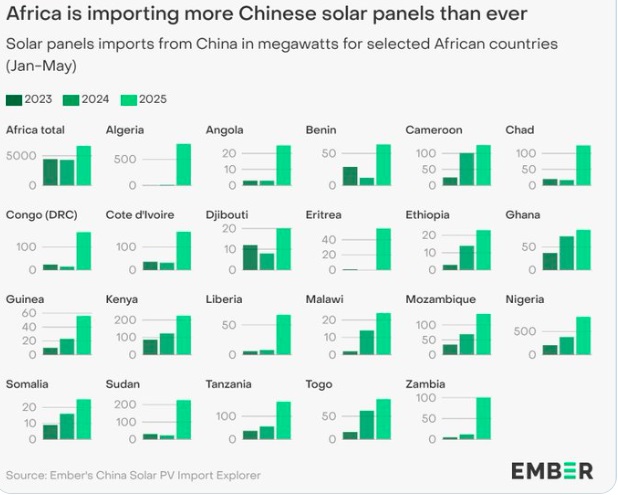
A few weeks ago, we pointed out how solar and batteries are winning in Pakistan. The same is true in much of Africa. Just as in Pakistan, the surge in Africa is driven by imports of Chinese solar panels, as you can see in the chart below from Ember. Current year exports of solar panels to Africa from China are soaring. U.S. tariffs are impelling Chinese exporters to find other markets. For solar panels, countries in Africa are proving to be a good alternative. Much of Africa is a prime location for solar power. It is great that these countries can benefit both from Chinese subsidies and other Chinese policies that deflated the cost of the panels, and the United States policy to eschew these cheap panels.* Energy generation has long lagged in many countries in Africa. If affordable energy becomes abundant in Africa thanks to solar, that might be a game changer for economic development. And as Jesse Peltan argues, solar power can be decentralized, “no longer controlled by the few.” That could have both economic and political ramifications for many countries in Africa.
*There are security concerns about solar technology—China could remotely sabotage energy generation—which is a reason why countries might want to manufacture their own solar panels and associated technologies.
China Corner: Shoulda Democratized
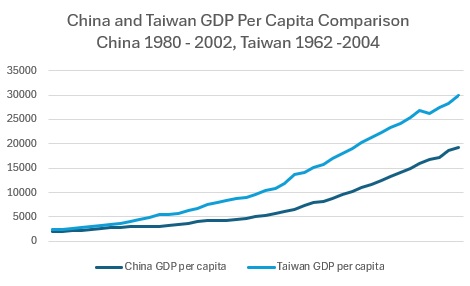
We’ve been charting China’s technological, industrial and exporting successes in recent months and years. And it’s real. China has become the factory to the world and is now innovating technology nearly on par with the United States. So authoritarian governments are great, right? We should all aspire to create ruling entities like the Communist Party of China, whether you are a developing country or an established democracy. Not so fast. We remind you that other countries, including Taiwan, have achieved economic success AND liberalized politically. The chart below shows GDP per capita for China and Taiwan over a 42 year time span during their fast growth periods. As you can see, Taiwan’s GDP per capita grew faster than China’s. We could create similar charts comparing China with Japan and South Korea during their rapid economic growth eras. In the last twenty years, as Taiwan became fully developed and achieved GDP growth at a more normal level, China’s GDP per capita did grow at a faster rate. But China’s economic development has now crested. And yet China remains far below Taiwan’s GDP per capita level. For world dominance purposes, China continues policies to dominate manufacturing and exports, but this is at the expense of the Chinese people. Taiwanese enjoy a good economy and freedom. China has somewhat of the former and none of the latter. It would have been better for the Chinese people if their government liberalized politically like Taiwan and South Korea did.