We have long asserted, to anyone who will hear us, that summer is better than winter. Of course, we prefer warmer weather as any right-minded person should. We like being outside, whether riding a bike, going for a walk, watering the garden, playing basketball and softball back in the day or settling down with a cocktail in hand watching the world go by. We do not like doing any of those things when the air is cold, the wind is up, the sky is dousing us with rain. We are, we admit, a fair-weather man, though we hope not friend. We like possibilities, opportunities and alternatives, which are far more abundant when the sun warms our fair climes. In sum, we feel both more relaxed and energized in the summer. The International Need to Know Spouse has come around to our way of thinking recently, which gives us hope for if we ever retire we can spend winters in a less dark, less cold place than Seattle.
Of course, no location is more beautiful, comfortable and hospitable than a Seattle summer. We have been lucky to travel all over the world and we can honestly say that there is nowhere we’d rather be than Seattle in July and August. But November or December…January through April, well, then we’d rather be in New Orleans. Once, years ago, when buying a photo of Dr. John from a New Orleanian who used to work for Starbucks in Seattle and had lived many places, we asked why he moved back to the Crescent City. He replied, “people don’t know how to relax elsewhere.” Indeed, perhaps the most relaxed we ever feel is when sitting at Cafe Du Monde, savoring a beignet, inevitably a street musician playing nearby. So, as we enjoy a Seattle summer we kindly suggest Hungary re-democratize, countries get their debt under control and the U.S. learn from China’s solar domination. It’s this week’s International Need to Know, pouring out international information like powdered sugar at Cafe Du Monde, brewing up chicory-flavored global data.
Without further ado, here’s what you need to know.
Hungary Should Re-Democratize
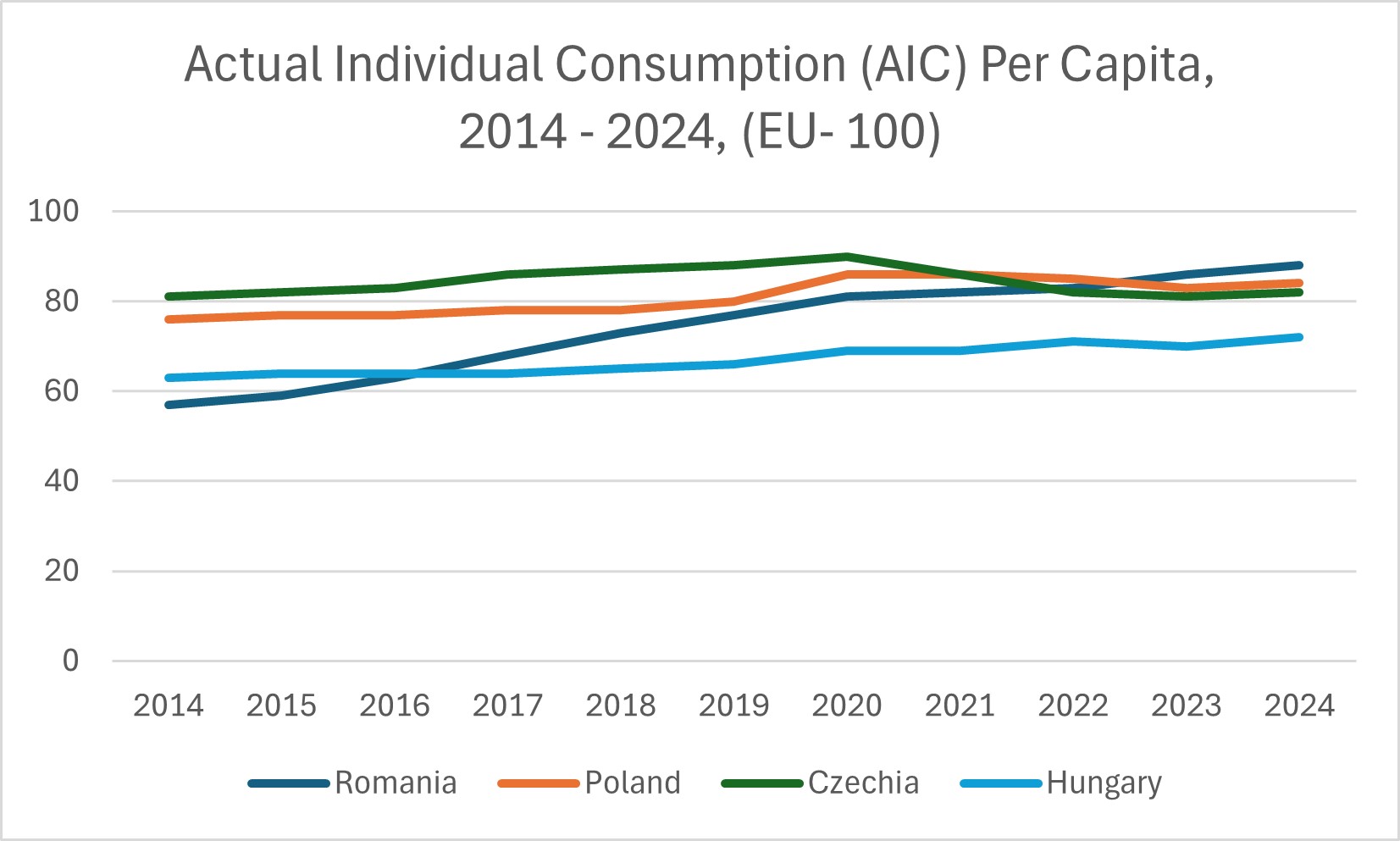
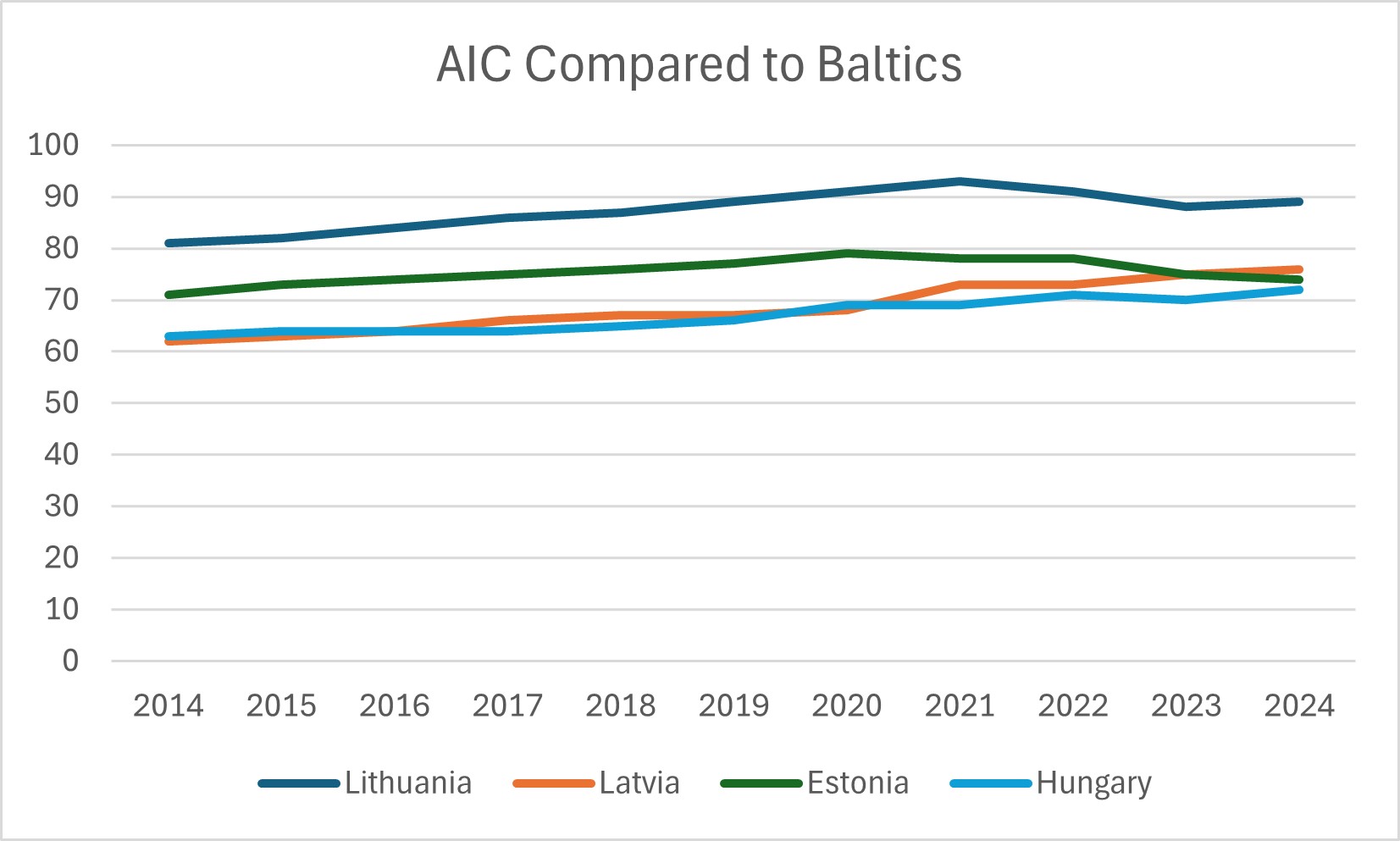
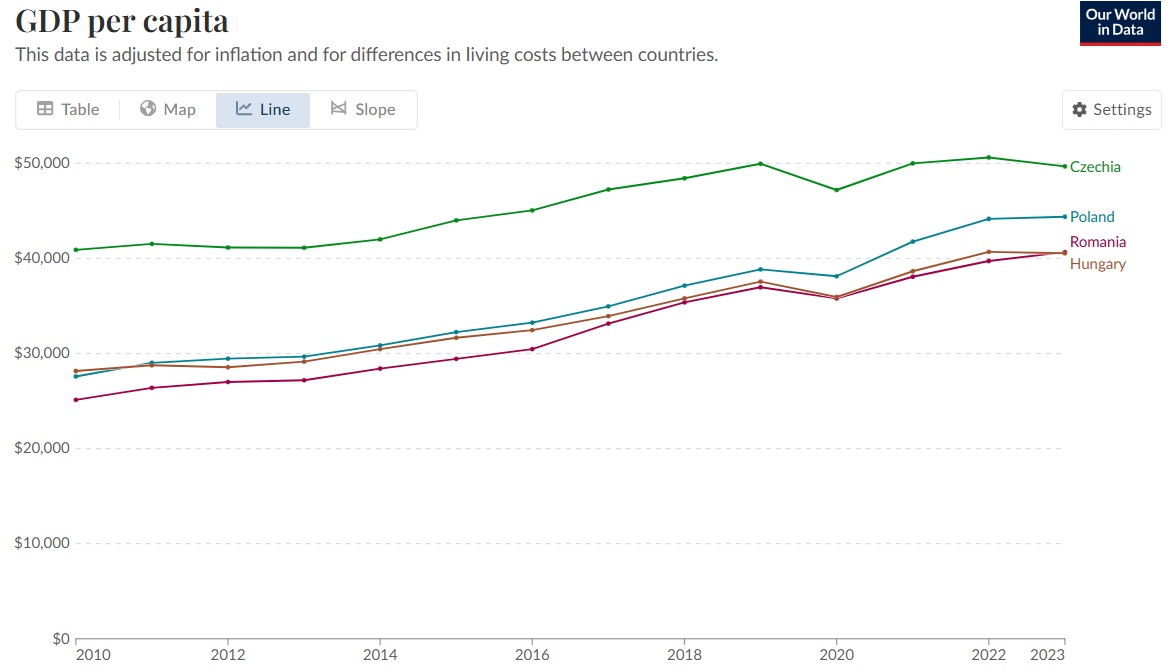
Under Viktor Orbán, Hungary has gone autocracy-light. It is not a full-on dictatorship, but it has taken on the trappings of non-democracies. It still holds elections, but Orban has neutered the media, tilted campaign finance in his party’s favor, and reduced civil liberties, most especially for the LGBTQ community, but also for universities and NGOs. Orban and his friends have also grown rich through corrupt practices. Are Hungarians better or worse for it economically? A professor at the University of California San Diego, Branislav Slantchev, claims Hungary “has dropped to dead last in the European Union (EU) in almost every ranking.” Slantchev provides a chart showing that Hungary is now last in Actual Individual Consumption (AIC) in 2024 in the EU. But to be fair, this should be tracked over time, which we do in the first chart below. When Orban took over, Hungary was already well below Poland and Czechia. On the other hand, Romania passed Hungary. If we do a similar comparison to the Baltic states, Hungary has nearly caught up with Estonia (very surprising to us), but has fallen behind Latvia. Looking at GDP per capita, Hungary has fallen behind Poland and Romania although all three have gained ground on Czechia. So, Hungary has indeed not done well. We’ve pointed to studies multiple times that show democracies outperform autocracies economically, but not by a lot. Democracies should work to do better economically. On the other hand, who wouldn’t rather do slightly better economically and have freedom? Hungary should restore itself to a full democracy. It is not a country to be admired, politically or economically.
Ozempic for Debt Control
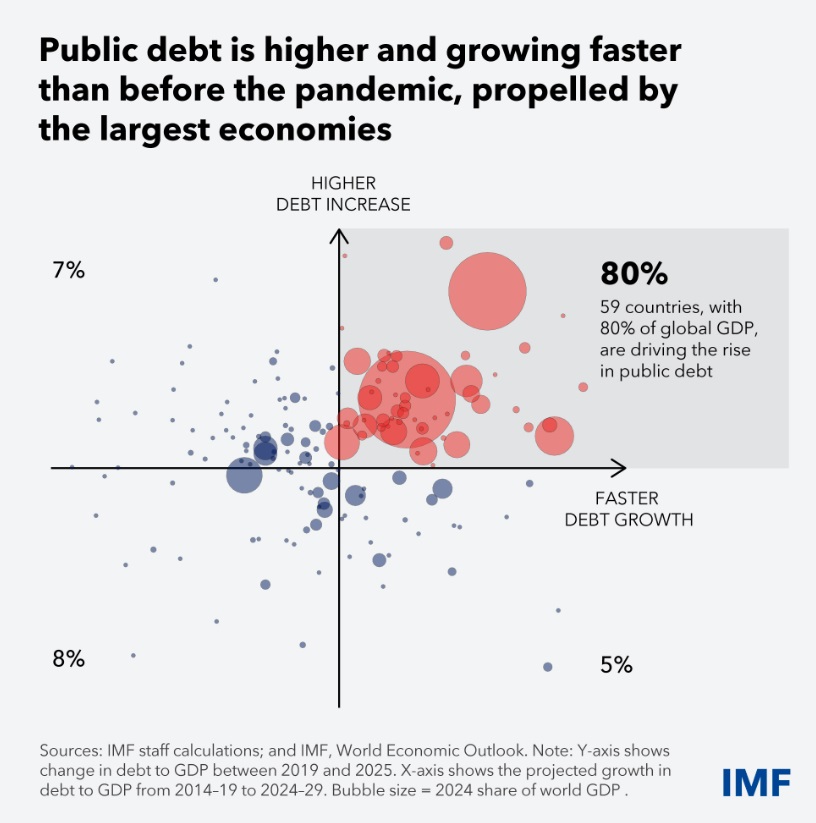
The class of GLP drugs such as Ozempic appear to work by giving individuals impulse control. That’s why they are not only effective at treating obesity but also addictions and a variety of other such ailments. The world appears to be in great need to develop a drug class that would give governments impulse control. The prime example is the remarkable increase in debt that governments around the world have racked up in recent years. According to the International Monetary Fund (IMF), “More than two-thirds of the 175 economies in our study now have heavier public debt burdens than before COVID spread in 2020.” Obviously there was a need to increase spending during the pandemic but those increases never ended, especially among the world’s largest economies. According to IMF data, as you can see in the chart below, “59 countries with 80% of global GDP, are driving the rise in public debt.” That debt is higher than it was pre-pandemic and more worrisomely, it’s now rising at a faster rate. We call on pharmaceutical companies to go find other lizard’s saliva that can be given to rulers, parliamentarians and congress people as they prepare budgets.
China Corner: The Sun Shines
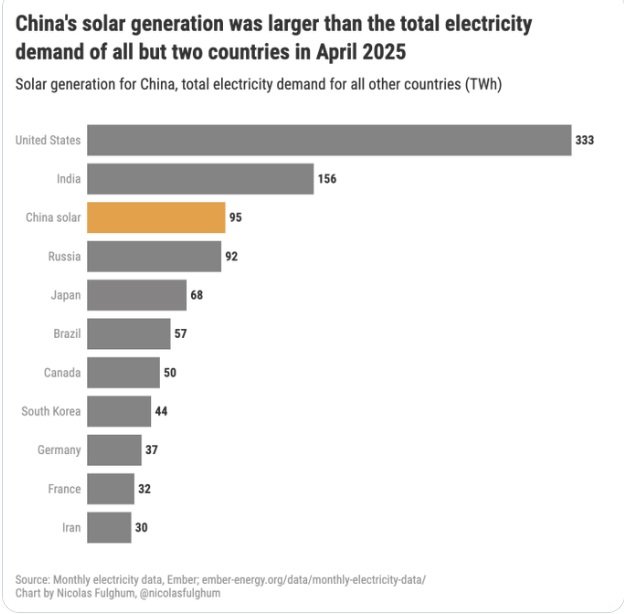
On our walks and bike rides through Seattle we see a smattering of new solar panels installed on the roofs of houses. Even this paltry increase would annoy The New Amish sensibilities of Trump and his anti-progress acolytes. The Trump administration attempts to squash solar power in the United States through the Big Beautiful Bill, although thankfully the Senate has moderated some of the worst anti-solar provisions. Earlier this week Trump said in an interview that solar panels are ugly and we need more coal. Meanwhile, Duncan Campbell reports that “China installed a record 60 GW of new solar photovoltaic capacity in the first quarter of 2025.” And 60 percent of that was rooftop solar. If I rode my bike and walked in China I would see a lot more houses and businesses with solar panels on the roof. Campbell notes further that China understands there is a growing demand for energy and “They know they need more electricity and solar is a fast and low-cost way to do it.” Not only will America fall behind economically because of turning its back on new energy technology that is now cheaper and more efficient than fossil fuels, it will also risk its national security since drones, robots and AI are dependent on abundant energy and batteries. To put China’s lead in perspective, “In April 2025, China’s solar generation of 95 TWh was larger than the TOTAL ELECTRICITY DEMAND of all but two countries in the same month.”