Like the old man said, sometimes you gotta get lost to find yourself. And we apply that occasionally on our bike rides. Sometimes, especially on an early Sunday morning, rather than following a preplanned route, we’ll let the wheels guide us, off the path, wherever fate wanders. But earlier this week without really thinking, we did this at rush hour and found ourselves on an arterial through which the cars raced at rapid speeds. We ourselves do the same on this road when driving so we can’t complain.
Our wheels wisely turned to a smaller, though much steeper road. We pedaled up it, breathing hard but admiring the wooded shade until we came upon a regal sign set on a lawn in front of a foreboding black iron fence. The gold writing on a purple background read, “Self-Realization Fellowship. Founded 1920 by Paramahansa Yogananda. Seattle Center. All Welcome.” Given the last two words, we came to a stop, and examined the stately building guarded by the black fence and large, locked gate with a prominent “No Trespassing” sign affixed to it. None of it seemed overly welcoming to us, but we know nothing of this religious outfit so rather than judge we pedaled on our self-realization ride and stumbled upon a mansion a block away, but not on a hill, rather, down in a steep gully. It pierced out of it like a wooden tower. it was huge, which we guess is common for mansions, and it was surrounded by tall firs, also emerging from the gully like towering green sentries.
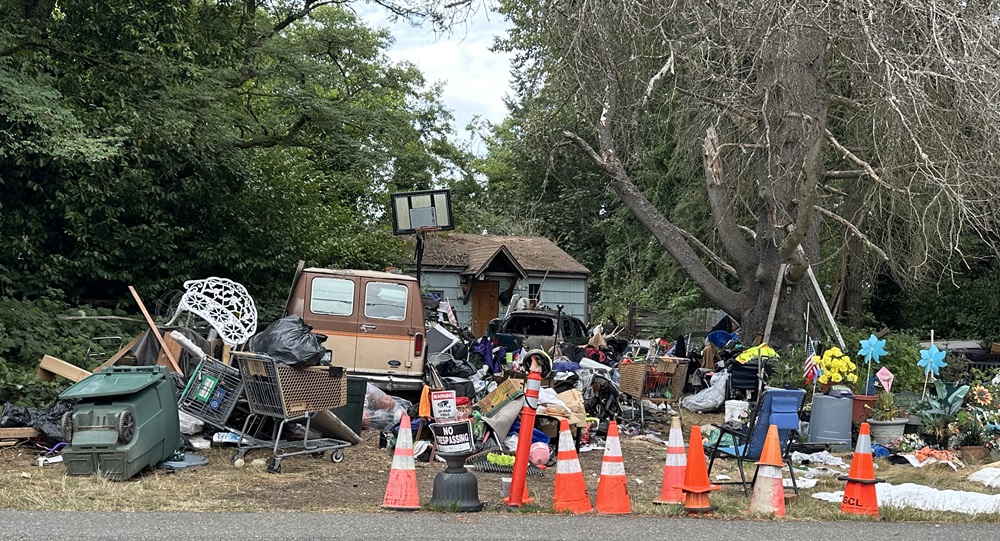
But two doors down was the house you see in the photo below. A complete wreck of a yard, the kind of scene that would make Sanford and his son blush. We wondered at all these places—Yogananda’s self-realization center, the mansion, and the junk yard–so close together, essentially neighbors. We are told that today Americans are segregated by class, by income, by race by just about anything you can name–almost never encountering the Other in the wild. And perhaps these folks stay to themselves too, notwithstanding they are within whispering distance of each other. There is much to see in this world, even within pedaling distance, even if only in the imagination. We see communist Vietnam helping communist Cuba with markets, solar power increase in all the right places, and China wanting its own Ellis Island. It’s this week’s International Need to Know, meditating on international information, actualizing global data.
Without further ado, here’s what you need to know.
Can Vietnam Turn Cuba Capitalist?
It’s a mixed-up, muddled-up world we live in, full of surprises around every corner. Don’t like the way things are today? Well, don’t worry, they’ll be different tomorrow. Take the fact that a Vietnamese company, Fujinuco Group, is growing rice in Cuba on land it was granted by the Cuban government. As France24 reports, “Vietnam has advised Cuba on rice cultivation in the past but this is the first time a private firm has done the farming itself.” Yes, a private company from Communist-governed Vietnam is growing rice in Communist Cuba. Very successfully, we might add, with yields seven times those of the previous Cuban farmers. Fujinuco is an agriculture company that, among other things, makes fertilizer. One challenge for the company is it can’t get its profits out of Cuba very easily because of Cuba’s immature banking system. Cuba, despite having fertile soil, has poor agricultural production because of its rigid communist system. Vietnam once had that problem but in the 1980s it instituted market reforms. Since then, Vietnam doesn’t have famine problems, its economy grows rapidly, and people’s lives have dramatically improved. It would be something if Vietnam can help Cuba become capitalist. The world continues to astonish
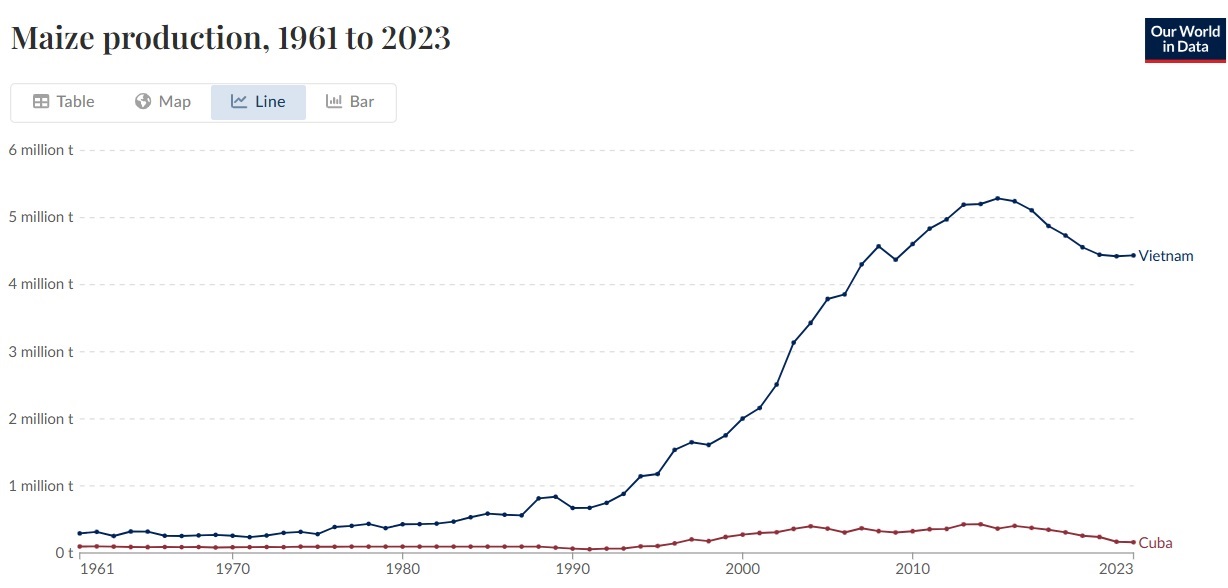
Maize acts as a stand-in for agriculture yields in general
The Sun Will Shine Where It Needs To
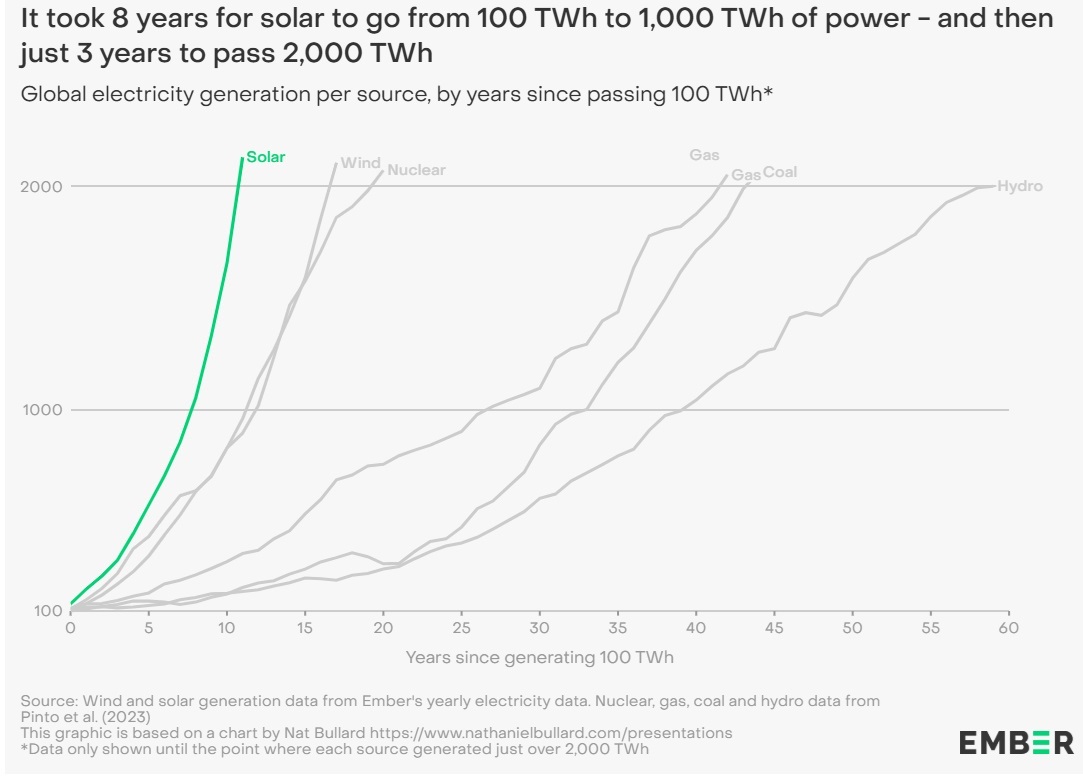
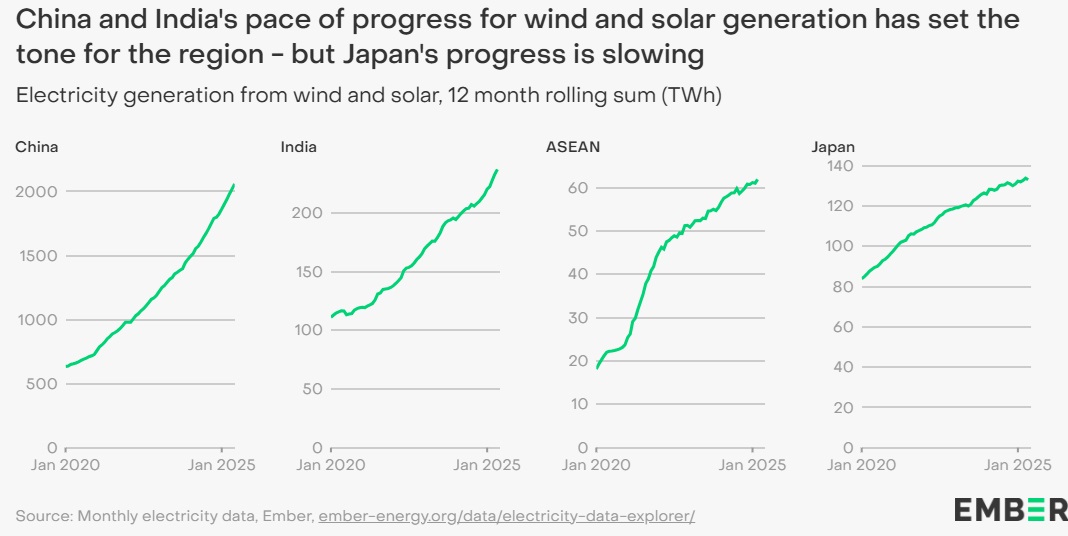
We have friends who are apoplectic about the current U.S. administration’s attempts to squash solar power. We’re concerned, too, but are confident that economics will win out in the United States just as they are in the rest of the world. And they are indeed winning. If you check the latest data, solar power is the fastest growing source for energy generation. As Ember notes, for the last three years solar has been the “largest source of new electricity globally.” In fact, “Solar electricity generation needed just eight years to grow from 100 TWh to 1,000 TWh. Then it took only three more years to double that — reaching 2,000 TWh in 2024.” Just as important in regard to addressing climate change, the growth of solar is happening in large countries who will increasingly use more energy as they continue to develop. As you can see in the second chart below, India and China are increasing electricity generation from solar power at a rapid rate. ASEAN countries, including Vietnam, are not increasing as fast but still the line is up. To quote Ember, “Solar is no longer just a daytime resource. With battery storage costs falling and deployment accelerating, we’re entering a new era where solar can reliably power economies day and night. It’s becoming a true 24-hour solution — clean, scalable, and central to the future of energy transition.” Technology and economics will win out everywhere eventually. Of course, those countries that leverage cheaper, more abundant energy will gain advantages over those that wait.
China Corner: China Adopts Our Book’s Recommendation
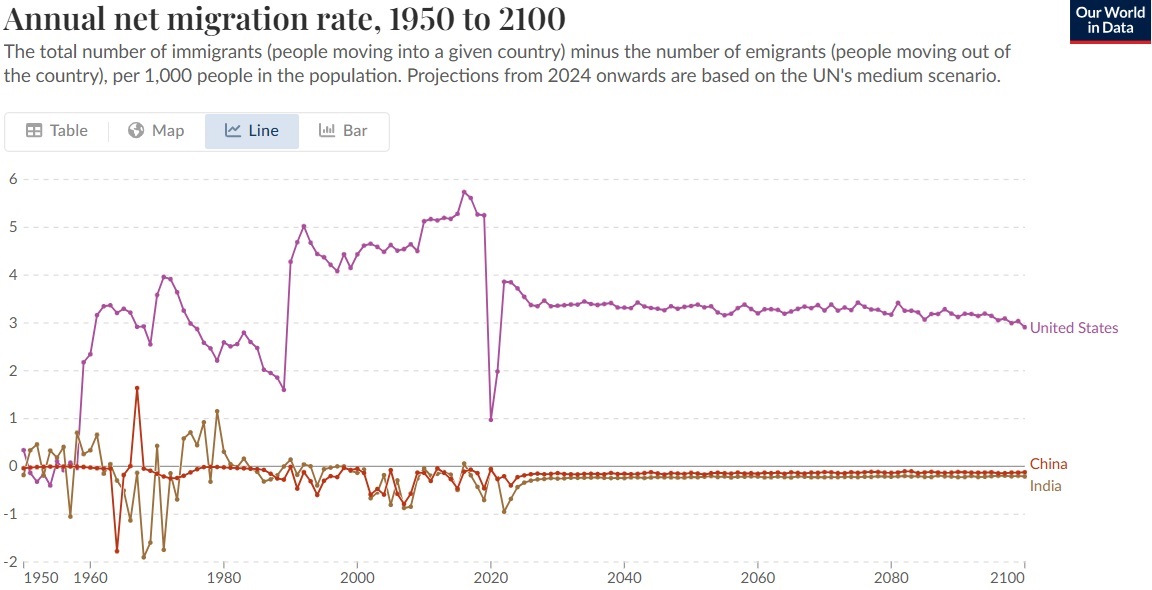
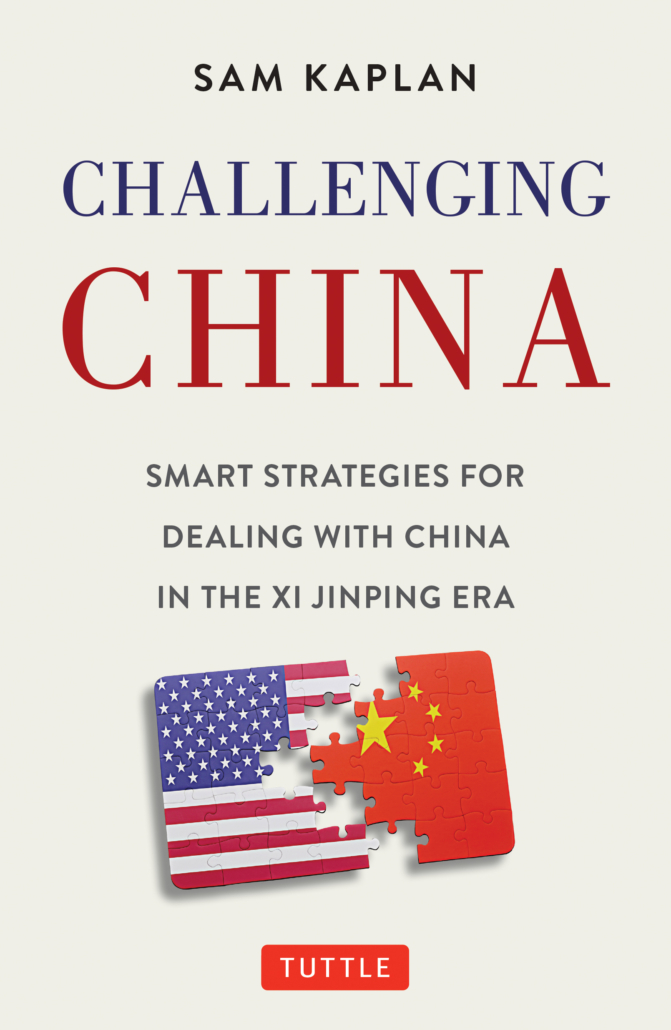
America’s Got Talent. But so does China. So does every country, but since China’s population is nearly four times larger than America’s, it has more talent. That’s one of the reasons why one of the main recommendations in our book, Challenging China, to deal with an increasingly authoritarian and expansionist China, is to bring in more talent. Unfortunately, the Trump administration is doing the opposite, pushing talent away from the country. Ironically, China is now doing what we recommended. It is trying to attract talent. It has instituted a new K Visa for young science and technology professionals. It is also providing visa-free entry to more countries’ citizens, including France, Germany, the Netherlands, Spain and Malaysia. These are good ideas. But the challenge for China is it is ruled by an authoritarian government. How many folks will want to move there given censorship issues and lack of civil freedoms? As you can see in the chart below, in the past far more people have wanted to go to the U.S. than to China. That’s still true today, even if the United States is less welcoming. But it’s interesting that China understands the great competition for talent better than some in the current U.S. administration. And it is certainly seeing some return of China’s talent diaspora.