In college, our favorite English professor was Wilbur Braden. He was, as all such favorites are, a character. He spoke with a light British accent even though he was from Idaho. If his accent was not so delightful, if he was not such a good teacher, if he was not so well-meaning and so wanting his students to enjoy and learn from literature as much as he did, we likely would have made much fun of this affectation. But instead we were charmed by it. Professor Braden loved Jonathan Swift. A friend convinced us to take a class our senior year from Braden that was intended for English majors and required, we learned early in the semester but too late to drop the class, our writing a senior thesis on a classic book. Professor Braden and I decided on Jonathan Swift’s Gulliver’s Travels.*
We had many long, deep and fun discussions with Professor Braden and one of the life lessons he taught us was that certain things have already been decided—for example, we, as a 21-year-old did not have the power to determine whether something was a classic or not. New great books would emerge but there were already books considered great, and for good reason. Time and history had already made that decision. We remember arguing against this with Professor Braden, as only an upstart confident young man who knows nothing is capable of, but with that lilt in his voice, that glint in his eyes, he guided us back to reality. And, indeed, as we grew older, we realized the wisdom of his words. For example, we are not a fan of David Lynch movies but we don’t presume to argue that he is not a great director—so many people we respect say he is. Lynch is just not to our taste. There are any number of artists across many mediums that are truly great but that our taste buds deign not to dine on.…well, except for the Counting Crows. They suck and we don’t care what you say (Professor Braden, if he were still around, we are extremely confident would agree with us). Self-driving cars don’t suck, neither does South Korea despite some big challenges, and that giant sucking sound you hear in China is the intake of the breath of policy makers facing difficult decisions. It’s this week’s International Need to Know, the Chaucer of international information, the Dickens of global data.
*Because of circumstances we won’t go into, we wrote most of our senior thesis—and again, we had no need to write a senior thesis given we were a math major [though we earned an English minor]—on the roof of a houseboat on Lake Shasta during Spring Break, likely often with a cheap beer in our hand. We earned an A—which set a bad precedent for much of our early twenties.
Tomorrow will be 20 years since Hurricane Katrina, or what New Orleans, a city that remains undefeated, calls the levy failure.
Without further ado, here’s what you need to know.
Driving Will Be Safer Internationally
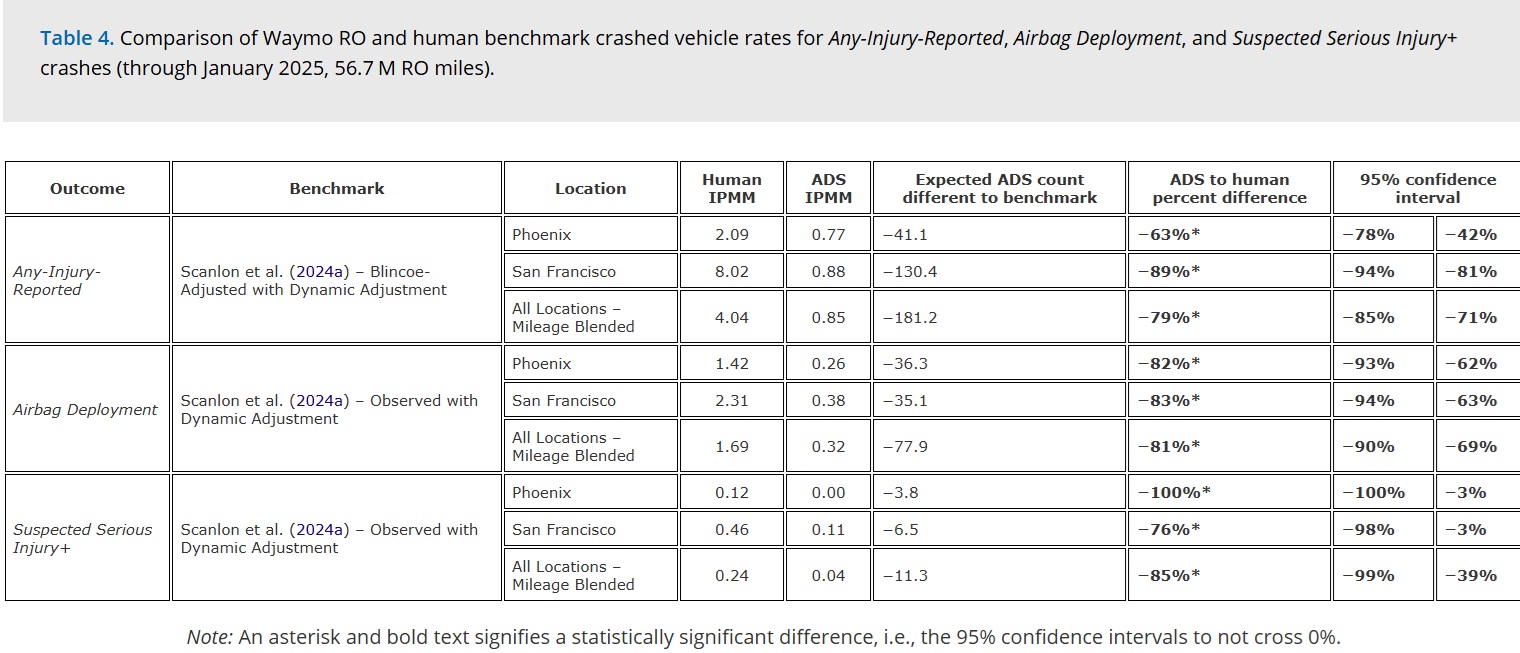
Long-time readers will remember we predicted, incorrectly, that self-driving cars would be ubiquitous by now. However, Waymo in recent years successfully runs self-driving taxis in the Bay Area, Phoenix, Los Angeles, Austin and Atlanta, with more locations planned for the future, including in Japan. So there is now lots of data on their safety since these vehicles have driven 57 million miles. And guess what? Robotic cars are a lot safer than we idiot human drivers. Those of our readers who drive know just how bad we humans are. But to put it into numbers, 2.4 million are injured and 40,000 are killed in US auto accidents every year. A recent peer-reviewed study found “a 96% reduction in Any-injury-reported (87–99% confidence interval) and a 91% reduction in Airbag Deployment (76–98%).” So now you’re thinking, we hope, great, we can soon radically reduce the 2.4 million and 40,000 numbers. Well, we’re not entirely confident about that given the current anti-progress and anti-technology vibe in America. For one example, Boston is instituting all sorts of “process” to stop or slow roll the use of self-driving cars with lots of interest groups involved. Our guess—and actually we wrote this decades ago—is that self-driving cars will become ubiquitous in other countries before they do here. Not because of technology but because of America’s obsession with process and now its distaste for technology and for the future. It will be our loss, including a loss of thousands of lives.

The Agony & Ecstasy of South Korea
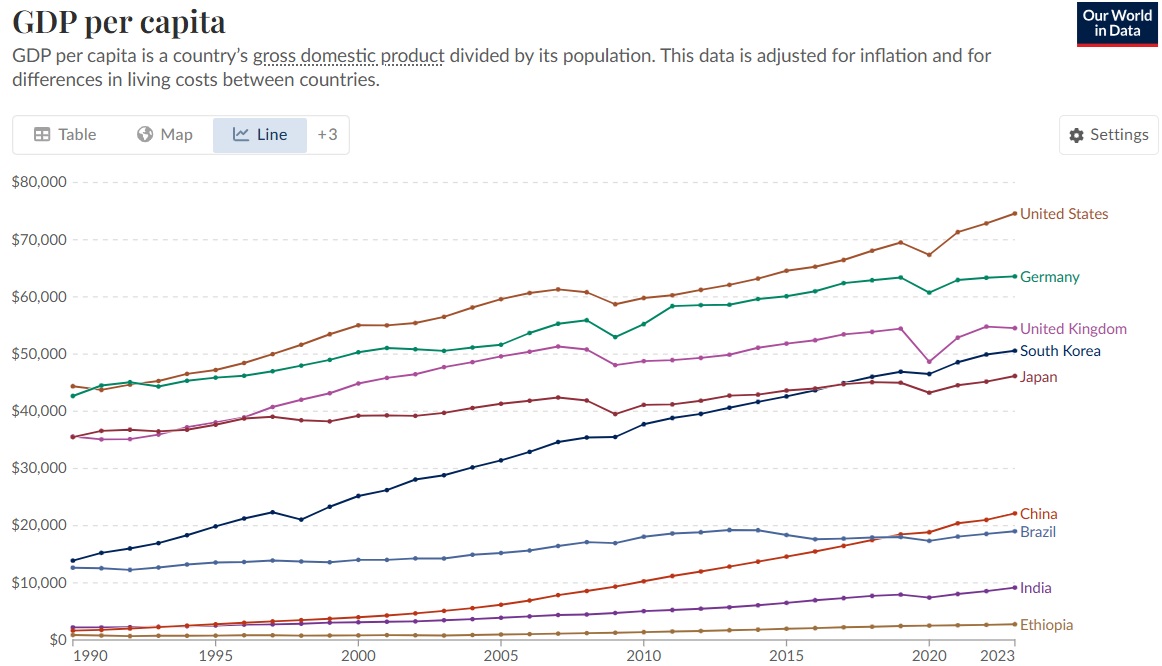
The President of South Korea, Lee Jae Myung, was in the United States this week. South Korea is remarkable in any number of ways. The country has built a modern economy that develops and manufactures high-technology products of many types. It’s one of the key semiconductor manufacturers and the second-largest shipbuilder in the world. Its GDP per capita, as you can see in the first chart below, passed Japan’s a few years ago and looks set to surpass the U.K.’s soon. It’s an impressive economic record. But at the same time, South Korea is on pace to disappear, or at least its population. South Korea has a fertility rate of 0.7. As you see in the second chart, that’s lower than Japan, China and Germany—all places that people worry about having low fertility rates. South Korea’s current population is 51.7 million but it’s going to get smaller and smaller in the coming years and with current trends will shrink to 36.2 million by 2072. Low fertility rates are a problem for the whole world, except for certain parts of Africa (and even there fertility rates are trending down). But South Korea is truly exceptional in its lack of children. Perhaps not coincidentally, South Korea is the largest adopter of industrial robots. Maybe one day that will be all you see in the country.

China Corner: Economic Sophie’s Choice
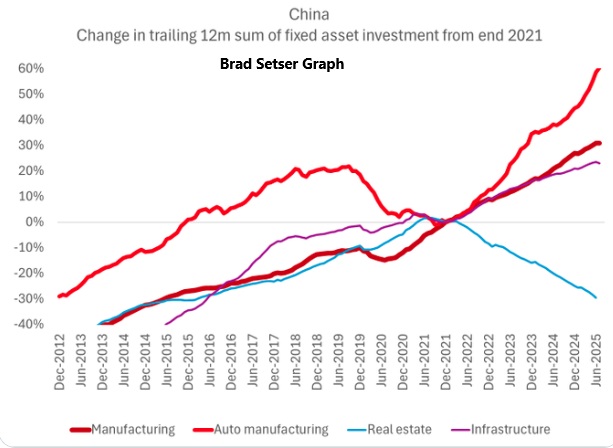
China, like South Korea, has seen remarkable economic success. Today it is the second largest economy in the world (first by purchasing power parity data), largest manufacturer and largest exporter in the world. But as Brad Setser, Noah Smith and others (including us) have been pointing out, it has some stark choices going forward in its economy. During the 2008 financial crisis, China poured money into infrastructure investment and real estate. That kept its economy growing at a high rate. It then purposely popped the real estate bubble around five years ago. Since then, it has tried to counter that economic headwind by pouring money into manufacturing. That’s created overcapacity in a variety of sectors so companies are producing huge amounts of goods—including in strategic industries—but not making any money. Profits are way down for Chinese businesses, and many aren’t making any profits at all. So now we see China reducing, at least in some industries, investment. This will likely cull some companies and the remaining ones will become profitable (though they may eventually face stiffer international competition). Of course, in the short term, this will increase unemployment. And GDP will grow below the official target of 5 percent (it likely already is, even if official data doesn’t show it). China will need to decide between lower growth or having zombie companies making no profit. Tough choices all around.