Apologies for missing last week—stomach illness and Mariners playoff games (unrelated believe it or not), had us in the fetal position or grandstands rather than at the keyboard.
To paraphrase the undertaker Bonasera at the beginning of The Godfather, we believe in capitalism. Democratic countries with free but regulated markets have done more for human welfare than any institution. We also note that we have good friends of every socioeconomic level, including those at the high end. All that being said, we couldn’t help but notice when attending Seattle Mariners games, the difference between people in the 100 and 300 levels. Our season tickets are in the 300 level behind home plate. During the regular season, we sell back some of our games and use the money to sit in the 100 level for the games we do attend. For the playoffs we were in the 300 level. Down in the 100 level there are—how can we put this—a lot of jerks, or at least people being jerky (sometimes including us—someday after the statute of limitations expires we’ll tell the story of our sitting behind Robbie Ray’s family). But up in the 300 level, it is more community oriented. People are supportive of each other, caring about each other, and generally just friendlier and nicer.
We thought about all this while reading an article about dysfunction on the Los Angeles Lakers. Those described in the article are all enormously wealthy men, both the players and management, and the Hollywood actor who meets with them. They all come across as bizarre, infantile jerks, who wouldn’t be caught dead in the 300 level of T-Mobile Park. So three cheers for markets, but only a tepid golf clap for some of today’s wealthy. But a full-throated cheer for democracy, bravo to improvements in the Human Development Index and a puzzled expression at the Netherlands-China dispute. It’s this week’s International Need to Know, resigning ourselves to the fact that we will not live long enough to see the Seattle Mariners in the World Series even if we write about international information and global data for another 40 years.
Without further ado, here’s what you need to know.
Yes, Damn it, Democracy is Better
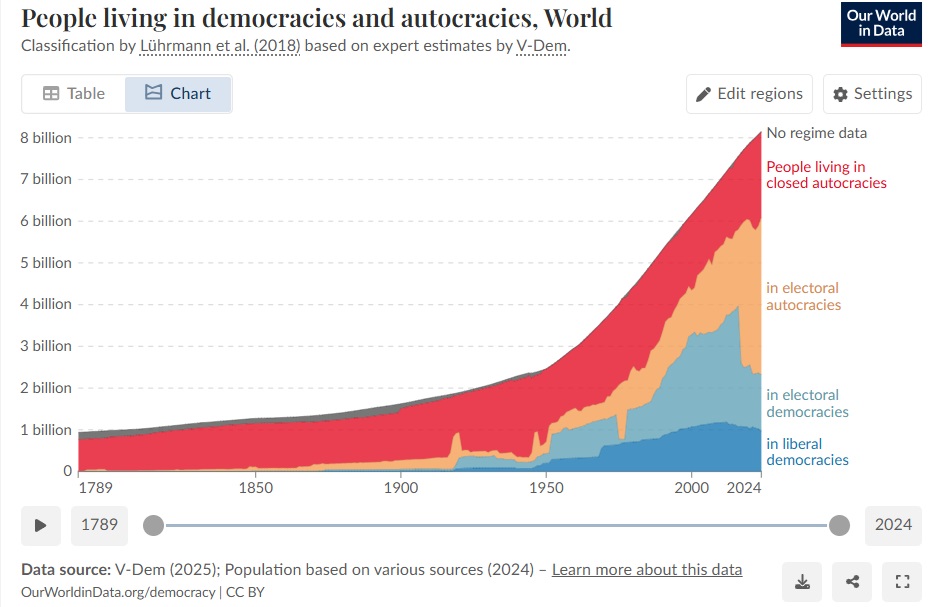
We attended an excellent conference on China last week, with good speakers and content. It was focused on the US -China economic relationship and rivalry, which meant that the large elephant in the room was ignored: Democracy. China has a lack of it and America has an increasingly weak hold on it. Most China analysts frame things through a U.S.-China rivalry. We don’t. China is now the most powerful nation in the world, which shouldn’t be a problem except that it’s ruled by an authoritarian government intent on making the world safe for authoritarianism. And so we were interested in reading an article in the Journal of Democracy that defends the virtues of democracy. The author writes, “Democracy delivers on peace, mortality, years of schooling, and economic growth.” However, as a research paper we wrote about in July asserts, “institutionalized” authoritarian regimes grow economically at about the same rate as democracies. But those regimes often turn into personalized dictatorships. Personalized dictatorships grow more slowly economically than democracies. Regardless of whether an authoritarian regime lags behind or equals democracy’s economic outcomes, who would rather not live in freedom with just as good economic growth rather than in repression? Well, as we’re learning in America, many people. Unfortunately, the elephant stampedes and people still ignore it.
The Human Condition…Improves
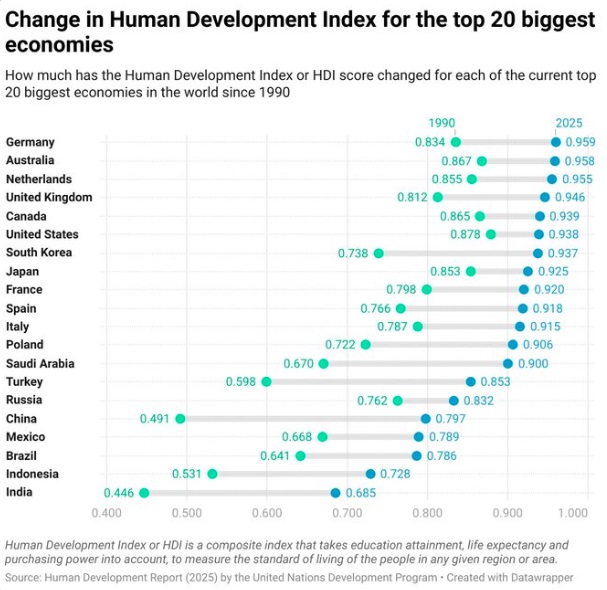
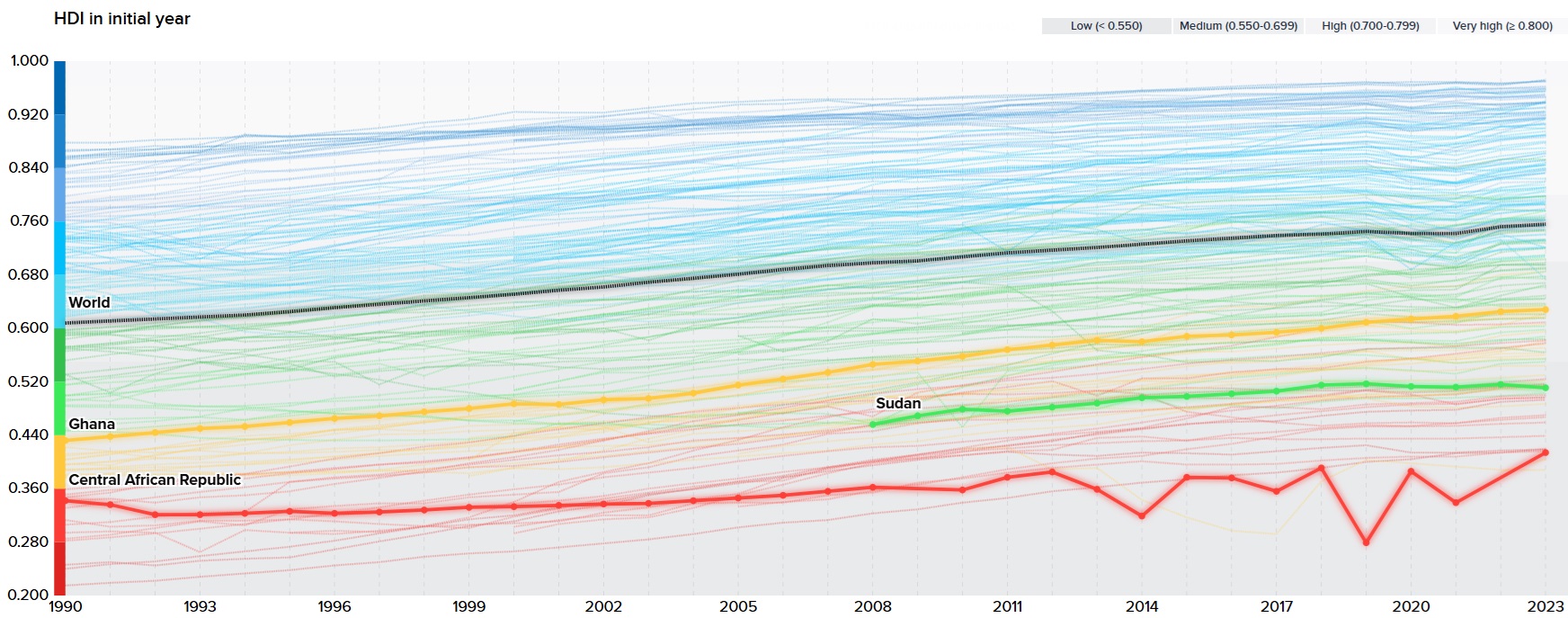
Yes, there are more bad trends in the world than we would prefer, but, as @StatisticUrban points out, most countries have improved their Human Development Index scores over the last 35 years. The Human Development Index is a measure used by the United Nations to assess and compare the overall well-being and development of countries. It was created in 1990. As you can see in the first graph below from @StatisticUrban, all the 20 biggest economies have seen improvements since 1990, especially developing countries. As you can see in the second chart below, nearly every country’s trend is up, most substantially. We highlight two countries which have not fared well, Sudan and the Central African Republic, and compare them to Ghana, which has seen steady progress. Of course, in recent times the international order of the last 30 years has been mauled by the most powerful countries in the world. Everyone hated the international order but they are going to miss it.
China Corner: Chips Canary
The Netherlands has wrested control away from the Chinese owners of Nexperia, a company which makes chips for cars and consumer electronics. In early reporting Reuters wrote, the government “cited worries about the possible transfer of technology to Nexperia’s Chinese parent company, Wingtech.” Later reporting claimed that this was more about financial irregularities, “The Dutch newspaper NRC has now published the official court documents from the Ondernemingskamer, confirming that the Dutch government’s intervention at Nexperia was not primarily driven by geopolitics, but by a serious internal financial conflict.” No matter the reason why, this move is a big deal, one of many actions in 2025 one might not have expected but that are becoming commonplace. Again, according to Reuters, “The Dutch government will not take ownership of Nexperia, but it will now have the power to reverse or block management decisions it considers harmful. The company’s regular production is continuing.” China, as one would expect, is hardcore in its response. China and the The Netherlands are currently in talks to resolve the dispute. China’s remarkable success in strategic industries sows the seeds of its own destruction…perhaps. Or perhaps it will continue to dominate for decades. Is Nexperia a canary? And for which coal mine?