The world is deeply and intricately connected. Like the sticky polymer matrices of spider webs. Like a product’s complicated global supply chain. Like music, culture and art appropriated from a multitude of sources and inspirations. We travel to Vietnam and New Orleans at least once a year. Two places many miles apart. And yet we saw recently while scouring the musical events of New Orleans, as we often do, a “Saigon Jazz Revival” taking place at Marigny Studios. Why, you might ask, would such a show be taking place in New Orleans? It’s not so strange–Vietnamese are the largest immigrant group in Louisiana. The Saigon Jazz Festival was featuring someone named Carol Kim, dubbed in the advertisement as “Vietnam’s Queen of Soul,” a nod to Irma Thomas, the “Soul Queen of New Orleans” who we have seen perform many times, most recently in April. But we had never heard of Carol Kim.
Turns out Kim, whose real name is Hoang Kim Hoa, was born in Vietnam to a Chinese father and Malay mother. She won a singing competition in 1965 and started performing soul and other American music, but also Vietnamese soul numbers. And let me tell you, these songs will hit you hard—they swing, they groove, even if you don’t speak Vietnamese and can’t tell what she is singing about. After the fall of Saigon, Kim moved to the United States. The event in New Orleans merged the two cultures together. As the flier said, “it brings together New Orleans’ finest jazz musicians with artists of the Vietnamese diaspora to reimagine the sounds and stories of our shared histories.” A untangled web indeed. And we reach out with our many information legs to discuss the poisonous events of Sudan, Chile’s latest democracy miracle and China’s latest thing to worry about. It’s this week’s International Need to Know, the Saigon soul scene of international information, the Nigerian psychedelic rock of global data.
This song would fit perfectly into a Vietnamese Quentin Tarantino’s soundtrack.

Without further ado, here’s what you need to know.
Forgotten Sudan
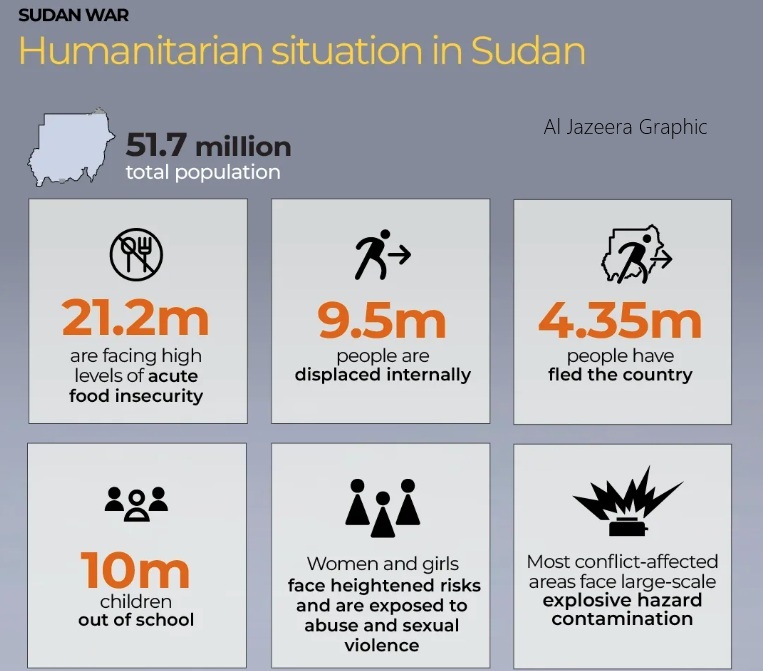
During a week of tragedies, it’s worth reminding ourselves what’s going on in Sudan. Reports recently emerged of the massacre that took place in El Fasher, after the North Darfur capital fell to the paramilitary Rapid Support Forces (RSF). According to these reports, at least 60,000 people were murdered in El Fasher and as many as 150,000 people remain unaccounted for. The Guardian reported, “Six weeks after the RSF seized the city, corpses have been gathered together in scores of piles to await burial in mass graves or cremated in huge pits, analysis indicates.” For weeks, the city was sealed off by the RSF to assistance, investigators and journalists. Finally, in the last few days, some aid is getting through after local groups received permission from the RSF to provide it. For a variety of reasons, Sudan receives far less attention, including in this space, than other crises going on around the world. But it shouldn’t. What to do about what is happening in Sudan is another question.
Chile is a Model of Democracy
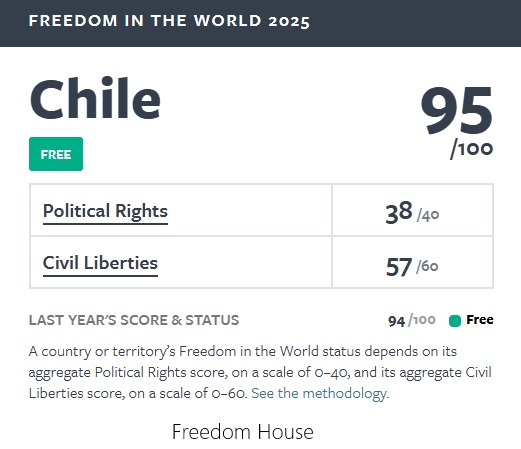
Chile held an election last weekend. It pitted right-wing hardliner Jose Antonio Kast against Communist candidate Jeanette Jara. Kast won 58 percent of the vote. Jara conceded the race in a dignified and conciliatory fashion. Kast apparently won because of concerns about crime and immigration. Kast’s father was a Nazi. We don’t mean that metaphorically, he literally was a member of the Nazi party in Germany. Neither Kast nor Jara are the candidates we would have nominated if we ran a political party in Chile (and Chileans say muchas gracias that we don’t operate a political party in their country), but these are the two that ended up running and Kast won a fair and free election. However, Colombian President Gustavo Petro said after Kast’s election, “I will never shake hands with a Nazi.” Chile’s incumbent president, Gabriel Boric, a very left-wing politician, who supported Jara, is sending a protest note to Colombia’s government. Boric supports democracy even if he vehemently opposes Kast’s policies. Chile, a recent democracy, is providing a model for the rest of the world to follow. This is especially important in the current era.
China Corner: Many Children Policy
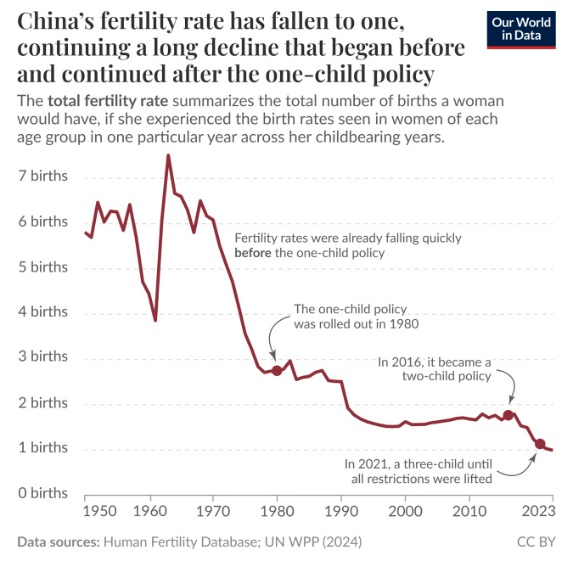
As we all know, China’s population is shrinking. Its fertility rate has plummeted to 1. China, like many countries with low fertility rates, is instituting policies to encourage and incentivize families to have more children. One recently announced policy is to “impose a 13 percent value-added tax on contraceptive drugs and devices, including morning-after pills and condoms.” This tax starts on January 1st. So far, no country, whether in Europe, Asia or elsewhere, has developed a suite of policies that are effective. Fertility rates have not increased meaningfully in any country, including those actively trying to increase it. China, of course, might be willing to be far more intrusive. Remember, the one-child policy? You might think it was just a general law saying you can only have one child with no accompanying implementation measures. But that’s not how Communist Party-ruled China works. Local and regional officials have to make their numbers—whether GDP or back in the day fertility targets. We’ve only read excerpts of Dan Wang’s book, Breakneck, about China, but one of the more startling excerpts is about China’s one-child policy. More than 108 million women were sterilized during that era. Local officials fined women, seized families’ property and forced women to have abortions. What if China, now that it wants women to have more children, does the reverse of harsh measures to restrict the number of children a woman can have? To what lengths will they go?