We come to bury Apple, not praise it. The software update programmers create lives after them. So my fellow honorable users, let’s speak of what wrath they have wrought with the unnecessary updates to the IOS. Let’s be clear: most software updates by companies nowadays, save for the security measures, are useless. They add no functionality, do not make life easier for the customer and are mostly done for performative reasons—to make it seem like the company is improving the product when what they are really doing is moving the chairs around an increasingly swampy deck.
For example, let’s talk about the calculator function of the iPhone, which we use often for everyday household chores. The new update moved the +/- key from the top right to the bottom left. Our brain, from years of using that key, keeps hitting the backspace key that is now in the top left instead of the intended +/- key. Like Pavlov’s dog, we want to hunt down the software programmer, lift our leg, and pee on him. Moving the keys around in the calculator provides no added value. And don’t get us started on the browser. Where once we could move around from tab to tab now we must make two clicks to even see all the tabs.
We like technology, we are generally an early adopter, we find many of the complaints against technology companies of recent years overwrought and ill-conceived. And yet, most software updates increasingly worsen the product, take up unnecessary memory and appear as if managed by designers holding a grudge against customers. In other words, we are compelled to stand athwart Silicon Valley, yelling Stop. But for you, dear reader, we provide an update on how young democracy is, provide a perfect calculator on EV sales, and keep easy tabs on what actually makes China unique. It’s this week’s International Need to Know, winning the Grammy for international information and the Super Bowl of global data.
Without further ado, here’s what you need to know.
The Youth of Democracy
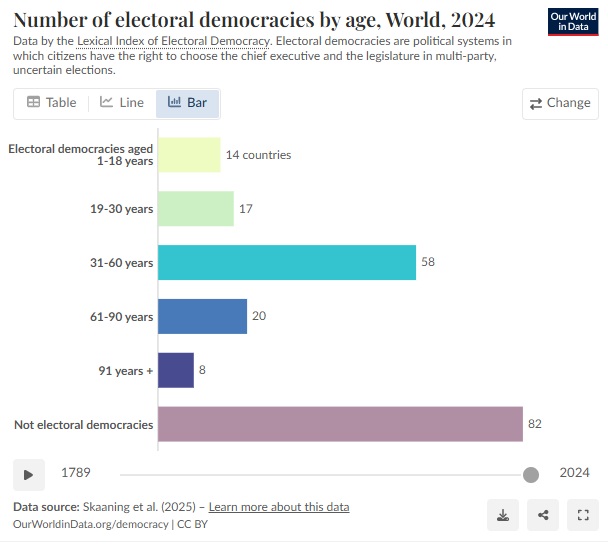
We’ve said it before and we’ll say it again; this whole damn thing is so young. The modern world is, well, modern. Sustained economic growth. Social welfare systems. Democracy. It’s all pretty new. For millennia human lives were indeed short, nasty, and brutish. There was no rule of law—instead there was the rule of hereditary kings or generals or others with dominant power. Our World in Data documents how recent most democracies are. About half of the world’s governments are currently democracies. And most of these are fairly new. As our World in Data says, “Many democracies are less than a generation old. Twenty of them are younger than 18, not older than a child… This means that in these countries even most young people have experienced authoritarian rule, and that older people have lacked democratic political rights for a large part of their lives.” Only seven countries have had democracies for a long time—Canada, Iceland, Ireland, New Zealand, Sweden, the U.K. and the U.S. The Beastie Boys almost got it right–you got to fight…for your right to form parties of similar political thought that run for elections. Not as catchy, unfortunately. And a right increasingly at risk.
No, EV Sales Aren’t Slowing
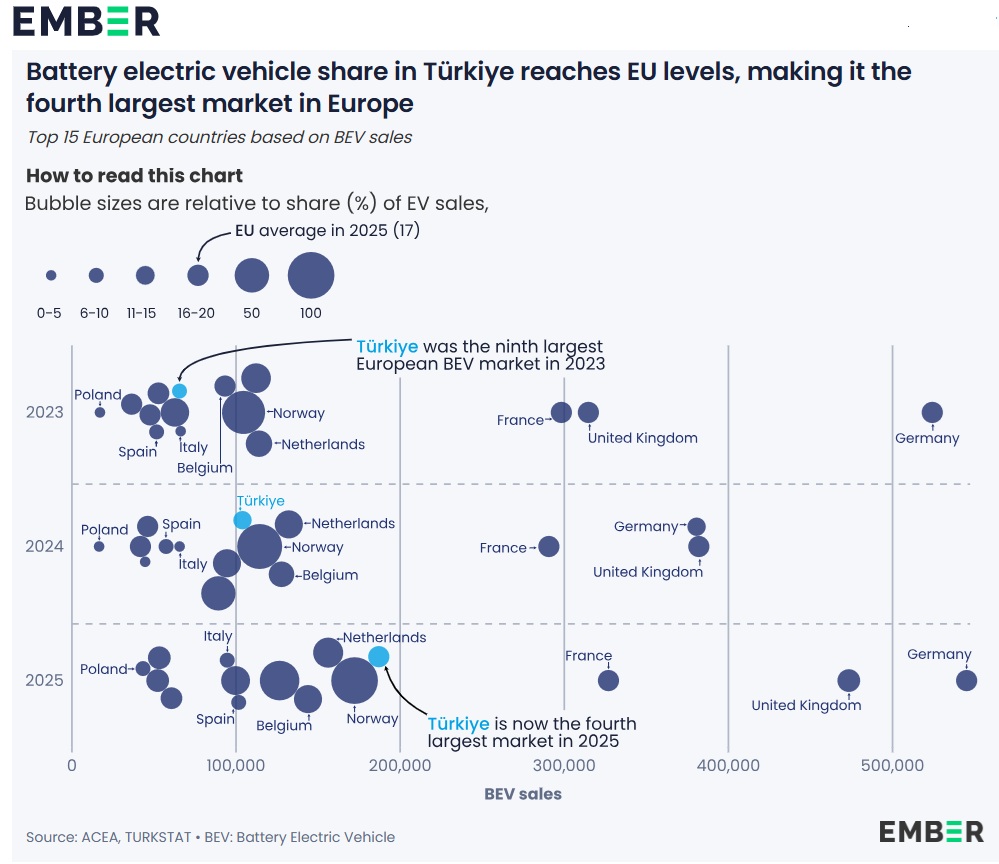
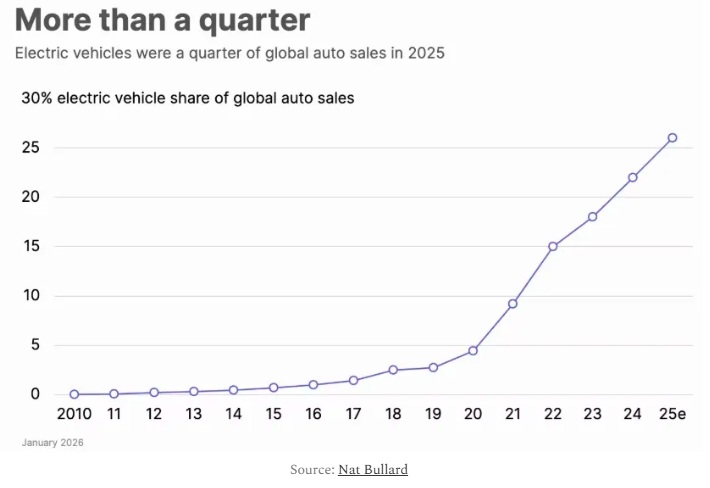
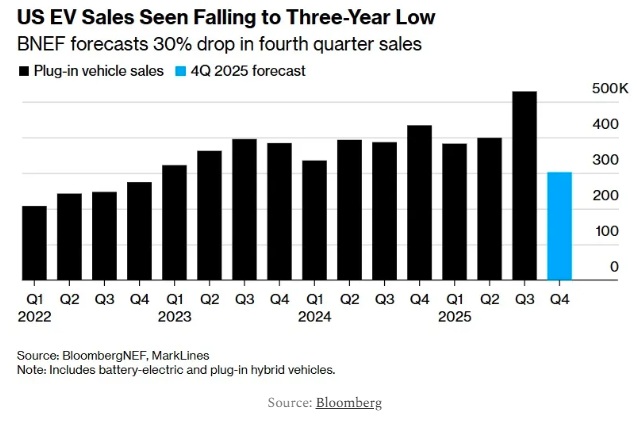
We have seen claims that there has been a slowing in the adoption of electric vehicles. It is not true. Look at the chart below from Ember. It’s taken from an article about the large increase in EV sales in Turkey. But as you can see, that’s not the only place in Europe seeing large gains, most countries in Europe saw rising sales of EVs in 2025. Poland saw more than 100% growth in EV sales. The UK more than 33 percent growth. It’s not just Europe. EV sales in Southeast Asia increased 62 percent last year. In the second chart below, you can see that more than a quarter of global auto sales last year were EVs. The trend line is pretty clear that by the end of the decade a majority of new cars sold will be EVs. There is one place where EV sales have slowed. The United States. But America is the anomaly. EVs sales aren’t slowing, they are increasing. Worldwide. Eventually they will in the United States too–for economic not climate change reasons.
China Corner: China Is Not Unique
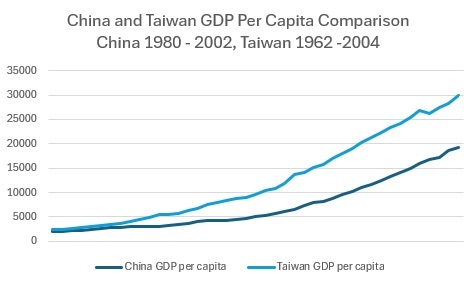
The International Need to Know spouse claims that British people sound smarter. We thought of this while listening to Columbia University historian Adam Tooze, during his appearance last week on the Ezra Klein podcast. They discussed “how the world sees America.” Tooze asserted many things, some of them as logical as Sherlock Holmes, others as crazy as Fleet Street. He has increasingly been opining on China, including on the podcast when he repeated the old saw that China is unique in its economic transformation. Like many things Tooze asserts about China, always in that confident British accent, he drives near the truth but often doesn’t hit the green. Many countries have grown rapidly over the decades. In fact, as we’ve shown here before, Taiwan and South Korea achieved greater economic growth over the same time period as China. China is likely to fall short in GDP per capita gains compared to those and other countries now that its era of rapid growth has ended. What’s distinct about China, and what is not appreciated enough across many issues with the country, is its scale. China is far larger than Japan, Taiwan, South Korea and other countries that grew quickly. China’s size is what sets it apart and allows it to dominate manufacturing and world trade. Hundreds of millions of Chinese climbed out of poverty because there are more than one billion people in China. Scale is what sets China apart not its impressive economic growth and technological advancements, as impressive as those are.