It was just another Tuesday this week in Seattle but in New Orleans it was Mardi Gras. We wish we could have been there. Kitty corner from our house it was just another day too, which means construction workers continued to labor on a house remodel that’s been going on for well over a year. We could hear saws buzzing from the inside, machinery digging up the side yard, a truck stopping by to empty the Porta Potty* standing in front of the house. So given how long this remodel has gone on, you’re probably picturing a large estate set on a massive lot, with multiple wings, at least three stories tall. Nope, like most houses in our modest middle class block, it is a relatively small house. In fact, smaller than the ones next door to it. Before the remodel, the renters moved out and essentially dumped their belongings on the parking strip in front of the house. After about six months, we assumed the renters must have wrecked the place and the owner had to do radical remodeling to bring it back to shipshape.
But as the work has continued, month after month, we admit to confusion. How much can one do to such a small place? What are they doing? We like to imagine secret passages being installed, an underground tunnel leading all the way downtown, perhaps to a favorite club or restaurant. Maybe an indoor pool that will double as a waterbed. We hope, if the remodel is ever finished, we have the opportunity to see inside…on second thought, it could never live up to our imagination. Which is why we deal in hard, cold facts regarding Mexico’s poverty progress, which large economies are having the most kids, and China’s possible CO2 emissions peak. It’s this week’s International Need to Know, the global data and information source that is like Mardi Gras, Lunar New Year and Ramadan all wrapped together in one week.
*Our idea of an AI/robotic dystopia is all jobs being replaced except for the Porta Potty cleaning positions.
Without further ado, here’s what you need to know.
Rise of the Mexican Middle Class
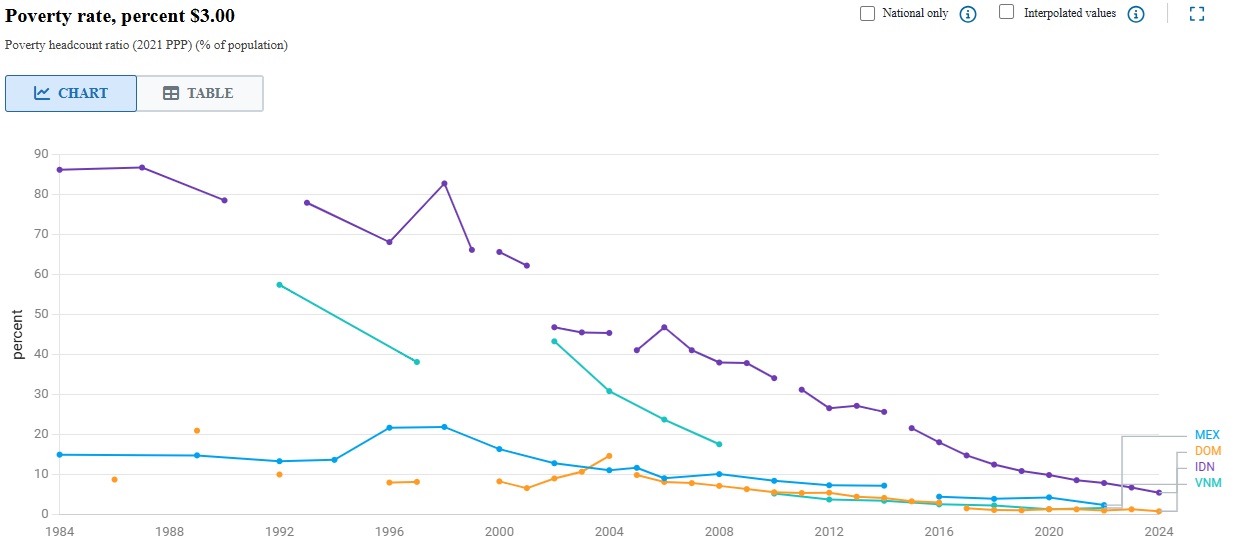
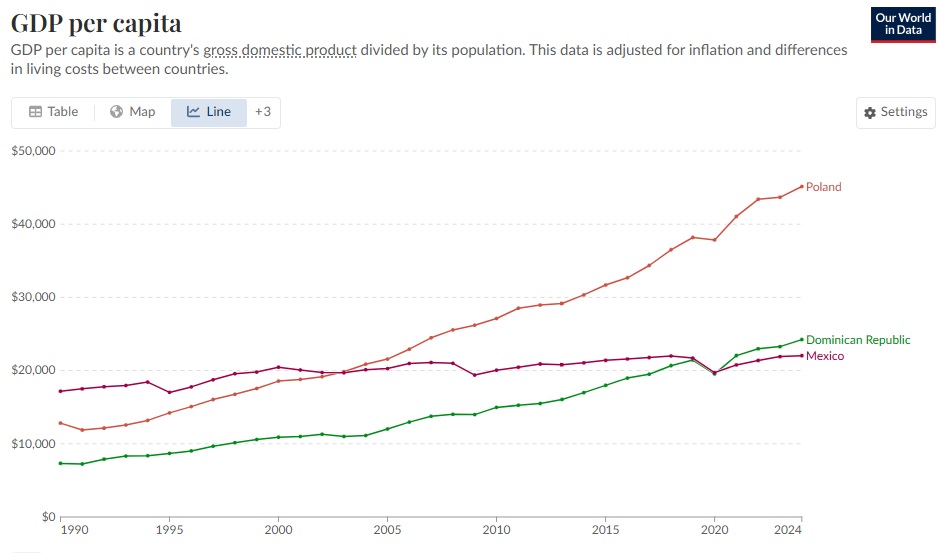
Mexico’s government has trumpeted the fact that for the first time there are more middle-class Mexicans than those living in poverty. World Bank data shows that Mexico’s middle class has grown by 12 percent since 2018. Of course, like any government, Mexico points to its policies for this success. And perhaps they should be congratulated. But overall Mexico could and should do better at reducing poverty. As the same World Bank report points out, Latin American countries, including Mexico, “lag behind their counterparts in more dynamic upper middle-income regions in long-term poverty reduction and economic growth.” Indeed, if we look at some other upper middle income countries, many have done much better than Mexico in reducing poverty, including Vietnam and Indonesia in Southeast Asia and closer to home the Dominican Republic (see first chart below). Or look at GDP per capita (second chart below). Starting from a much lower level, the Dominican Republic passed Mexico in 2021. And look at Poland, which after the fall of the Soviet Union has far outpaced Mexico in economic growth and thus in poverty reduction. Mexico needs to grow its economy at a faster rate—that will reduce poverty far more quickly and permanently.
The Birth of the Blues
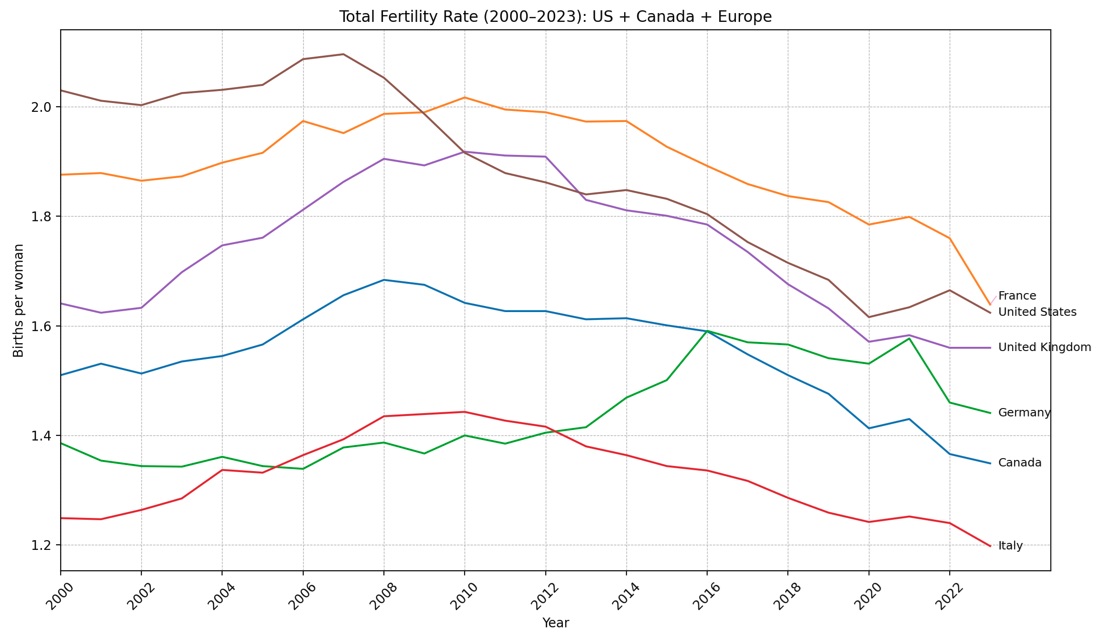
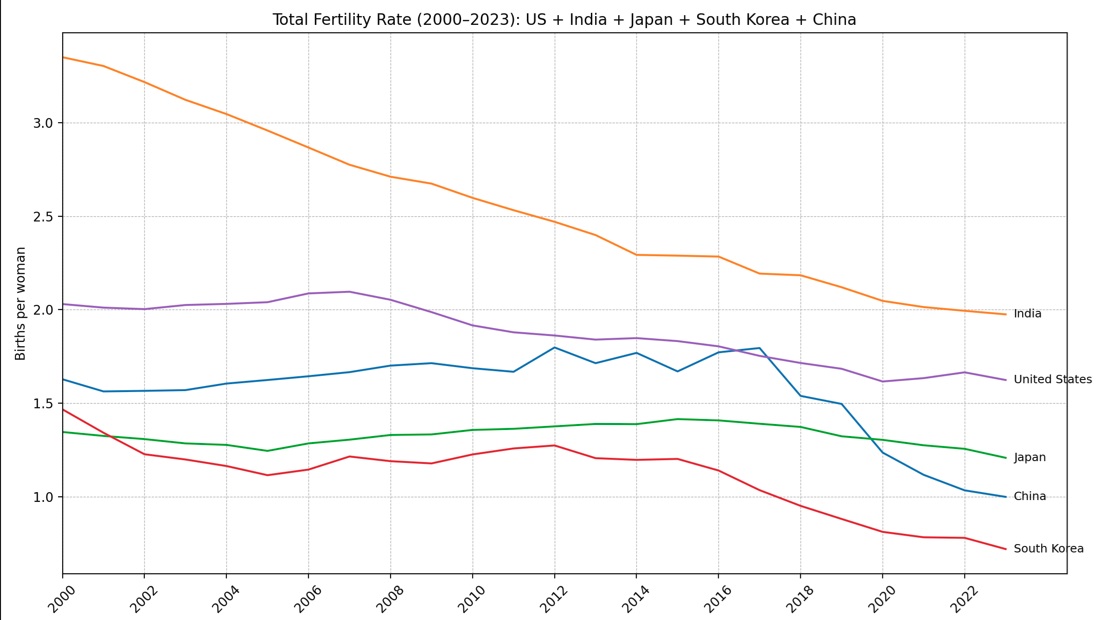
We all know that fertility rates are falling everywhere. In fact, just about every country outside of Africa and India has below replacement level fertility rates. And even their rates are falling. Jeremy Horpedahl, an economist at the University of Central Arkansas (Go Sugar Bears!*), notes that the United States has one of the highest fertility rates among high income countries, what he calls its peer countries. That got us to wonder how the 10 largest economies’ fertility rates are faring. The United States also ranks well among these countries, trailing only behind France and India. As you can see in the first chart below, the UK, Germany, Canada and Italy’s fertility rates are all well below the U.S. The other four largest economies are all located in Asia. The second chart shows Japan, China and South Korea’s fertility rates are all well below the United States. Indonesia is not one of the ten-largest economies but It’s the fourth most populous country in the world and its economy has been doing pretty well…and its fertility rate is above replacement level, barely. If I’m looking to the future, I’d bet on India and Indonesia…and the United States, if it can get its act together. Most countries will face challenging demographics in the coming years, including and especially the largest economies.
*Scottie Pippen is an alum
China Corner: Peak CO2 Emissions?
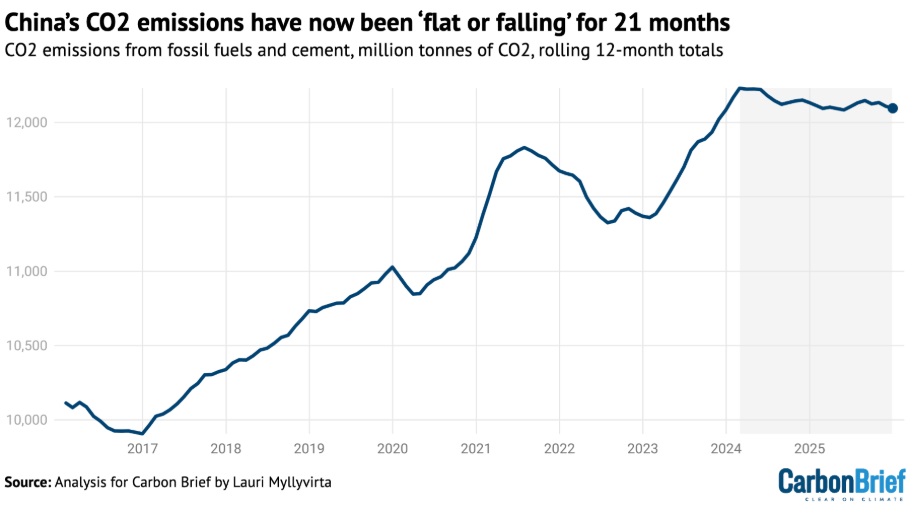
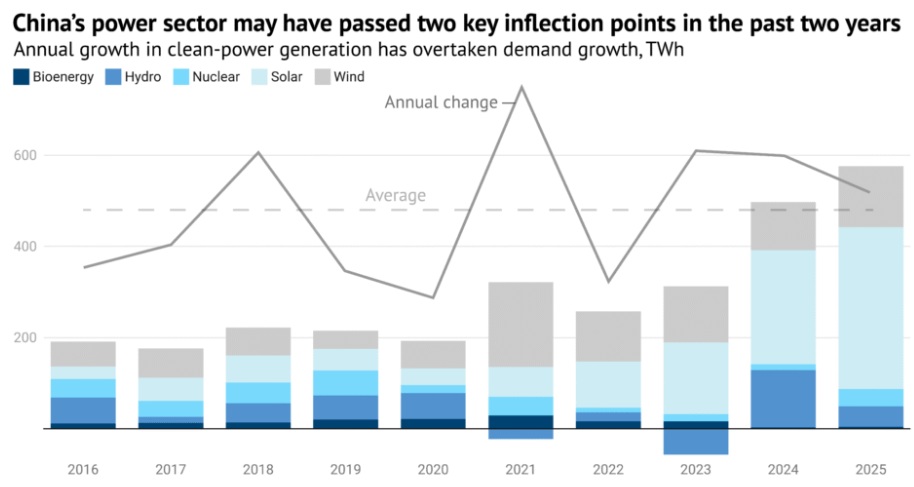
Almost a year ago, we pointed to Carbon Brief data showing that China CO2 emissions were down 1.6 percent year over year and wondered whether China’s CO2 emissions had peaked. Returning to Carbon Brief, like a moth to a solar-powered flame, this week they write, “The latest analysis shows China’s CO2 emissions have now been flat or falling for 21 months, starting in March 2024. This trend continued in the final quarter of 2025, when emissions fell by 1% year-on-year.” In fact, emissions have been falling in Chinese industry with the exception of the chemical industry. China has been installing large amounts of solar, wind and nuclear energy. As a result, even though electricity demand is growing rapidly, emissions are not. This is all good news for addressing climate change. But while China does care about the environment, the main driving factor for installing clean energy capacity is the desire to remain dominant in industry. Drones are flying batteries, EVs are driving batteries. AI, which China also wants to be dominant in, has large energy needs. As it turns out solar, wind and batteries are the most cost-efficient means of adding electricity capacity. Countries should learn from that.