For reasons we won’t go into here, we were leaving an assisted living facility after midnight last Saturday in Bellingham, Washington. As we drove down the steep driveway to the street we saw at the bottom a police car with its lights flashing. We slowed down to make sure it was safe to exit, looked right as we were taught lo those many years ago in driver’s ed, and saw another police car a block away, its lights also flashing. We carefully turned left towards the main road which leads to the freeway. On this thoroughfare were multiple police cars at different intersections—their lights also flashing. We turned left, pulled into a gas station, filled up and headed on I-5 (a freeway that Californians strangely add a definite article to—The 5 in their nomenclature) and drove back to Seattle without incident while listening to the only podcast that manages to achieve the status of art—60 Songs That Explain the 90s (this episode talking about a song from the 2000s).
When we arrived in Seattle around 2 am, we took our usual shortcut from the freeway to our house. As we drove the backstreets towards Highway 99/Aurora Avenue (a Californian calling it The Aurora Avenue?), we saw at the intersection…a police car with its lights flashing. Now quite experienced in such situations, we slowed down and at the intersection we looked left…a swarm of police cars were at the end of the block, all with their lights flashing. We looked right, the direction we would be turning, and saw another police car across the street one block down, its lights, you guessed it, flashing. But in this case, the officer stood outside the car directing traffic. We turned right, came up to the officer and asked if it was okay to turn left onto the street that would lead into the neighborhood where we call home. He said yes, and so we did. The world is full of coincidences and there are good explanations why there was a swarm of police activity as we exited one town and another swarm as we entered another city—but we prefer to imagine they were our police escort, like we were a president, or a king or some sort of international dignitary. And so we proclaim who makes robots, issue an executive order on global poverty reduction, and make a short statement on how Chinese EVs are so cheap. It’s this week’s International Need to Know, the Baron of international information, the Crown Prince of global data.
Joe Borich, former head of the Washington State China Relations Council and former Consul General in Shanghai, taught me so much about China over the years. I remember sitting on a bus with him in, if memory serves, Shanghai, around 2003, asking him a thousand questions. He always answered with patience, intelligence and quiet wit. He was helpful as I wrote my book, Challenging China, and supportive and kind in his praise. But Joe was far more than China—he was a great storyteller and he had wonderful tales to tell, from being one of the last officials evacuated out of Mogadishu to playing guitar on stage with John Denver. Wait, what? Yes, you read that correctly. Denver was touring China and somehow Joe found himself on stage with him, strumming the guitar to, again if memory serves, Take Me Home Country Roads. I hummed a bar when word arrived last night of Joe’s passing. A wonderful man who did much good in this world, RIP Joe.
Without further ado, here’s what you need to know.
Who Makes The Robots?
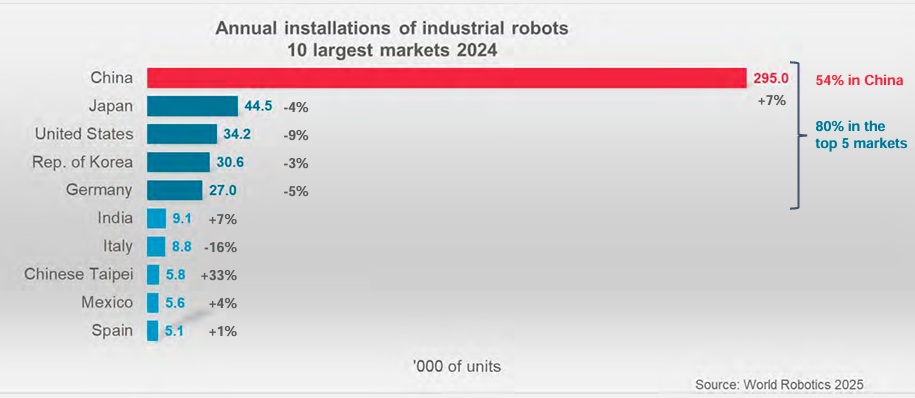
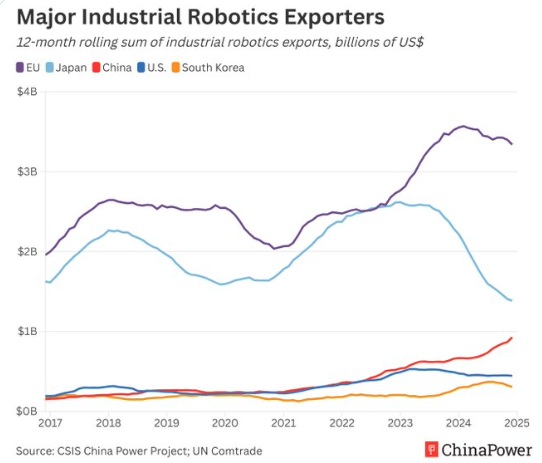
Two years ago, we wondered in this space what it would mean now that robots were loaded up with AI. How would being trained on real world data be different than AI trained on data from the Internet? We still wonder about that. We thought about this when looking at data regarding who makes robots. We knew that China has the most industrial robots but South Korea has by far the most robots per capita. But who is manufacturing them? This is more difficult to determine than we guessed. The International Federation of Robotics tracks installations and stock but it doesn’t detail which countries are making the robots, at least not in any systematic way. It does note that where once China imported 75 percent of its industrial robots, it is now making 57 percent of them itself. As you can see in the chart below, the EU is by far the largest exporter of industrial robots. But that doesn’t mean it’s the largest manufacturer. China is such a large market that its robot manufacturing companies might not be keeping up with domestic demand and so exports fewer robots than the EU. Indeed, you can see in the second chart below, that China is increasing its installation of industrial robots at a rapid rate. More than likely China is now producing the most robots, followed by the EU. Of course, industrial robots are not necessarily using AI and exploring the world, their focus is narrow. At least so far. Our question remains: what happens as robots learn from the world around them?
A Big Poverty Reduction Party
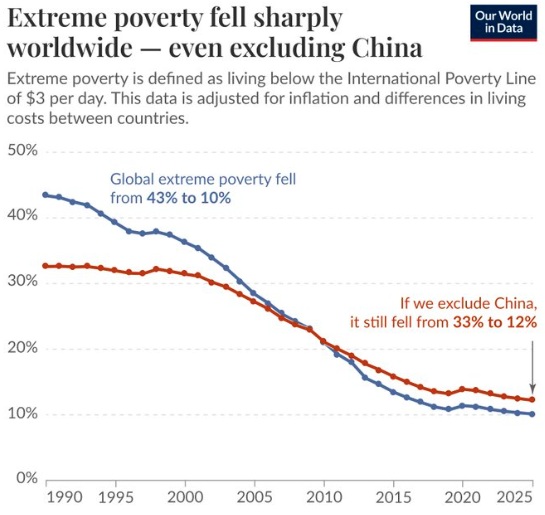
In presentations we often talk about how much the world improved during the rules-based liberal international order, including massive reductions in global poverty. Sometimes when we say this an audience member will assert this is all due to China’s development and its lifting 800 million Chinese out of absolute poverty. China did play an important role in reducing global poverty. But it’s not true that the reductions in global poverty is only a China story. Much of the rest of the world achieved great success too. Our World in Data recently posted an article about this very subject. Their chart below shows that even when pulling China out of the data, global poverty still decreased tremendously over the last 35 years. What drove the decrease in poverty? This gets to something we wrote at the end of last week’s Rise of the Mexican Middle Class story—”Mexico needs to grow its economy at a faster rate—that will reduce poverty far more quickly and permanently.” Someone asked us what we meant by that. Economic growth is what reduces poverty. Social programs can help reduce poverty but economic growth is what is most important, especially for developing countries. As Our World in Data puts it, “The large economic growth that lifted 940 million Chinese people out of extreme poverty since 1990 was a major contributor to the global decline in poverty.” Economic growth in other countries also drove poverty reduction. Of course, the rules-based liberal international order era is over. Will there still be strong economic growth? If not, the era of rapid declines in poverty is over too.
China Corner: Why Are Chinese EVs Cheaper?
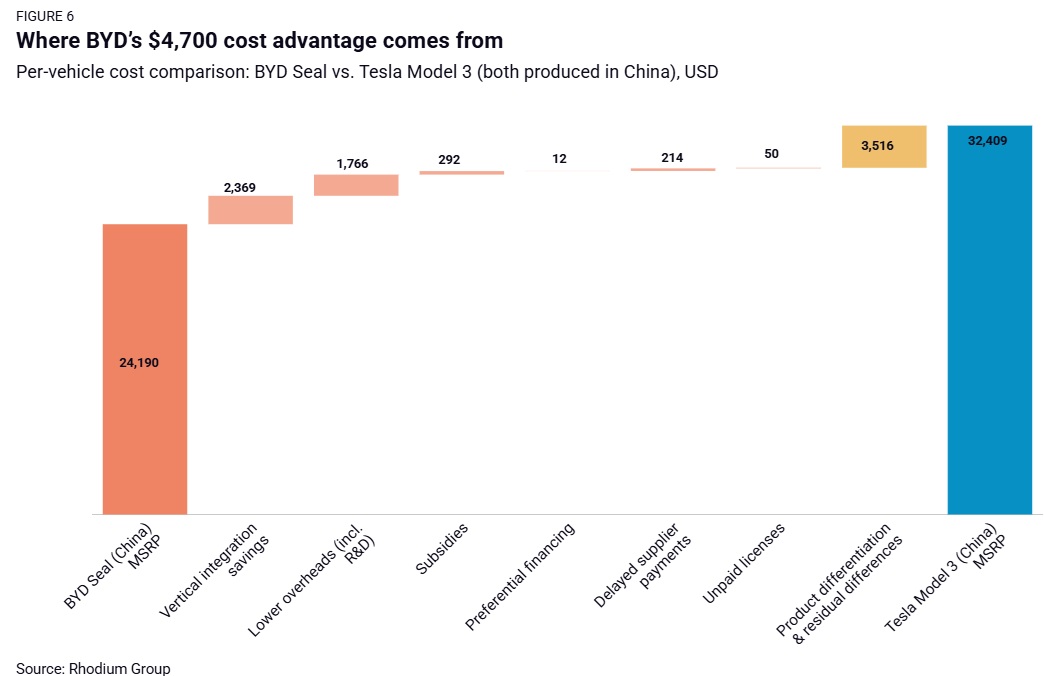
We’ve previously noted the large increase in Chinese auto exports, much of it EVs. Driving that success is both the quality of the autos and the price. Chinese EVs are significantly cheaper than their foreign competitors. But why are they cheaper? A new analysis from Rhodium Group asserts Chinese auto manufacturers price competitiveness “is driven by structural advantages: deeper vertical integration, greater scale, and lower overhead costs, including significantly cheaper R&D.” While subsidies from the government and cheap financing also play a role, they are not the main factor. China can build cheaper EVs because Chinese firms have developed the expertise and capability to build batteries and other key parts in-house. The scale of the Chinese domestic market helps make that possible. You can see in Rhodium’s chart below that overhead costs are higher for non-Chinese car companies. But Rhodium also notes that Chinese OEMs reduce costs by “minimizing financing needs through very long supplier payment terms.” We are curious how this plays out in the long-term for China’s auto industry. We are also interested in auto industry experts delving into Rhodium’s research. There are many ways to slice and dice these costs and numbers and we guess that others may come to different conclusions than Rhodium. Nonetheless, the entire report is worth reading.