Many years ago back in the late 1980s as reckoned in the Gregorian calendar we worked on microfinance legislation for a congressman. We did so in collaboration with staffers from other representatives and a nonprofit which specialized in this issue. One of the key staff people on this nonprofit who we’ll call Alex because that was his actual name, a kind and earnest type, just the sort of person we were suspicious of in those days, suggested during a meeting we go get a drink the next evening. We demurred saying we were going to be out of town, a small fib in the great scheme of things. It wasn’t that we found Alex to be a bad guy but we felt there might be more enjoyable uses of our time and so we, yes, lied to the man.
The next evening we went to dinner with a friend who we had told about our harmless fib to escape hanging with Alex. As she and I entered the restaurant who should be sitting at a table near the front door but none other than Alex. I looked at him, only a few feet away, and after the slightest of humiliated pauses said “Alex,” with an intonation dripping with guilt. My friend, once we retreated to a table as far as possible from Alex’s, laughed uproariously, and through the years often reminded us of the moment by repeating in the same tone and manner, “Alex,” which we thought a bit uncharitable. We were reminded of this because through our work on microfinance legislation we learned of and met Muhammad Yunis, who ended up winning a Nobel Prize for his work on microfinance, and who just this week became interim head of the government in Bangladesh after the unrest we reported on two weeks ago. Contrary to popular opinion history doesn’t repeat, it stumbles drunkenly down an acid-laced, Escher-drawn Möbius Strip. And we stumble into good news on HIV, AI in Denmark and China exporting autocracy. It’s this week’s International Need to Know, the Taiwanese badminton team of international information, the Turkish shooter of global data.
Without further ado, here’s what you need to know.
The Good News On HIV
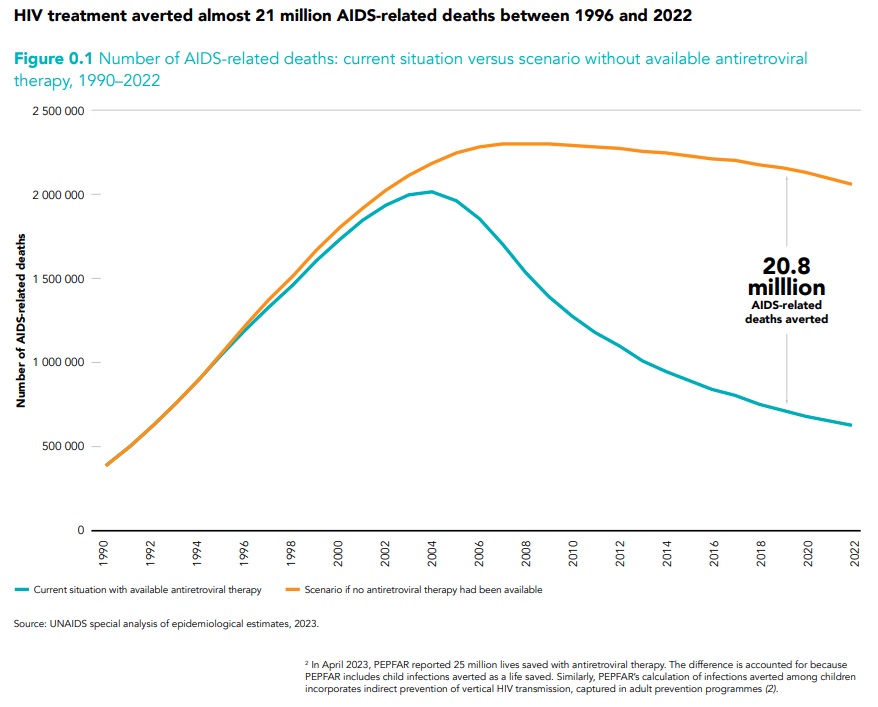
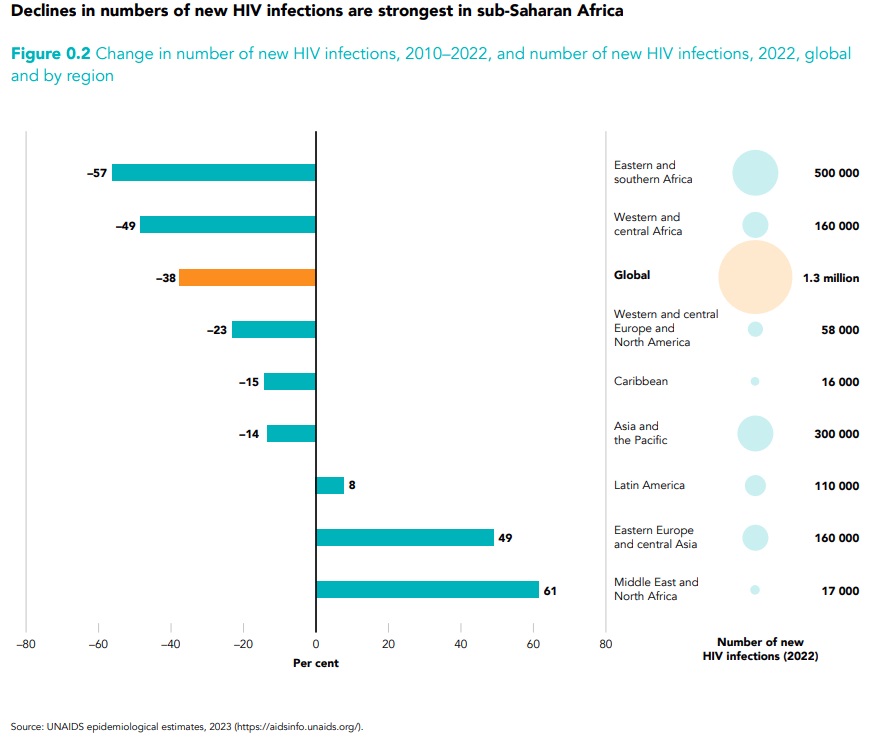
Like clockwork, when the Nikkei fell sharply on Monday and the U.S. stock market dropped a little, the bad news industrial complex went into full motion. From coverage of these events, it’s understandable that one would think the world was about to collapse into devastation and anarchy. Someday there will be another recession, but what happened to the Nikkei and U.S. stock market is not an indication of one. The world is addicted to bad news (the media gleefully pushes it) and so this week we feel obligated to administer a Narcan of good news which is easy to do because there is an abundance of it even if it is mostly ignored. Take HIV, for example. The most recent U.N. AIDS Global Update finds that HIV infections fell 38 percent globally from 2010 through 2022. In eastern and southern Africa, where HIV was a crisis situation for many years, HIV infections fell 57 percent during that time period. According to the U.N. report, “Overall, numbers of AIDS-related deaths have been reduced by 69% since the peak in 2004.” Further, “The estimated 1.3 million [1.0 million–1.7 million] new HIV infections in 2022 were the fewest in decades, with the declines especially strong in regions with the highest HIV burdens.” It’s not all good news, of course. Infections have increased in certain parts of Eastern Europe, central Asia, Latin America, the Middle East and North Africa. That is mostly due to discrimination against LGBTQ communities preventing the kinds of policies that are working in parts of Africa. But let’s end on some additional good HIV news: a recent study finds that twice yearly shots of Sunlenca made by biopharmaceutical company Gilead offers “100 percent protection against HIV.” More than likely the great improvement in HIV infections of recent years will become stunningly better in the coming years.
There’s Nothing Rotten In Denmark
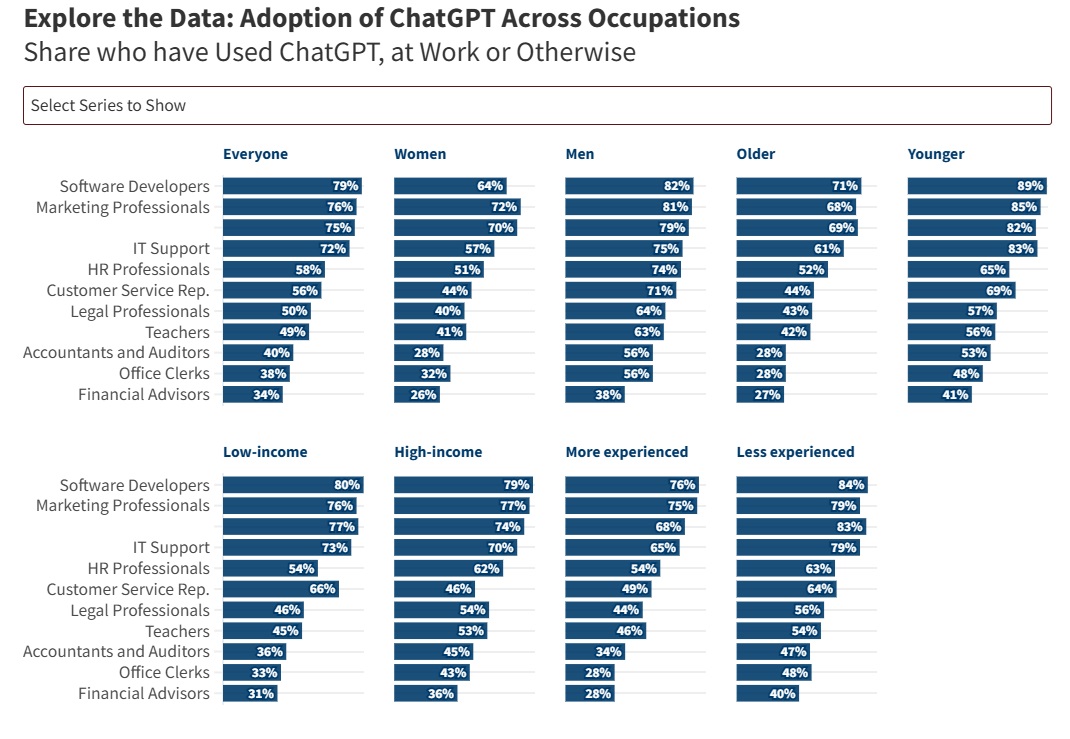
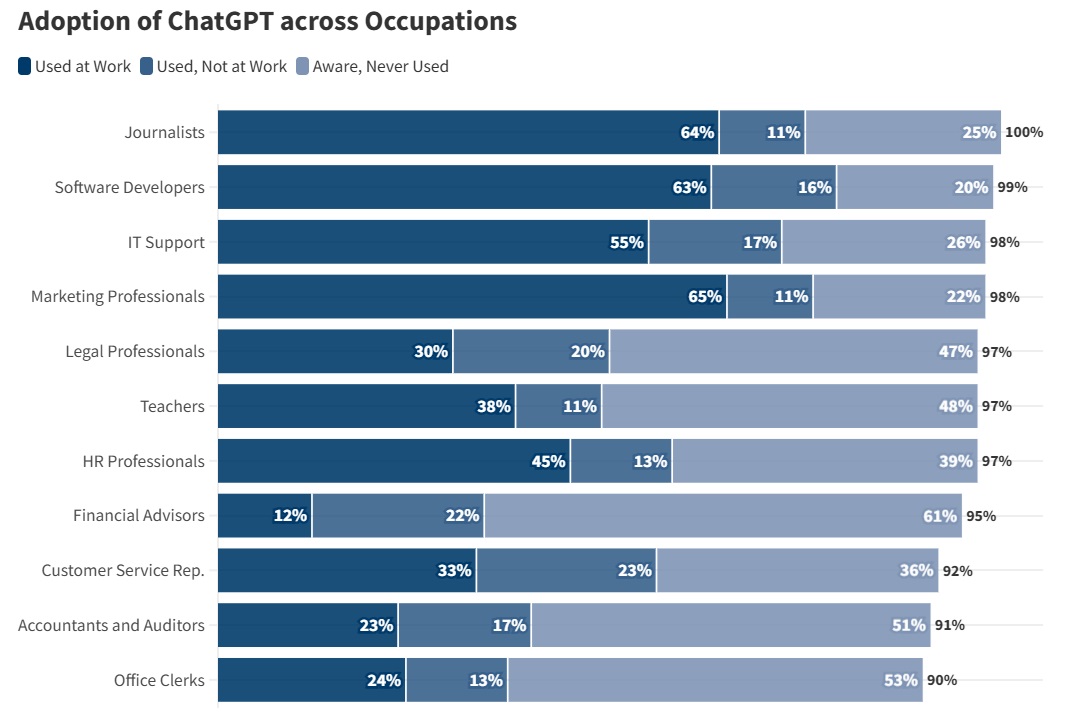
We continue to use the new LLM AIs to productive and helpful effect. And so it turns out are many folks in Denmark, to where we traveled for work earlier this year. According to research by the University of Chicago in collaboration with Statistics Denmark, half of workers in the country have used ChatGPT. As you can see in the first chart below, “younger, less experienced, higher-achieving, and especially male workers [are] leading the curve.” But even if men are using it more than women, women are still using it at a high rate, including 64% of female software developers, and 72% of marketing professionals. In the second chart below you can see adoption of ChatGPT across occupations with journalists, software developers, IT professionals, marketing professionals, legal professionals and teachers among those using it at a high level. At the same time, we came across the below video of the company Figure’s (backed by OpenAI) latest humanoid robot. The most interesting part of the video is the last 30 seconds which show it working in a BMW factory. Perhaps the current models of AI level off and today is as good as it gets. Or perhaps the next 10 years are going to be extraordinarily transformative.
China Corner: Exporting Autocracy
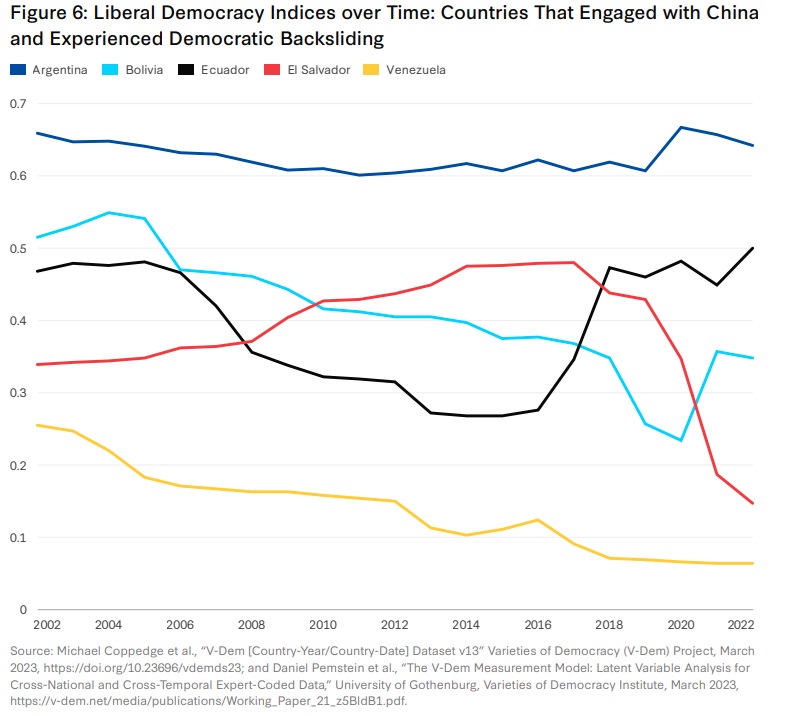
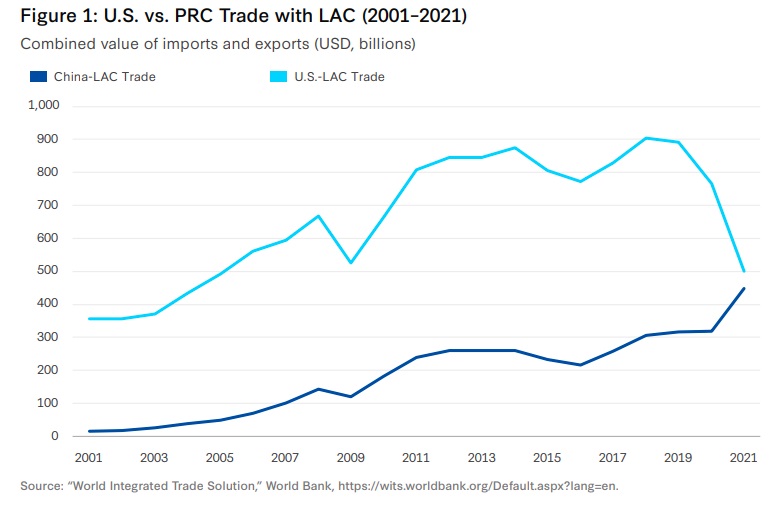
Last week we asserted that China wants to make the world safe for authoritarianism. This week we highlight a report by the Center for Strategic and International Studies (CSIS), Exporting Autocracy: China’s Role in Democratic Backsliding in Latin America and the Caribbean. The report asserts that China “propagates its model of authoritarian governance” in a number of ways, including “through its security assistance, which often features tools enabling mass surveillance and the curtailment of civil and political rights.” This is something we wrote about in our book. The CSIS report also states, “China protects regimes undergoing democratic backsliding by providing economic and diplomatic cover even as these governments become increasingly isolated from the rest of the international system, in effect extending these governments beyond their natural lifespan.” CSIS looks at 13 case studies in Latin America and the Caribbean. It does not find that China’s involvement in these countries always leads to democratic backsliding but it asserts that China does work in ways that are unhelpful to democratic development. Another reminder of the ongoing battle between democracy and authoritarianism.