
We attended the Trombone Shorty concert last weekend with some great friends at the Chateau Ste. Michelle Winery. As always, Trombone Shorty and his band were incredible. It is a lovely setting for a concert. So we were in a relaxed and generous mood as we walked over to the food and drink vendors. It was good we were feeling generous since the price for a cocktail was $20. This seemed a bit steep, but we recognize the economics of a captive audience, so relented and ordered one. We paid and the bartender handed us the drink you see in the photo below–a glass barely half-full. While we examined food options, including a $28 burger, two other concert goers admired our drink. When we informed them it was $20 their admiration fell like a spy balloon spotted by a hostile country. Our International Need to Know spouse reminded us that two months earlier in New Orleans, at French Quarter Festival, we had paid $18 for a frozen cocktail in a reusable bottle, which probably held four times the amount of the half glass the bartender handed us. We submit a photo below of said bottle as evidence in our case.
We might also note that security to enter French Quarter Festival lives up to New Orleans’ nickname–the Big Easy–while security to enter the concert at the winery was typical Soviet Seattle security theater. This is yet more evidence that NOLA is better than Seattle, with the exception of the weather this time of year (one would be downing many a frozen cocktail to deal with the heat and humidity). Oh, and by the way, it turned out the concert attendees we talked with about our expensive drink were seated next to us. When we got to our seats they had bought a bottle of wine inside the winery for, yep you guessed it, $20. They urged us to do so, even providing us a taste from their bottle. We quickly adjusted our imbibing strategies and bought a $20 sparkling rosé, if you must know, the same vintage our neighbors were drinking. We wonder if Chateau Ste. Michelle requires the drink vendors to charge such an exorbitant rate to push attendees to buy its wine instead. While we ponder this, we sell you on the cheap why the world rearms, a Kenyan example of how power corrupts, and where China dominates global production. It’s this week’s International Need to Know, trumpeting useful international information, trombone-sliding global data into your inboxes.

Without further ado, here’s what you need to know.
Up In Arms
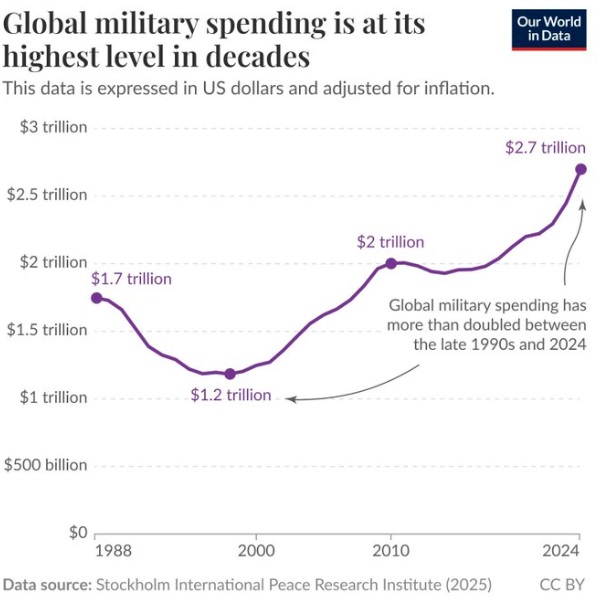
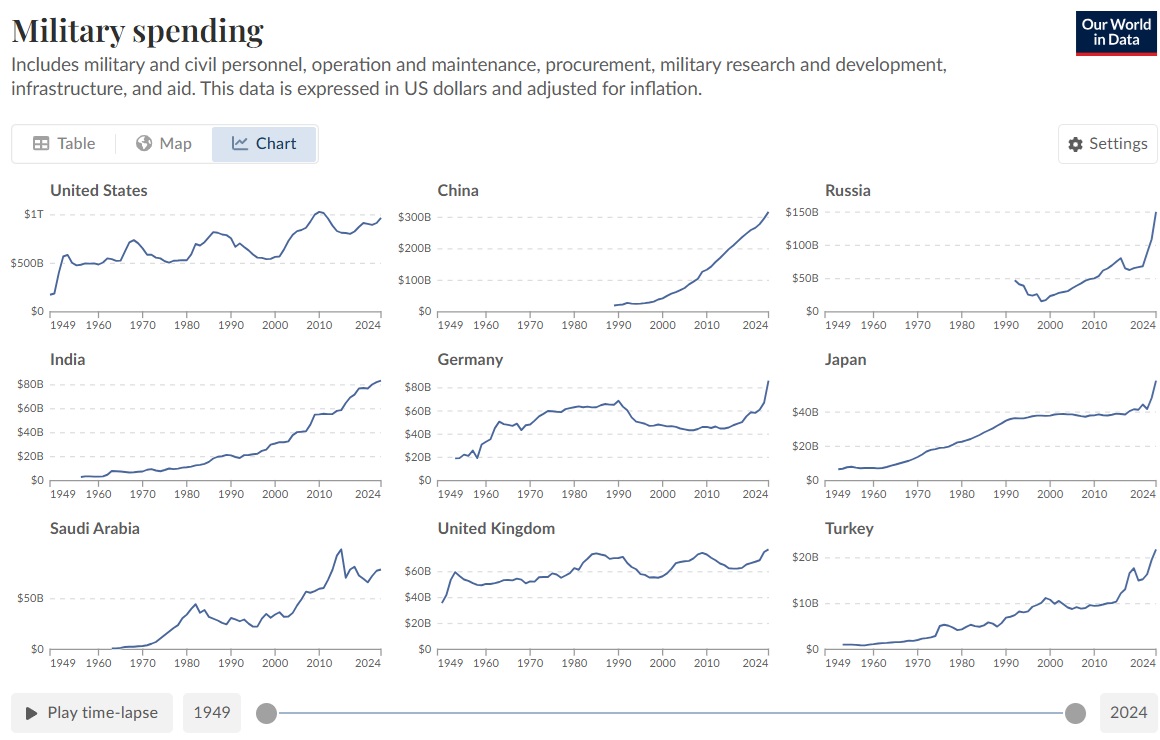
You might have noticed more military conflicts in recent years. Just in the last week we had Israel attacking Iran, who responded by launching missiles right back at Israel. And now the U.S. might become involved. Russia invaded Ukraine, of course. There are a number of wars in Africa. India and Pakistan exchanged hostilities last month. By our count, that makes five of the nine nuclear powers engaged in fisticuffs or worse right now. The world itself seems far more unsettled than it did even ten years ago. And so in the midst of threats and uncertainty countries are spending more on their militaries. You can see in the chart below from Our World in Data, that last year global military spending reached $2.7 trillion, a ten percent increase from the year before and up a third from five years ago. It’s double what it was in the late 1990s. Timur Kuran, a professor at Duke, claims, “That’s what happens when the global international order starts disintegrating under the weight of technological change, fertility collapse, domestic political polarization, mismanagement by self-serving elites, and declining government legitimacy in countries rich and poor.” Kuran is like a Duke basketball player, always wrong, because he forgets the most important reason: the U.S. is unwilling to play a constructive role in the world anymore. There were lots of complaints about America’s leadership, but it was the most constructive world leader in history, and it kept the world more stable and prosperous. That world and that America aren’t coming back, even when Trump is gone. People will increasingly miss it.
Power Corrupts: Kenya Edition
If there is one thing we know is true in this world—something that has been true since the beginning of time–it’s that power corrupts. It’s why there must be effective checks on power—whether politicians, police, industry, unions or other entities. Kenya offered a stark example last week when the police murdered teacher and blogger, Albert Ojwang. He was arrested a week ago for “false publication.” Reuters reports that “Ojwang was arrested in Homa Bay, in western Kenya, as part of an investigation triggered by a formal complaint from the deputy chief of the national police force.” By the next day, Ojwang, a father of a three-year-old, was dead, with the police claiming it was a suicide. But that became an untenable claim when “an autopsy found that his wounds – including a head injury, neck compression and soft tissue damage – pointed to assault as the cause of death.” He was murdered by the police, three of whom have been arrested, including the officer in charge of the police station to which Ojwang was taken. Kenyans have since protested in the streets, about a year after mass protests against other police corruption. The President of Kenya, William Ruto, called the murder, “heartbreaking and unacceptable.” When evaluating a system, put aside any partisan biases and ask whether it is adequately designed to confront the always present truth: power corrupts.

China Corner: Production Dominatrix
Nothing lasts forever, including dominance. Success eventually leads to failure. Ask any company, sports champion or cocktail mixer. We’ve noted that China has an outsized share of global manufacturing, now accounting for about a third of all global production. If this were about toys or washing machines or shoes or other such consumer products, there would be economic and labor consternation in various countries but not alarm about the security implications. The larger challenge is China dominates in strategic industries. Indeed, it made a conscious choice years ago to become dominant in these industries and has been remarkably successful in doing so. We saw data from the consulting firm Dunne Insights showing just how dominant China is in drones, batteries, solar panels, EVs and rare earth minerals. Dunne showed such high production share for China that we felt obligated to double check them. For the most part they are accurate. We created our own chart with our own sources below. Dunne didn’t list China’s share of electronics manufacturing but we do. China makes a little more than a third of the world’s electronics. That isn’t nearly as high as in the other categories but it ain’t nothing either. And lots of other strategic products are downstream of electronics so China’s large share is important for its being successful in other strategic industries. Tariffs aren’t necessarily the answer, or at least not the whole answer to countering China’s dominance. Other countries, including America, Europe and Japan have to support their local industries, not just prevent the import of Chinese goods. The CHIPS Act tried to do that for semiconductors. The Inflation Reduction Act tried to do that for batteries. The current administration has been tearing those and other industrial policies down. But so far they haven’t replaced them with anything, somehow thinking tariffs is the whole answer. As with so many policy ideas, they are wrong.
