For years we’ve been telling you about aging demographics and what a profound effect it will have on our world. We haven’t written about it as much recently because now everyone else is doing so, including this piece by Matthew Yglesias about how if you look around you see gerontocracy everywhere. One of the revelations that comes with age, and provides a problem for us in particular, is the realization that the world has the same arguments over and over again. Including arguments that we assumed had already been decided—like rent control and government-run retail in the NYC mayor’s race or the 19th century politics of the current U.S. president. But the truth is, the battle is never over, the war is never won. It is a continuous never-ending cycle. We are doomed to have the same arguments, the same fights perpetually until humans cease to exist, until society is no longer. When you’re young this is okay. You might understand this is true conceptually, but you don’t experience it, you don’t feel it viscerally. But alas for older folks, and increasingly they will be a larger proportion of the population, they look around, or at least we do, and exclaim, we’re really going to have this argument again, sigh and head to the bar, or for a bike ride or to the porch looking for people to shout at on the lawn.
Related to this are that the big fights—over freedom, democracy, civil liberties—are also never completely won. There is no final victory leading to utopia on earth. Great works of art have depicted this for centuries, whether in Macbeth, the Lord of the Rings, The Once and Future King or Buffy the Vampire Slayer and its spinoff, Angel. Evil is eternal, so good must be stubborn. Perhaps that might be a silver lining of too many old people hanging around. They are a stubborn sort. And so we stubbornly tell you of Vietnam and the new trade order, the EU and the vanished world order, and China shaping the new international order. It’s this week’s International Need to Know, personally we want to slay the dragons of international information and data.
Without further ado, here’s what you need to know.
Vietnam and the New Trade Order
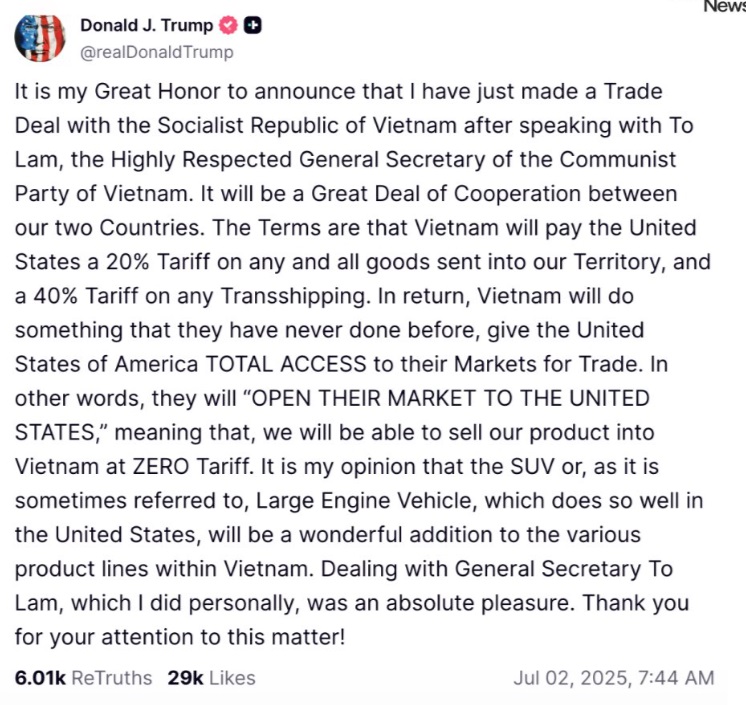
Last week, Trump announced a new trade agreement with Vietnam. As per usual, there isn’t actually an agreement, or at least not one that has been released to the public, only a post on Truth Social, which you can read below. U.S. companies importing from Vietnam will pay a 20 percent tariff* and a 40 percent tariff “on any Transshipping.**” What Trump undoubtedly means by “transshipping” is goods coming from China through Vietnam. Any Chinese goods that are truly transshipped through Vietnam would be subject to the tariff rate on Chinese goods. Ryan Peterson, CEO of Flexport, and Ted Murphy, an international trade lawyer, believe that the Trump administration is going to set up new rules and procedures for the application of tariffs. Peterson writes, “This is a major departure from how trade is done and will require far more granular data tracking of bills of materials and the country of origin and valuation of each component in an item.” If Murphy and Peterson are correct about what is actually in the agreement, companies will need to employ more trade compliance staff. Frictions in international trade have risen substantially in recent years, leading to a less efficient global economy. That means less economic growth and poorer standards of living. But, of course, no one has yet seen the “Vietnam – U..S. trade agreement” so maybe it will be simpler than what people are guessing. We can only hope.
*As we have repeatedly noted, there is far less transshipment through Vietnam than people think. Mostly what is happening is Vietnam is adding value to Chinese goods or taking Chinese components and assembling them (and other countries’ components) into a final product. Likely, as happened in China and other countries, over time Vietnam will increasingly make more of the components and China will make fewer. Alas, the developing country equation will be perverted, into what shape we’re not yet sure.
**Pretty sure under international law, letters from leaders who are unable to use capitalization correctly are ruled invalid. Thank you for your attention to this matter.
The EU and No New World Order
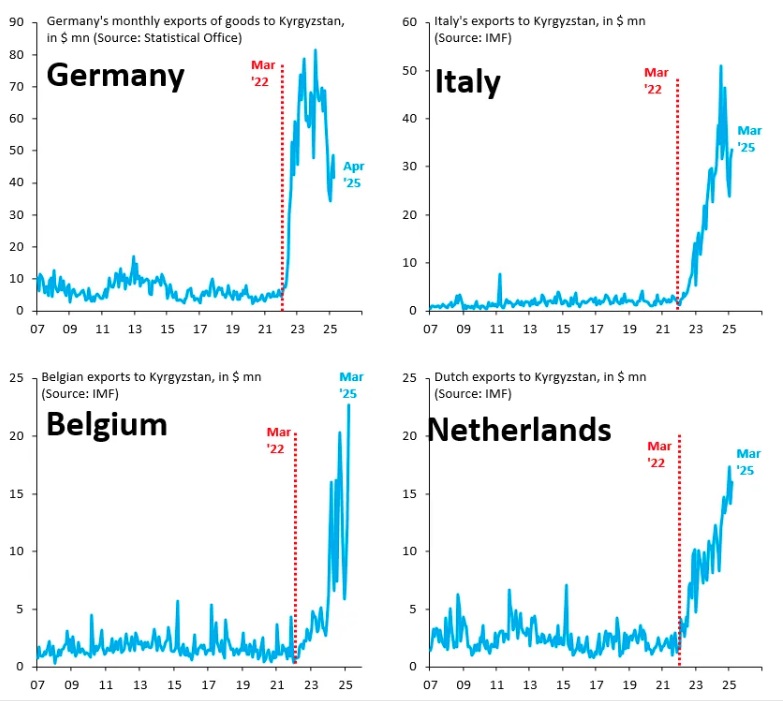
Late last year, in The Silencing of the Chimes, we wrote about the end of America’s role as a beacon for freedom and asked if there was a substitute to be found. We noted that “The European Union currently seems ill-fit for the role… The EU structure itself is a model of bureaucracy not a beacon of liberty.” This so far has proven to be true. The EU has not taken the lead in defending freedom, not even in its front yard of Ukraine. Robin Brooks, a senior fellow at the Brookings Institution (they didn’t select him just because of his name) has long been charting the EU’s inability or unwillingness to stop exports to Russia. EU companies are directly exporting to Russia but they are doing so through transshipments through other countries, including through Central Asia. In his latest article, he notes that, “Since Russia’s invasion of Ukraine, exports from many EU countries to Kyrgyzstan – a tiny, landlocked country in Central Asia – have exploded.” As you can see in Brooks’ charts below, exports to Kyrgyzstan went vertical after the invasion. He notes that EU exports have increased throughout Central Asia and to Turkey and states, “When you add all those transshipments up, they’re big enough to fully offset the fall in direct exports from the EU to Russia. These transshipments are therefore substantial and mean that the flow of goods to Russia from the EU never slowed.” But this is not true of all EU countries. Poland, the Baltics, Sweden and Finland have stopped such transshipments to Russia. It’s the old-line EU stalwarts that are not serious about Russia’s invasion of Ukraine. The beacons of freedom are miniature beams of light from smaller countries. We hope that is enough to create more light in the future.
China Corner: Shaping The New World Order
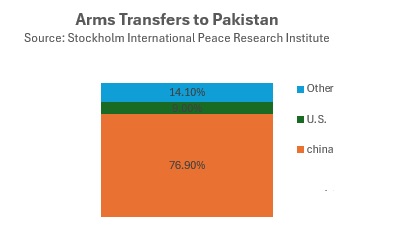
Remember the clash between India and Pakistan a couple months ago? Earlier this week, India’s Deputy Chief of Army Staff Lt Gen. Rahul R. Singh claimed, “China gave Pakistan ‘live inputs’ on key Indian positions.” Singh asserted China used the conflict like a “live lab” to test its weapons systems and that China provided all kinds of support to Pakistan during the conflict. Pakistan Army Chief Asim Munir called this claim “factually incorrect.” But given most of Pakistan’s weapons are bought from China, and given the rivalry between China and India, it’s not hard to imagine that China helped out Pakistan during the skirmish. Indeed, China has apparently been trying to prevent India from making gains in manufacturing, including pulling Chinese staff from Apple’s new factories in India. Perhaps this is why Prime Minister Modi this week extended his “warmest wishes to His Holiness the Dalai Lama on his 90th birthday.” Something we’re sure China did not care for, since it believes, even though it is officially atheist, that it should choose who the next Dalai Lama is. China continues to work to extend its power around the world, and sometimes in the afterworld. It is no beacon.