Not that long ago, fairly far away, someone we occasionally work with asked us and a colleague for advice on a personal matter. She shared that her sister had an abusive husband and was trying to figure out what to do about it. This is far outside of our area of expertise. If she had asked us about supply chains, international trade or what the Mariners should do at the trade deadline we feel we could have provided cogent and helpful answers. Nonetheless, we listened carefully and tried to provide helpful advice, even though this woman lives in a culture and legal system different from America’s. Fortunately, our colleague is far wiser, smarter and more worldly than we are, and she provided excellent counsel. Indeed, we felt we were learning as much as the woman asking us for advice, at the least on how to be empathetic and handle a situation where a person’s sister is in such a horrible situation.
Recently, we learned the woman who asked us for advice had gotten a divorce. We thought back to the conversation my colleague and I had with her. We remembered the stories of how her young son was having a difficult time in school and how he gravitated toward me, as if needing positive reinforcement from an older male. Our favorite movie, you may recall, is Chinatown. In one scene, John Huston’s character says to Jack Nicholson’s character, “You may think you know what you’re dealing with, but, believe me, you don’t.” And indeed, we often don’t, or at least it takes us a while to get it. In fact, we didn’t know what we were dealing with in the measles outbreak in Texas, or the complications of democracy vs. autocracy, or why China will soon beat America on basic research. Forget about it, Jake, it’s this week’s International Need to Know.
We’ll be busy making the world safe for Japanese baseball players next week. Back on Thursday, July 31st..
Without further ado, here’s what you need to know.
Not Always About America–Measles Edition
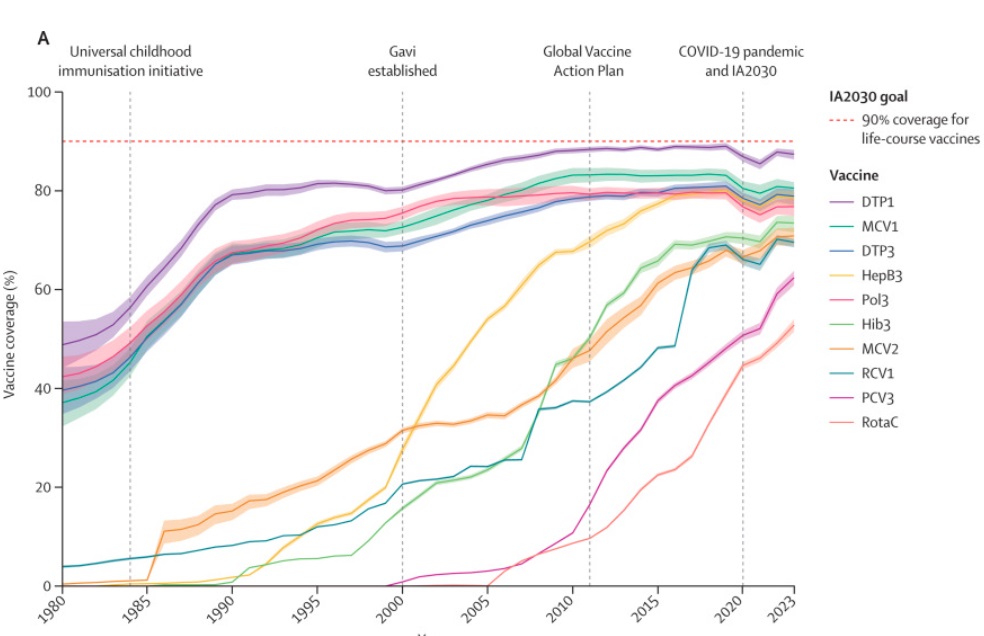
One of our pet peeves is whenever something happens in the world, certain people always blame or credit America, as if everything everywhere all the time is due to actions by America. This we remind you is not true. But we sometimes fall prey to this fallacy too. For example, when reading about the measles outbreak in Texas, we immediately blamed America for its decreasing vaccination rate. But Marginal Revolution reminds us that overall the U.S. has a vaccination rate above 90 percent and that mainly the source for the measles outbreak comes from our neighbors Mexico and Canada. It’s true that certain pockets of population in America—often devout religious communities (Christian, Jewish and Muslim) sometimes have dangerously low vaccination rates. Marginal Revolution states “These local shortfalls do explain how outbreaks spread once they begin—but how do they begin in the first place, given these communities are islands within a largely vaccinated country?” It turns out the measles outbreak is larger in Mexico than in Texas. And the vaccination rate in Ontario is under 70 percent. We’re worried if the Trump administration learns of this, it’ll slap another 20 percent tariff on the two countries. But we can’t shy away from facts just because someone might do something stupid if made aware of them. Besides, maybe this information will impel the Secretary of Health and Human Services to move to Canada or Mexico. But the facts of the mater are the source of these measles outbreaks is from other countries and then it spreads in pockets of American communities with low vaccination rates. We need to somehow convince devout religious groups that God, Allah and Yahweh like vaccinations. And Canadians and Mexicans too.
Democracy Vs. Autocracy Round 7
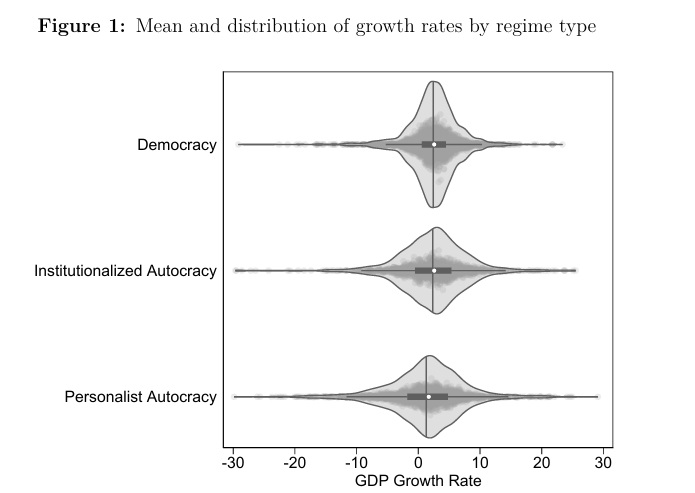
We often remind people that democracies outperform autocracies economically. But University of Chicago economist Chris Blattman tells us about his new study that complicates this assertion. Blattman, who conducted the research with two other economists, claims that while democracies do outperform “personalist” autocracies economically, they don’t outperform institutionalized autocracies. The study states that “There are vast differences, for example, in the nature of authoritarian rule in such institutionalized autocracies as Mexico under the Institutional Revolutionary Party (PRI) or Singapore under the People’s Action Party (PAP), versus the personalist dictatorships of Mobutu Sese Seko (Zaire) or Saddam Hussein (Iraq).” It turns out democracies do outgrow personalized autocracies but essentially perform the same as institutionalized autocracies. But the latter shouldn’t get cocky. The study points out that institutionalized autocracies often devolve into personalized ones. “In recent years, two of the world’s most powerful autocrats—Vladimir Putin of Russia and Xi Jinping of China—have systematically removed institutional checks and balances to rule by personal influence and decree.” And we’d further note that other studies have found that autocracies, whether institutional or personalized, overstate GDP growth. Plus, if a democracy is growing at the same rate economically as an autocracy, why shouldn’t we choose freedom and economic growth rather than only the latter? A better way for Blattman’s study to phrase it is institutional autocracies score low on freedom, with no economic benefit. So, even with this study, there is no good argument for autocracy.
China Corner: Emperor of Basic Research
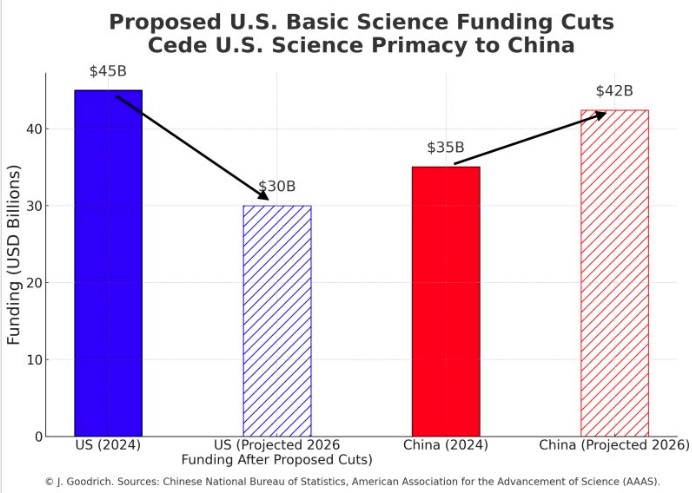
China, under Xi Jinping, is all-in to become the worldwide leader across multiple domains. It’s tripled down on industrial policy, is building up its military and likely next year will become the leader in basic research funding. Today, we concentrate on the last item, basic research–understanding foundational principles without regard to practical applications. According to Jimmy Goodrich of the University of California Institute on Global Conflict and Cooperation, China is increasing its basic research budget to $42 billion. China will be the largest funder of basic research in the world not only because it is increasing its funding, but also because the U.S. is slashing its basic research funding. The big bad bill cuts basic research funding from the 2024 level of $45 billion to $30 billion in 2026. As Goodrich writes, “America will fall behind China for the first time since WWII and the Cold War, a shocking reversal after nearly eight decades of global leadership.” Basic research eventually leads to practical applications. The world will reap good things from China investing more in basic research—from new medical treatments to energy technology. But it’s not ideal that an authoritarian government will be the leader in developing new technologies, some of which will not be benign. We need to do basic research on why countries elect leaders who would cut basic research.