In the quaint village of Cooperstown, where we watched the Philosopher King Ichiro inducted into the Baseball Hall of Fame, we chatted with a young waitress at a restaurant. Tiana and her mom had moved from Florida to Cooperstown six years prior. Tiana had survived the Parkland massacre, and her mom wanted a clean break from that horror, so to upstate New York they traveled. After graduating from high school, Tiana went to a local college and earned a double major in criminal justice and biochemistry. She told us she was leaving the restaurant world behind and becoming a cop in a few weeks, having recently passed the required exams to be an officer of the law. This, she explained, was a way to earn and save money so she could eventually go to graduate school in biochemistry in Tennessee. There are not many ways to earn a decent wage in the Cooperstown area–beautiful and old-school Americana as it may seem–but being a police officer is one of them.
We asked her if surviving the Parkland mass shooting influenced her to go into law enforcement, at least in the short term. It had, she said. She was a delightful person, and not only did we enjoy our conversation, but we found her inspiring. She survived a shooting where 17 students were killed, went on to graduate from college, and now has plans for graduate work in biochemistry. To add a cherry to the sundae (or in our case, the maraschino in the Old Fashioned she served us), Tiana got engaged just last week to her boyfriend, who works in the restaurant’s kitchen. He proposed in a park, bent on one knee, in front of a crowd of people despite his inherent shyness. We come to you, dear reader, on bended knee to engage you on the disappearing Americas, continued progress on hunger, and China’s disappearing manufacturing jobs. It’s this week’s International Need to Know, the Ichiro speech of international information, the C.C. Sabathia of kind global data.
Looking back, it seems crazy that the jazz song “Feels So Good” became a hit. In 1977, only the Saturday Night Fever soundtrack outsold the eponymous album. The 1970s, as we’ve noted before, were a freer era, a warped and wild decade where anything could and did happen. It is a vibe America should aspire to return to. It will feel so good. RIP Chuck Mangione.
Without further ado, here’s what you need to know.
Vanishing Americas
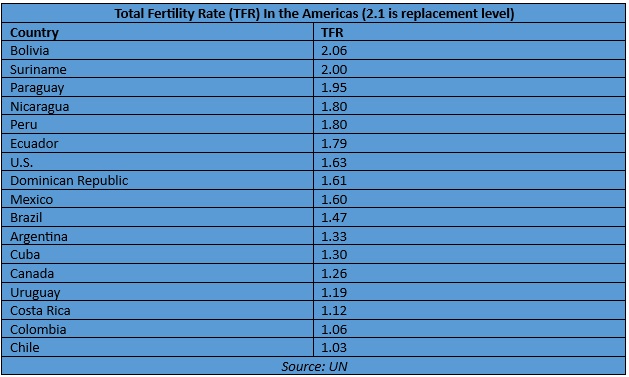
Europe and Asia get the star treatment for falling fertility but don’t forget about disappearing Latin America. Jesus Fernandez-Villaverde, a professor at the University of Pennsylvania, reminds us that just about every country in South and Central America has a total fertility rate well below the 2.1 replacement level, as you can see in the table below. In fact, they are essentially at the catastrophic level of East Asia–South Korea without the K-pop, a samba rhythm method. Chile and Colombia are barely above 1.0 TFR. Brazil is down to 1.47, Mexico is at 1.6. Uruguay, a place to which we occasionally contemplate fleeing, has a TFR of 1.19. Like China, many of these countries’ fertility rates have plummeted before they become fully economically developed. This means few young people will be around to support old people even as their economies are not wealthy enough to provide robust safety nets for the elderly. We increasingly suspect that the low fertility rate trend, like the previous worries about overpopulation, will somehow be upended by a new trend. Or else, other species’ populations around the world will start to explode later this century–and if our neighborhood is a canary in the coal mine, that will include rabbits and coyotes.
An Appetite for Curing Hunger
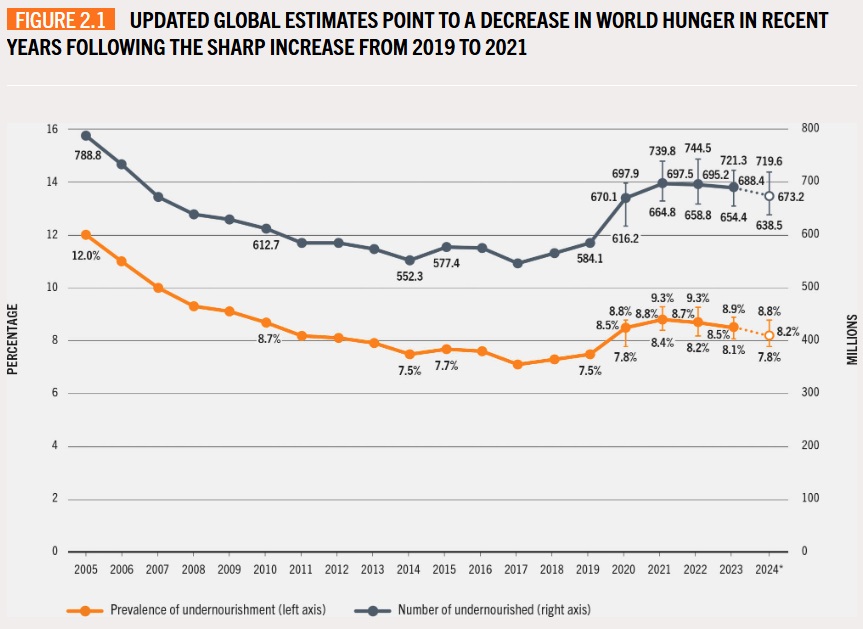
A couple of years ago we noted that after a brief pause during the pandemic, hunger started falling again. Thankfully, and unsurprisingly, that trend continues. Reuters reports that a new UN report finds that “Around 673 million people, or 8.2% of the world’s population, experienced hunger in 2024, down from 8.5% in 2023,” The rate for 2023 was lower than for 2022. However, this decrease in hunger came after two years of increases during the pandemic. Those increases were the anomaly—hunger and malnutrition have been decreasing for decades. Of course, we are in a new era—post international rules-based order and post American-leadership. Conflicts–military, trade and others–are on the rise around the world. If these conflicts spread, it’s possible the continual progress in reducing hunger will halt. The reason for the decrease in hunger is economic development—that is economic growth. That is why for decades and decades fewer people are going hungry. The post-World War II, post-Cold War order that so many were eager to discard, led to the most prosperous, healthiest era in human history. We need to encourage continued economic growth and the development of technologies that address negative externalities associated with growth. The worst thing we can do is institute policies that harm or retard economic growth. That way leads to more hunger and malnutrition.
China Corner: Declining Manufacturing Jobs
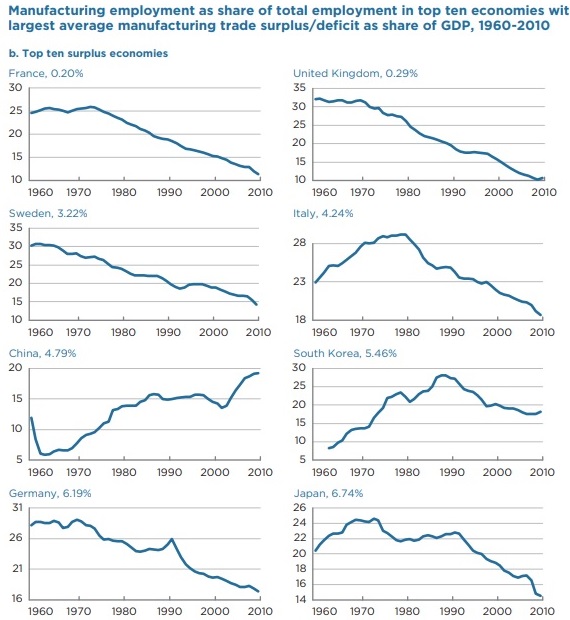
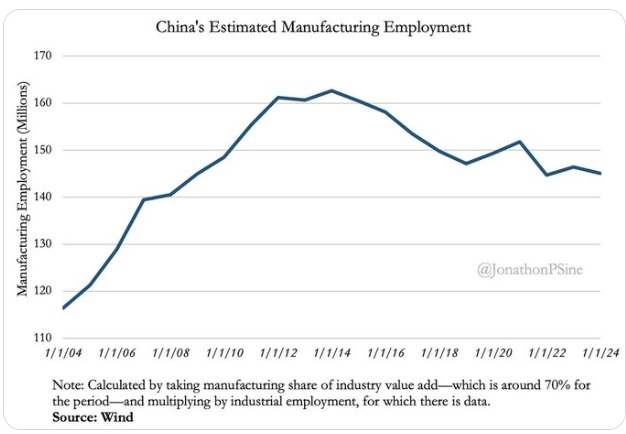
China is the factory of the world, accounting for around a third of global manufacturing. It is a remarkable feat and one that the world is increasingly pushing back against. But that factory is populated with fewer and fewer workers. As we’ve noted in the past (with accompanying graphs), the decline in manufacturing jobs is not limited to the United States. The rate of decline is consistent across countries (see first graph below). And China is no different. More than ten years ago, manufacturing jobs began declining, as you can see in the second graph below from Jonathon P. Sine (not to be confused with his cousin, Jimmy T. Cosine). As Sine notes, “A weird thing to think about is that China shed the equivalent of the entire US manufacturing sector (~15 million jobs) over the last 15 years.” As the U.S., E.U., China and others battle to build more products, it is important to remember this is a battle over control of production, not generation of jobs. It is important for a nation’s security, at least in certain industries, to have manufacturing capacity. But to build your economy, to help your people, to produce jobs, don’t look to manufacturing.