Sometime in the late 1980s, historians are still working to determine the exact date, we traveled to Taiwan as part of a congressional staff delegation. We were in the bloom of our youth even as Taiwan was in the bloom of its early democratization. We gazed in amazement at the thousands of scooters zooming down Taipei’s streets. Our current visits to Vietnam, where scooters currently rule, reminds us of our early days in Taiwan. We remember our Taiwanese hosts taking us to what was then the largest disco in Asia. We were busting some moves on the dance floor with congressional colleagues when suddenly a new song came on and there was a roar from the Taiwanese jammed into this giant disco. They flooded the floor shouting the chorus, “I Love Rock and Roll, So put another dime in the jukebox, baby, I love Rock and Roll, So come and take your time and dance with me. Ow!” To this very day, we are surprised by the love Taiwanese had in 1988 (historian: or it might have been 1989) for Joan Jett and that song. We don’t say it is misguided love, only, like all love, confusing to understand.
We were in Taiwan again last week, with the International Need to Know spouse, enjoying night markets, gazing at the car-crowded streets, and enjoying all the wonders of this island country. From data, we know that Taiwan has one of the lowest fertility rates in the world and an aging population. But we couldn’t tell from the street and country lanes we wandered. We saw young people everywhere, and parents and their children too. Sure, we saw elderly, but not in the numbers we expected. And so we wondered about the data—until we exited the plane upon returning to Seattle and in the gangway we saw a line of wheelchairs as long as today’s Hollywood movies, as ubiquitous as the scooters we saw on the Taipei streets in 1987 (Historian 2: whatever), if not nearly as speedy. And so we can only turn to data and information to understand this world, including Taiwan’s success, evidence the new world order is bad for us, and whose stock market is tops. It’s this week’s International Need to Know, a knowledge night market featuring the sweet potato ball with plum sauce of international information, the leek pancakes of global data.
Without further ado, here’s what you need to know.
A Bad New World
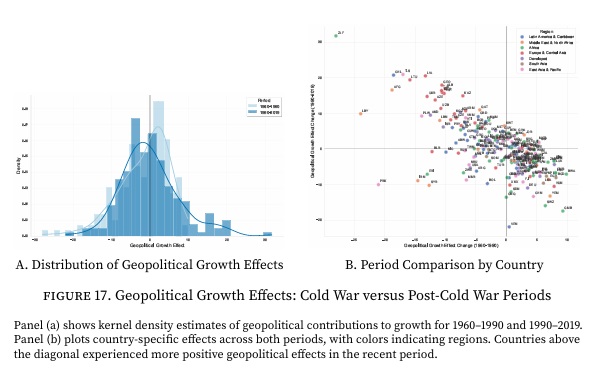
We warned about this four years ago in our book, and have harped on it here and in Substack articles since. The end of the rules-based international order and rise of the new 19th century is bad for a variety of reasons, including for the world economy. A new research paper by Tianyu Fan of Yale University is not explicitly about this but confirms it. His paper finds that when a country’s geopolitical relations with other countries improves, so too does its economy. Its GDP increases. Fan used large language model AI to “compile and analyze over 440,000 major political events between all country pairs involving 196 countries with 24 major nations from 1960–2019.” Using this data, Fan found “the 1990–2010 globalization era generated widespread GDP gains through improved international relations. The 2010s, however, witnessed renewed fragmentation, with the median country experiencing negative geopolitical growth contributions for the first time in our sample.” There are economic consequences for the international order falling apart. The current rivalry between China and the U.S. is inevitable but also has bad consequences for the world economy. The aggressive 19th century behavior of the United States, Russia and China will diminish countries economies in real, measurable ways.
This is Not Investment Advice
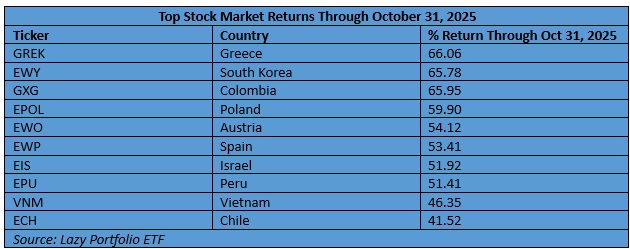
We’ve seen people posting this week on X a list of the best performing stock markets so far in 2025. They do so in referencing where the United States places (middling). We present our own list below, as of October 31st, 2025, per the Lazy Portfolio website. As you can see, Greece is number one, which is impressive given the dire straits of the Greek economy during and after the Great Financial Crisis that erupted in 2008. Countries’ governance and policy are not static. The world always turns. Following Greece are South Korea, Colombia and Poland. South Korea isn’t so surprising as it’s been a powerhouse economy for many years. But your image of Colombia’s economy might be filtered through Hollywood and focused on the cocaine trade. Who knew the world is more complicated than Hollywood stereotypes? Poland, as we’ve noted here before, is a remarkable success story since separating from the Soviet Union and Russia. Of course, a word of caution about all of this, stock markets are not economies. A strong stock market may indicate many things that have nothing to do with strong economic basics.
China Corner: Emulate Taiwan
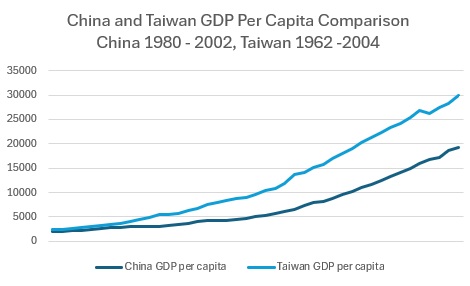
On the way to Sun Moon Lake during last week’s trip to Taiwan, we passed through the heart of the country’s semiconductor industry, the center of where the most sophisticated semiconductors in the world are developed and manufactured. From the highway we could see the large offices and plants of TSMC. What a remarkable society Taiwan has created. Who would have guessed in 1950 it would develop so robustly economically and flower so liberally politically. Its nominal GDP per capita is in the top 30 in the world. Its purchasing power parity GDP is higher than most European countries. And as we wrote in the introduction to Sunday’s Trump Law-Breaking and Corruption Tracker, we saw one of the most successful societies in the world. People enjoying their lives, living in a prosperous economy, under a thriving democracy. Elections are routinely held. People can live their own lives. All of those folks who tells us Chinese can’t and don’t want freedom—turns out it’s a convenient fiction for both the authoritarians and their fellow travelers. Developing countries around the world should emulate Taiwan, both economically and politically.