We were surprised to discover last weekend that we spent our formative years in funky town. Where, we can hear you asking through this grand-ole-digital-opry people call the Internet, is that? Why Bellingham, Washington, tucked up in the northwest corner of the United States, just a few miles south of Canada, that big bullying country to the north. In our defense, there was little evidence of Bellingham’s funkiness decades ago when we lived in the soft bosom of the little burg. Back then it was a small working town beholden to the paper mill and the college. Today it’s dotted with breweries, retired people and still a college town. In our experience, it was highly unlikely one would come across anybody even faintly resembling a cosmic carnival with wild hair–often a neon, defying gravity coif—wearing costumes that were a combo superhero- street parade-sci-fi fever dream. In other words, no George Clintons, the founder of Parliament and Funkadelic, inhabited Bellingham.
But last Saturday we attended a special showing of one of the greatest movies ever made, Stop Making Sense, at the historic Mt Baker theater where way back in 1974 we sat frightened under the chandelier watching the movie Earthquake in full Sensurround. At the end of Stop Making Sense, Jerry Harrison, a member of Taking Heads, did a Q and A. In the midst of his talking, he introduced the widow and son of Bernie Worrell, who played keyboard during the Stop Making Sense Tour AND is a founding member of the Parliament-Funkadlic collective. Bernie, it turns out, and we had no idea (shame on us) spent his last year in Bellingham where his wife has family. His memorial service was held in Bellingham. His wife and family still reside there. And if the great Bernie Worrell lived there, even if only for a year, that means according to the purple neon laws of the universe, Bellingham is officially funky town. Them’s the rules. And we rule on the Board of Peace, where the old people roam and China goes electric. It’s this week’s International Need to Know, looking for global data in all the right places, acting as the Tinder of international information.
Without further ado, here’s what you need to know.
Marley Was Dead
The rules-based international order is dead, to begin with. There is no doubt whatsoever about that. But what will replace it? Like the characters in its a Mad, Mad, Mad, Mad World, there is a greedy race to erect a new world order. Xi Jinping will do whatever it takes to erect his vision, Vladimir Putin will too.. And Trump, of course, has his royal idea: The Board of Peace. It was originally presented as a vehicle for transitioning Gaza into…well, something. But if you read the actual charter, there is no mention of Gaza whatsoever. Indeed, the stated purpose of the Board of Peace, which is described as an “international organization,” is “to promote stability, restore dependable and lawful governance, and secure enduring peace in areas affected or threatened by conflict.” Donald Trump, not the generic “president of the United States,” is designated as the “chairman” of the Board of Peace. To become a member state of the Board of Peace, you must be invited by the chairman—the Donald. You’ve probably seen the news that invitees are asked to pay $1 billion to be a member. How long is the term of a member? “Each Member State shall serve a term of no more than three years from this Charter’s entry into force, subject to renewal by the Chairman.” The chair decides when to meet, how many times and basically rules the roost. Essentially, Trump is trying to replace the UN with, well, himself. The charter says Trump’s successor will be chosen by Trump himself. An executive board will be created but Trump has veto power over it. Countries are starting to pledge the $1 billion entry fee but there are no audits or other financial safeguards specified in the charter. Given Trump has already enriched himself by $1.4 billion over the past year, how secure do you feel about what happens to the money? Feel free to read the entire charter. Essentially Trump’s vision is to replace the rules-based international order with…Donald Trump. We can hear Marley’s chains rattling.

What a Drag It is Getting Older
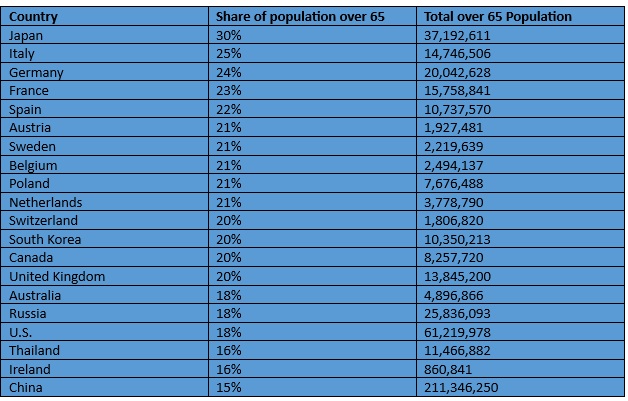
China hit the headlines this week with news that births dropped to 7.92 million in 2025. As an economics professor at the University of Pennsylvania put it, “there were fewer births in China in 2025 than in 1776.” However, China is not alone. Most countries outside of Africa have low fertility rates nowadays. We face a future of old, cranky people. Should be a lot of fun. Where are the old concentrated in the here and now? Visual Capitalist, using data from the U.N. and the IMF provides the answer for the world’s largest economies. As you can see in the table below, Japan comes in at number one with 30 percent of its population aged 65 or older. The rest of the top ten are all in Europe with Italy, Germany, France and Spain rounding out the top five. South Korea is 12th but will be climbing the rankings in the coming years with its current fertility rate well below 1. China is 20th but by mid-century will have also climbed these dubious rankings. Russia is 16th but with its perpetual war sacrificing young people at a high rate, it too will climb the rankings. Maybe the only silver (!) lining of aging demographics is perhaps countries won’t have enough young people to engage in war. Or it will just be drones and robots fighting.
China Corner: China Goes Electric
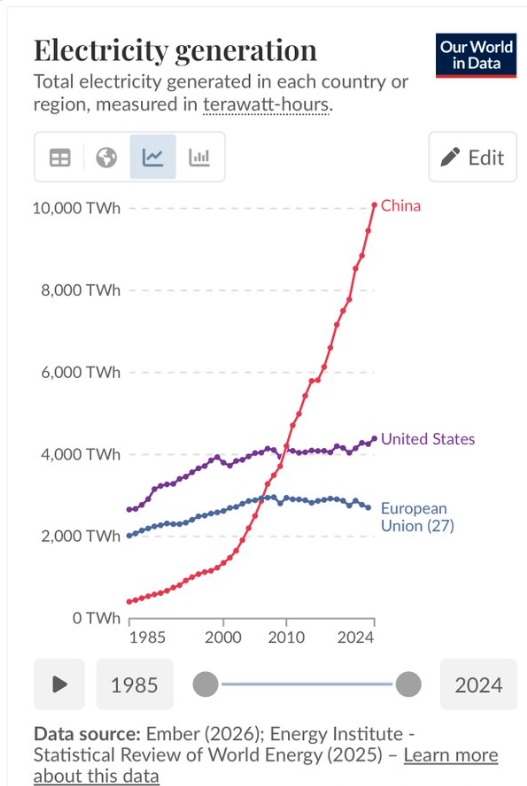
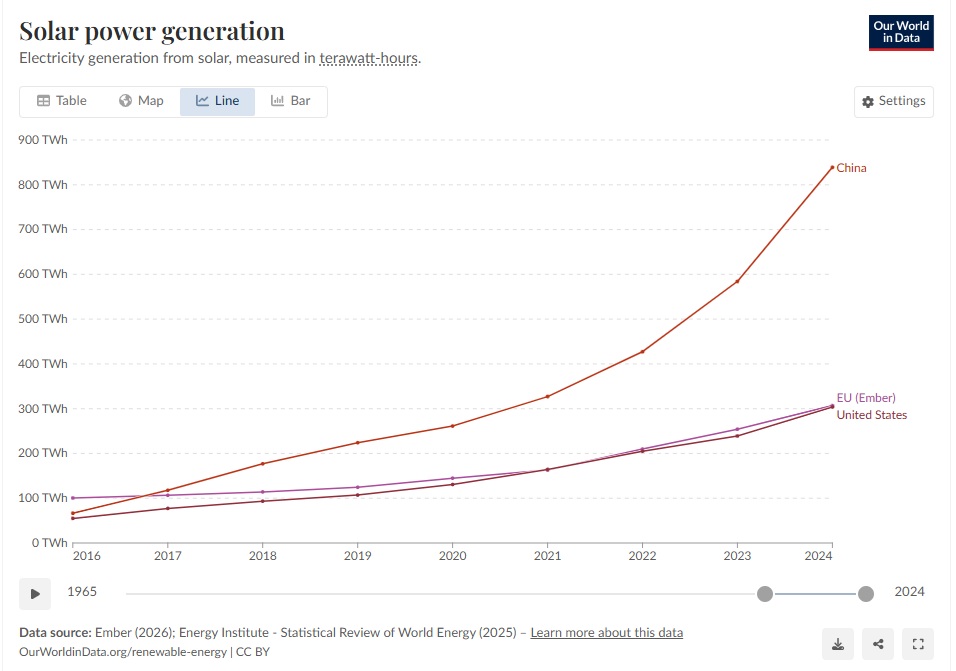
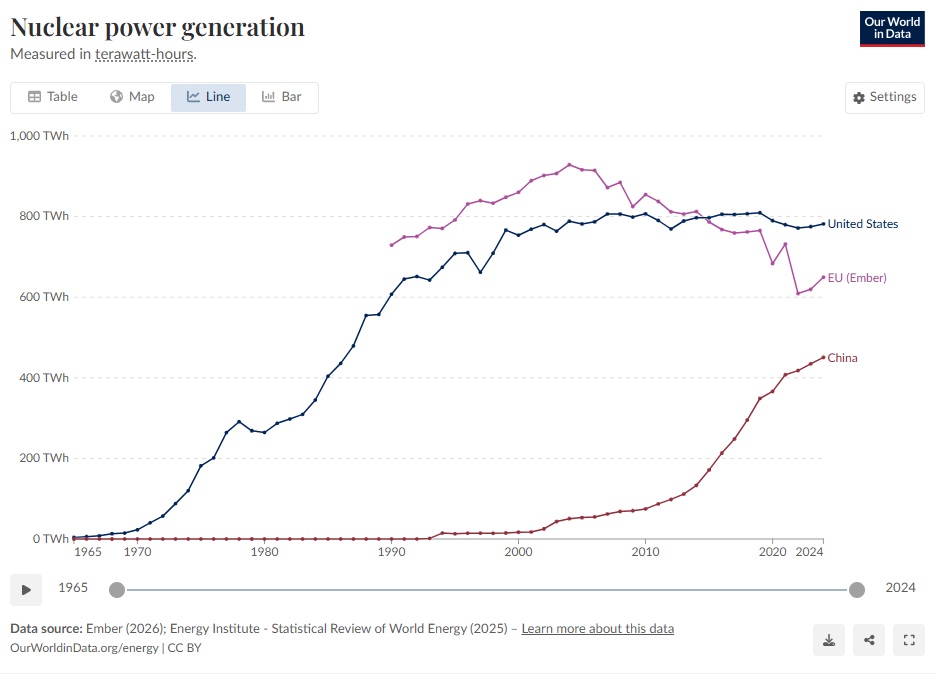
The least interesting part of A Complete Unknown, last year’s movie about the early years of Bob Dylan, was the controversy over Dylan going electric at the Newport Folk Festival. At this distance, it seemed silly that anyone cared he started playing electric guitar. Far more consequential, however, is China’s going electric. China continues to boost its electricity generation capacity through a variety of means, including and especially in recent years solar and wind power. This can lead to some misleading data, however. Someone recently posted on X that “China now generates 40 percent more electricity than the U.S. and E.U. combined.” Pretty impressive, right? Well, there are 800 million people in the U.S. and E.U. combined and between 1.3 and 1.4 billion in China. So per capita, China is still behind the U.S. and E.U. But the trend is the thing. Look at the second and third charts below. China’s solar and nuclear is going way up. In total electricity generation, China’s trajectory is northwards and the U.S. and E.U. is relatively flat. Why is that a problem? Well, the future is electric. From AI to drones to moving vehicles of all sorts to desalinization and a host of other applications, they are going to be driven by cheap and abundant electricity. China is preparing for the future. It’s unclear what the U.S. and E.U. are preparing for.