Humans are pattern recognition animals. We are no different. We notice things in our neighborhood on walks and when we drive to other corners of the city. What we see are fences being erected. The folks down the street recently put one up, and so too a house a few blocks over and generally we see them going up everywhere. Ordinarily this would not be cause for alarm. Good fences, as Robert Frost wrote, make good neighbors. But we are struck by the kind of fences popping up all over the place. They are exceedingly tall and opaque. These are not picket fences that one can see through and over and Tom Sawyer can make a quick buck off. They are solid and so tall even Victor Wembanyama would have difficulty seeing over them. And they aren’t just erected in the side yards between houses, they are in the front blocking off the house from the street, as if homeowners are creating their own gated community of one.
Why this trend, we wonder? Who are we all trying to keep out, and what eyes do we not want prying? Perhaps the coyotes who wander our neighborhoods like the street gang from the movie The Warriors? Or perhaps, even though crime continues to fall, home owners still feel afraid? We wonder if this is part of a larger American retreat from the world, if these are not only physical fences but metaphorical ones too? We have fewer immigrants coming to America, fewer international tourists as well. We impose tariffs and bomb and arrest others overseas. We are collectively fencing ourselves in from the greater globe. Yet we wonder what it is like to sit on your front porch and look out at the world and all you can see is a large wooden wall—only sensing what is beyond it, perhaps hearing the howl beyond. We peer above the fence and howl at The Assassination Doctrine, despair at The Destruction Doctrine, and puzzle out how China knew to stockpile oil. It’s this week’s International Need to Know, the Bam Adebayo of international information, the advanced NBA stats of global data. .
Without further ado, here’s what you need to know.
The Assassination Doctrine
The onset of the U.S.-Israel war against Iran was the assassination of Ali Hosseini Khamenei and other leaders of the country. Let’s put aside the question for a moment of whether this was legal under either U.S. or international law and ask another question. Was it a good idea? The Trump doctrine is to remove leaders of countries, either by killing them, as with Khamenei, or extracting them and jailing them in the U.S., as with Maduro in Venezuela. In this new 19th century world that Trump is creating, and other countries must adapt to, will this new assassination doctrine likely be helpful to the United States, to the world? Now that we have discarded rule of law for rule of the jungle, perhaps some Americans think assassinating other countries’ leaders is in our interest, since along with China we are one of the two most powerful countries in the world. But technology is a great equalizer. Perhaps it will soon be easier for smaller countries to kill powerful countries’ leaders as new technology proliferates.
There’s a scene in the Godfather Part II where Michael Corleone says, “If anything in this life is certain, if history has taught us anything, it’s that you can kill anyone.” It’s highly unlikely that any current U.S. leaders thought through game theory on any of this. The fundamental finding from iterated prisoner’s dilemma research is that the most successful long-term strategies are those that cooperate, retaliate proportionally, and forgive. Strategies based on maximum aggression tend to perform well in the short run but collapse in the long run as other players adapt. The critical question is: what happens when this norm killing leaders is available to everyone? The U.S. currently enjoys technological superiority, but that advantage is eroding. AI-enabled autonomous weapons, advanced cyber capabilities, sophisticated drones, and biotechnology are all proliferating. A world where leader assassination is normalized is a world where U.S. presidents, members of Congress, and military commanders are also legitimate targets — not just in the eyes of non-state actors (which was already the case) but in the eyes of other states that can now point to U.S. precedent. The deepest irony from a game theory perspective is that the doctrine is designed to make the U.S. safer by making examples of adversaries, but the equilibrium it creates may make every leader in the world — including American ones — less safe in the long run. It’s a classic case of winning the immediate game while changing the rules in ways that make the larger, longer game far more dangerous.The world will reap the consequences. Michael Corleone will be increasingly correct. And the world deeply screwed.
The Destruction Doctrine
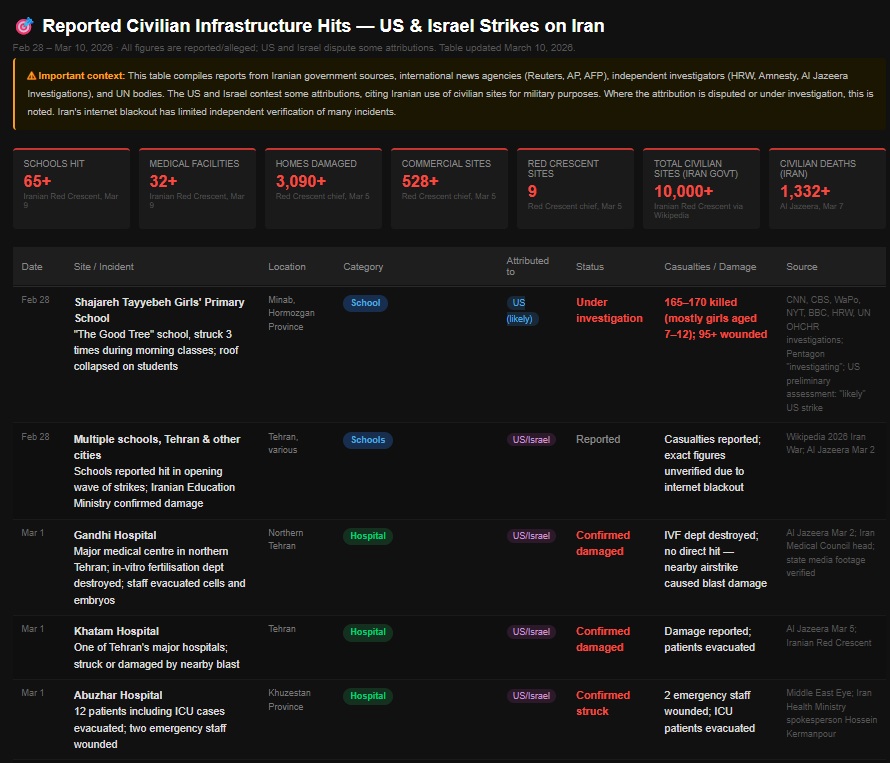
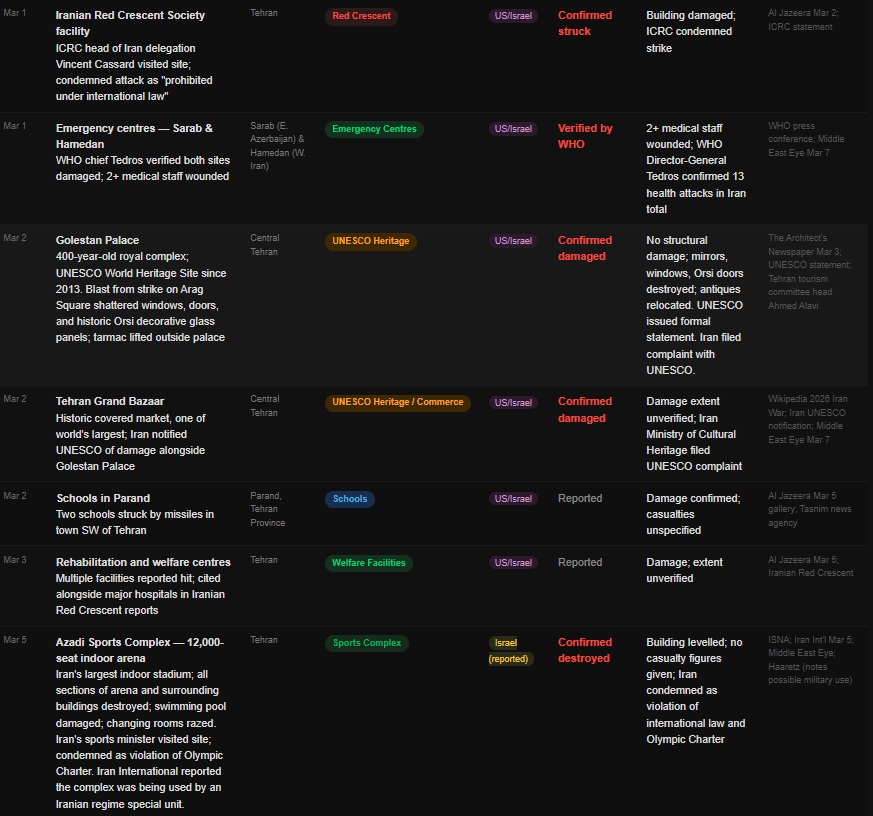
Separately, perhaps a corollary to the Assassination Doctrine, is the Destruction Doctrine. This one is really an Israeli military doctrine, pioneered in earlier military actions and then executed broadly in Gaza after October 7. The U.S. in working with Israel against Iran, has adopted it. In Gaza, Israel was not particularly attempting regime change. It wanted Hamas gone, but Israel was not keen on a different Palestinian leadership emerging. Instead, it waged a war of utter destruction, apparently under a theory that Palestinians can’t be a threat if their land is in rubble. Israel—and the U.S.—are conducting a similar policy in Iran. There is no desire to see a democratic Iran. Israel would be quite content to, as one Israeli defense official said to an NPR reporter, “decimate Iran’s military forces”—the army, navy, and military industries. But it’s beyond destruction of the military. Israel with the United States help is destroying much of Iran’s infrastructure, including Iran’s state broadcaster headquarters, parliament building, oil storage facilities, and other buildings.
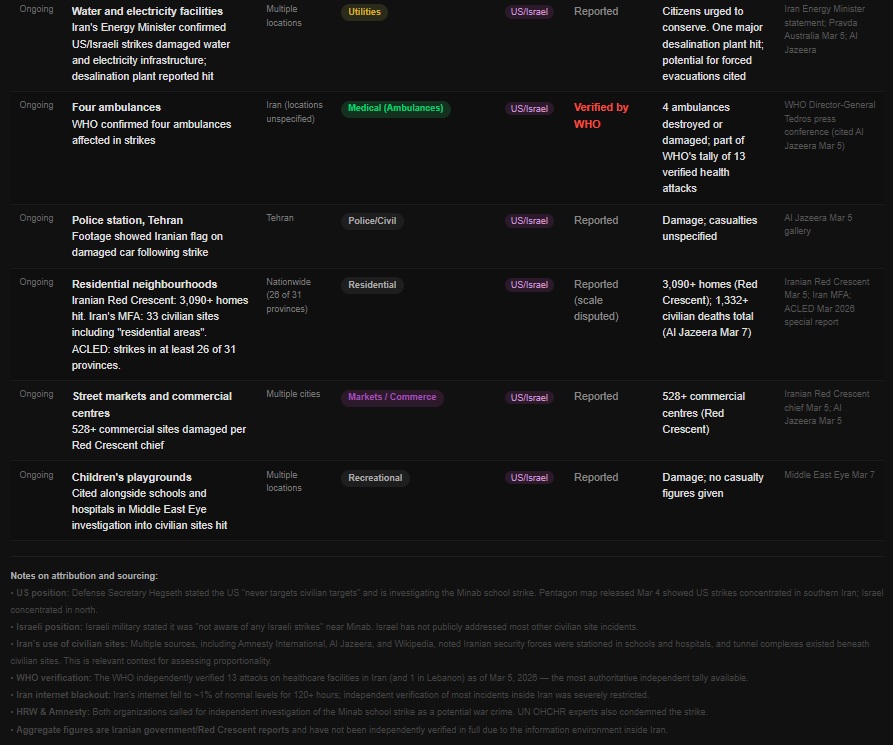
The World Health Organization has identified 13 Iranian health infrastructure sites hit during the war. Even water desalinization sites have apparently been targeted and destroyed. Poland’s Centre for Eastern Studies assessed that Israel is not interested in a successful political transformation of Iran, but rather the opposite — its “profound weakening, and potentially even its disintegration, for example along ethnic lines.” Late Monday, Trump posted to social media in response to Iranian threats to close the Strait of Hormuz, “Additionally, we will take out easily destroyable targets that will make it virtually impossible for Iran to ever be built back, as a Nation, again – Death, Fire and Fury will reign upon them—But I hope, and pray, that it does not happen.” Essentially, Trump is threatening to commit war crimes. In addition to the dubious morality of destroying the land of 2.1 million Palestinians, we question whether that will really make Israel safe for the long term. Iran, unlike Gaza, is giant geographically and home to 91 million people. Believing that Iran’s destruction, with potential for civil war, will keep one safe is, well, madness.
China Corner: Boy Scout Espionage
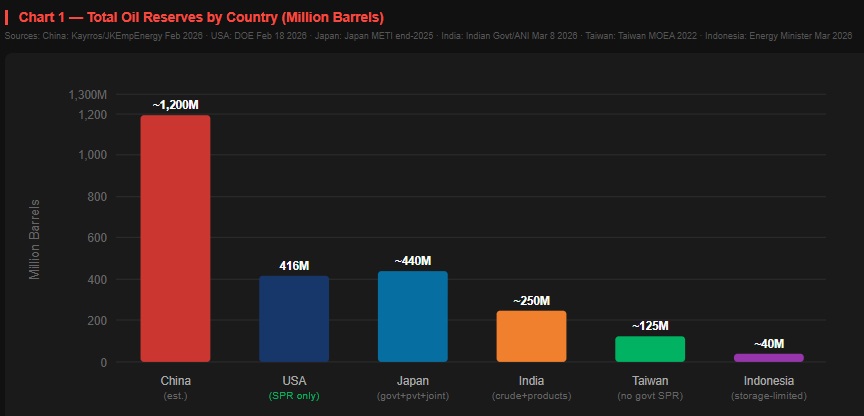
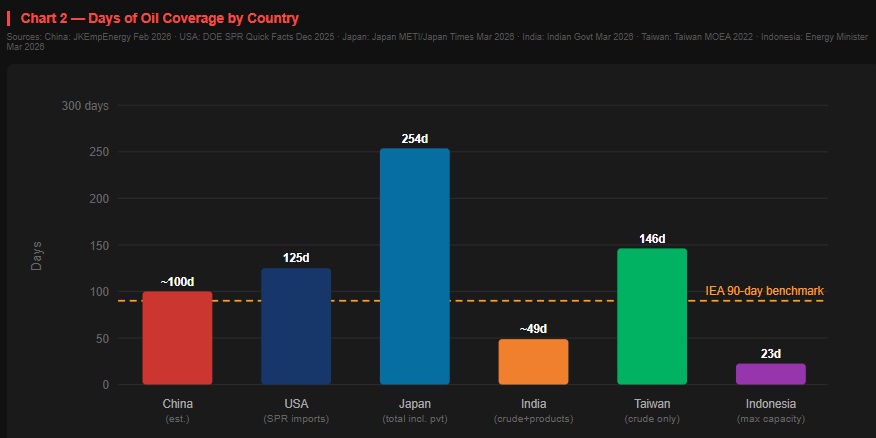
As the U.S. helps Chinese ships traverse the Strait of Hormuz (wait, MAGA folks assert Trump is tough on China), let’s review how China has prepared for this moment of strife in the Middle East. Last week we showed China is moving toward electrification. But during the transition, in 2025, China undertook one of the most aggressive oil stockpiling campaigns in history. China’s crude oil imports hit a record-high 11.6 million barrels per day in 2025, bolstering its stockpiles. By late 2025, China’s total reserves — combining roughly 400 million barrels in strategic petroleum reserves and 800 million barrels in commercial stocks — were estimated at 1.2–1.3 billion barrels. Very impressive. At the time this was happening, we remember analysts speculating China was preparing to invade Taiwan. “Energy production and stockpile buildups often precede great power industrial wars,” one analyst told the U.S.-China Economic and Security Review Commission. Perhaps that is part of the reason but we wonder if China also knew the United States and Israel might very well go to war against Iran and so was preparing for the day when havoc would reach the oil markets. How would China know U.S. plans? Well, as we’ve written in the Trump Law-breaking and corruption tracker, the Trump administration has fired key National Security Agency personnel, uses unsecure phone lines and generally is as sloppy with classified material as it is other facets of governing. Plus, China is remarkably successful in cyberespionage. To be fair, some of that successful espionage penetration took place in the previous administration. However, it is likely China has full sight on Trump administration decisions, whether made on Signal or elsewhere. And it has prepared based on that intelligence.