One day many, many, many days ago, an employee angrily came into our office. She was mad about something I had done in a meeting and ready to tell me about it. Like any angry person, she was a bit breathless and her tone strident but she had obviously thought through her points and laid them out logically. Even more important, she was right. And I had been wrong. When she finished her lecture, I admitted so. Told her I was wrong, apologized and said I had learned a good lesson. As I spoke the words, I could see she was about to vent some more but then paused, a surprised look on her face—obviously not expecting this response. When she prepared for this confrontation and went through scenarios in her head, this was not one of them—not even Nathan Fielder anticipated this. If we are honest, we wouldn’t have anticipated our reaction either. It is rare to admit a mistake, and it isn’t necessarily our standard operating procedure. Our employee immediately calmed down, said something along the lines of, I didn’t expect you to admit you were wrong, and then we proceeded to have a good conversation and never had a problem working together again.
We all should admit we’re wrong more often. Paul Erlich, The Population Bomb author, who died earlier this week, and was seemingly wrong about everything, never admitted so. The New York Times obituary that stated his “predictions proved premature” is unlikely to apologize for that obviously wrong headline. We have looked dubiously upon the U.S. and Israeli war on Iran. We do not think we are wrong but it is always good to entertain the opposition’s argument, or at least those that have a seed of logic to them. The problem is Trump and his allies are a barren field. But Muhanad Seloom, an Assistant Professor of International Politics and Security at the Doha Institute, pieces together an argument that while we think has many holes, at least makes one grapple a bit with some underlying issues. For example, he writes,
“But the critics are making a different error: They are treating the costs of action as if the costs of inaction were zero. They were not. They were measured in the slow accretion of a threat that, left unchecked, would have produced exactly the crisis everyone claims to fear: a nuclear-armed Iran capable of closing the Strait of Hormuz at will, surrounded by proxy forces that could hold the entire region hostage indefinitely.”
Again, there are many arguments and facts against this, but at least it makes one think. As we grapple, we wonder what do we get wrong about Sudan’s war, about India tripping the light fantastic, and about China’s jet fuel exports. It’s this week’s International Need to Know, the Eugenio Suarez of international information, the Venezuelan baseball coaches of global data.
Without further ado, here’s what you need to know.
All The Pieces Matter: Sudan Edition
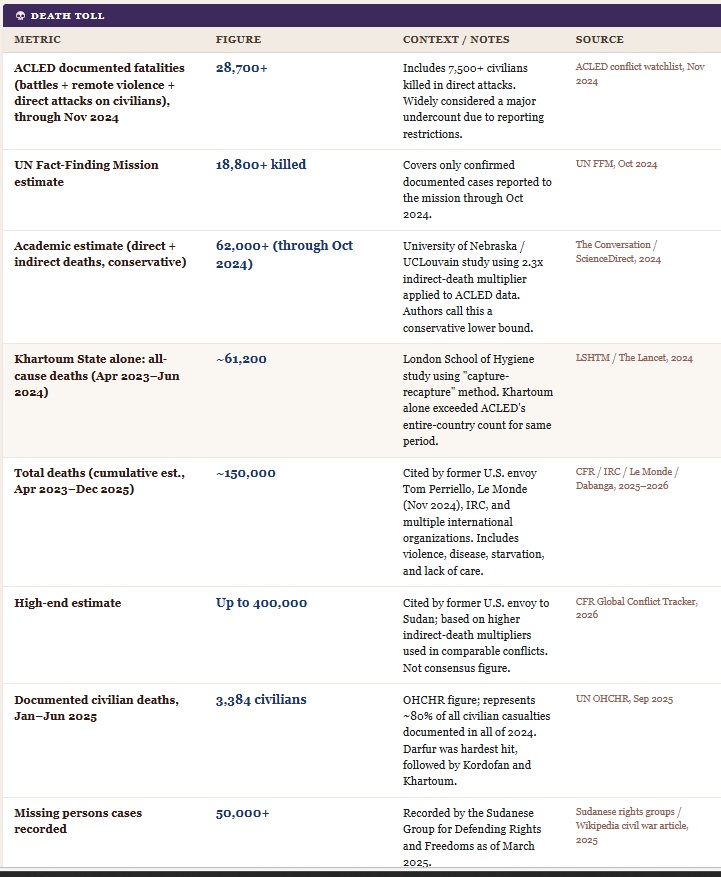
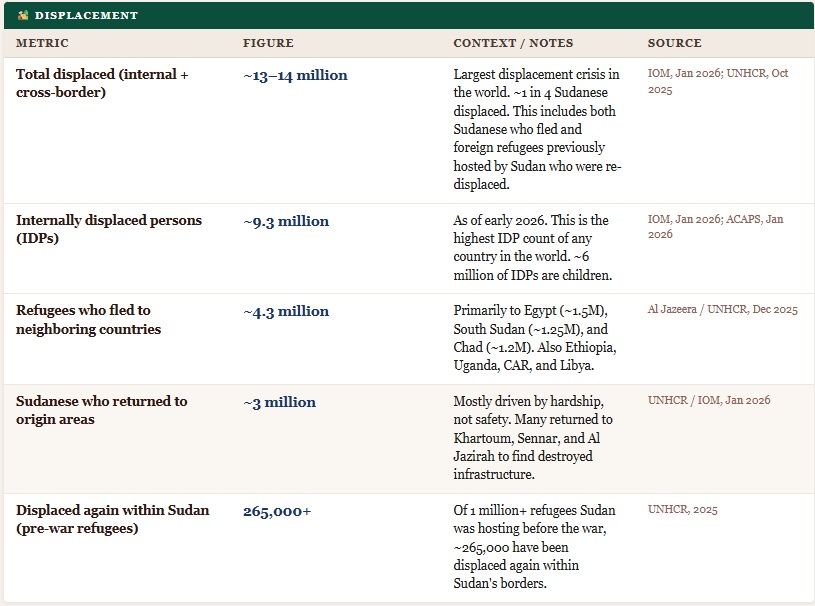
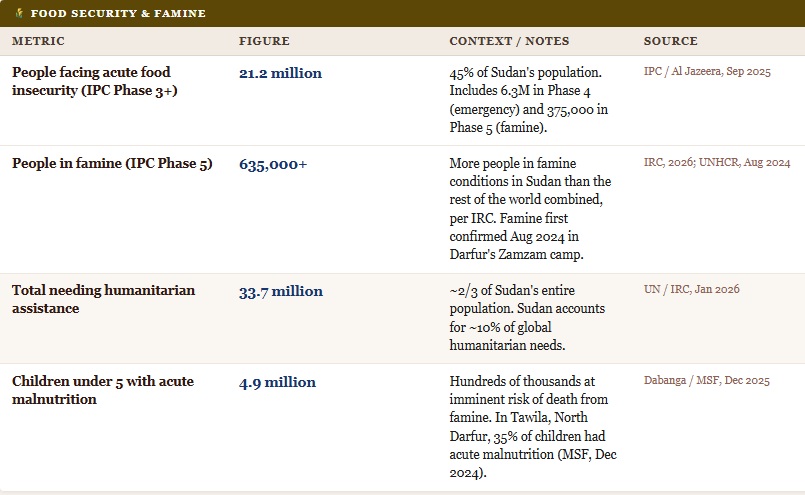
It’s easy to forget but there are other wars going on in this increasingly distressing world of ours, including in Sudan. Of course, the Sudan conflict has many ties and haunts to the Iran war. Nonetheless, Sudan is not on the current news menu. But to remind ourselves as much as you, the two main warring parties are the Sudanese Armed Forces (SAF) which is the official national military, and the Rapid Support Forces (RSF), a paramilitary group. It’s also worth remembering that Sudan has a 530-mile Red Sea coastline, a body of water perhaps now even more strategic given the Strait of Hormuz fiasco. At any rate, the war in Sudan rages on. According to the German news organization DW, “ In recent days, waves of drone strikes killed dozens of people across the White Nile state and the Kordofan region. Earlier this week, a drone struck a pickup truck carrying mourners to a funeral in West Kordofan, reportedly killing about 40 people, many of them women, the news agency AFP reported.” Interestingly, neither the SAF nor the RSF, nor any of their allies, claimed responsibility. There have been nearly 200 drone attacks in the first two months of the year. Since the war started in April 2023, between a quarter and three quarter of a million people have been killed, 14 million people have been displaced, and more than 20 million people are in need of health assistance. All sides of the conflict have committed human rights abuses. Many of the countries engulfed in the U.S. and Israel war on Iran are involved in various sides of the Sudan conflict, including the UAE, Egypt, Turkey, and, yes, Iran. We have no words of wisdom here, we only don’t want to forget about this war in the midst of another. And to remember the many connections to the Iran war and possibilities for more trouble springing from both in the short, mid and long term.
Trip The Light Fantastic
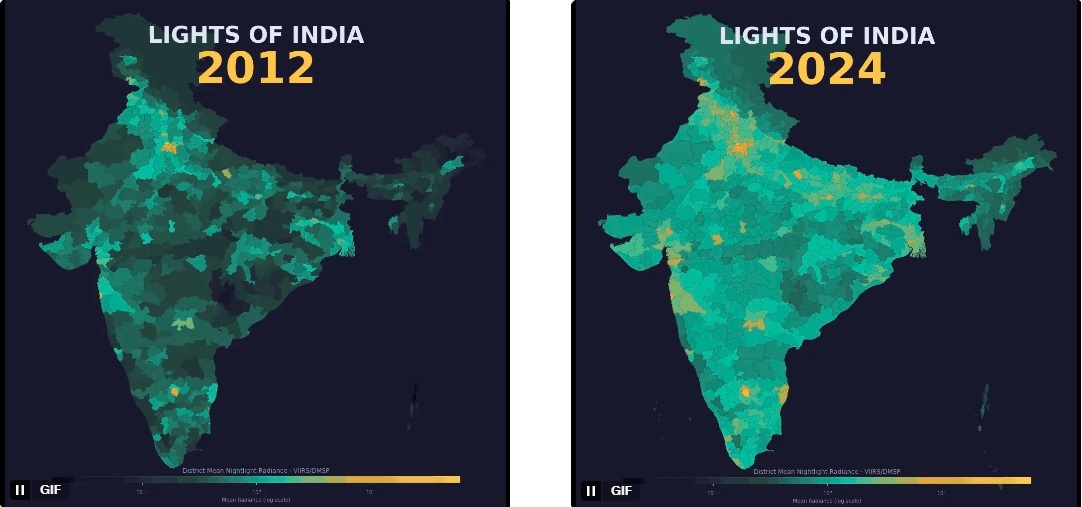
What does that title even mean, you might be asking? Well, more Indians have light, which means they have electricity, which means India is developing, which is good, and something we have repeatedly written is important for the world (not to mention Indians). Via Marginal Revolution, we saw Yashveer’s work where he analyzed data on lights in India. He found:
India literally got 2.6x brighter in 12 years. Total nighttime light output across all 641 districts grew from 1.7M to 4.5M radiance units between 2012 and 2024 — a 163% increase. The typical (median) district tripled its brightness: 0.38 to 1.16, a 203% jump.
That’s good, it’s a sign of progress. Yashveer also found the progress is reducing inequality. “India’s light inequality is falling — fast The coefficient of variation (spread between bright and dark districts) dropped from 3.91 to 2.47 — a 37% decline in inequality over 12 years.” He created a cool GIF showing the changes in light from 2012 to 2024. We’re not sure how to reconcile this light data with a new paper by India’s former Chief Economic Adviser that claims the country’s GDP has been overstated by roughly 22 percent. More on that paper next week. In the meantime, India needs to continue developing and maintain a robust democracy—it is crucial for our world, a world you might notice is currently in turmoil.
China Corner: Leaving on a Jet Plane
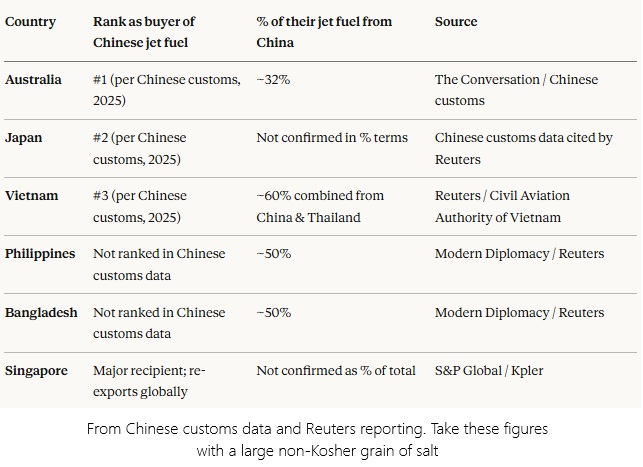
We bought group airline tickets for a project we’re involved in a month ago, just before the U.S. and Israel attacked Iran driving up oil prices. Jet fuel prices spiked shortly after the war started and we were feeling pretty smug about our purchase. Then we remembered a colleague had not bought tickets for a similar project. We emailed and told him to buy quickly. Of course, we’re not the only ones in such a predicament, others are in much stickier situations. Vietnam and other Asian nations are rationing oil usage since they are dependent on the Middle East. We knew that but didn’t realize how many of these countries import their jet fuel from China. It turns out that China, although it imports the overwhelming majority of its oil, is a large refiner. The core driver of China’s emergence as a fuel exporter is a massive, government-directed overexpansion of refining capacity that outran domestic demand. China has gone from being a net fuel importer to one of the world’s top ten refined product exporters, with total gasoline and jet fuel exports rising 277% between 2012 and 2018. So it exports the excess jet fuel. But now that there is a crisis, it is cutting off exports, which is a problem for Vietnam and other countries. In fact, if the Iranian war continues on its current path, we expect the largest political and economic turmoil to erupt in southeast Asia. We watched Hamnet last week and wonder the words of Claudius, “When sorrows come, they come not single spies, but in battalions.”