We are uncomfortably optimistic. Today the Seattle Mariners—one of the most woebegone, ill-fated, unsuccessful sports franchises in all of human history (Red Sox fans in 2003 thanked the ghost of Babe Ruth they weren’t Mariners fans, Cubs fans in 2016 would rather eat goat meat than don the blue and teal)—open their 50th season. They do so with the experts predicting they will win the division, with many of them even asserting the team will finally—for the first time!—make it to the World Series. Yesterday, we read The Ringer’s Preseason Power Rankings, which started at number 30 and worked to number one. As we scrolled through the article, eventually reaching the top ten, we became more and more uneasy—the Mariners were not yet mentioned. We got to number five and still no Mariners. Finally, we arrived at their entry: number two, only behind the powerful and reviled Los Angeles Dodgers.
We do not like it. At all. Not because we think they should be ranked number one, but rather because everyone believing this is the Mariners’ year means either it most certainly isn’t and they won’t even make the playoffs, or this is a harbinger of the apocalypse. In fact, having been a Mariners fan since the team’s inception, we can easily envision the Mariners winning the division, sweeping the first round of the playoffs, being up six runs in game seven of the American League Championship Series, looking up from our seat at T-Mobile Park to the sky, and seeing a fleet of incoming nuclear missiles, or the eruption of an underground volcano or perhaps even some large dragon-like creature that has burst forth from the underworld and our dying words will be, “Noooooooo, we’re about to go to the World Series!!!!!!” So, although we are severely uncomfortably optimistic—like the happiest man in the world with hemorrhoids–we comfortably reveal the Iran war’s damage to helium, dangle another Argentina comparison, and ask an uncomfortable question about China’s share of global GDP. It’s this week’s International Need to Know, the automated balls-and-strike challenge system for international information, the Moneyball of global data.
Without further ado, here’s what you need to know.
In a Deep Voice: Helium and Iran
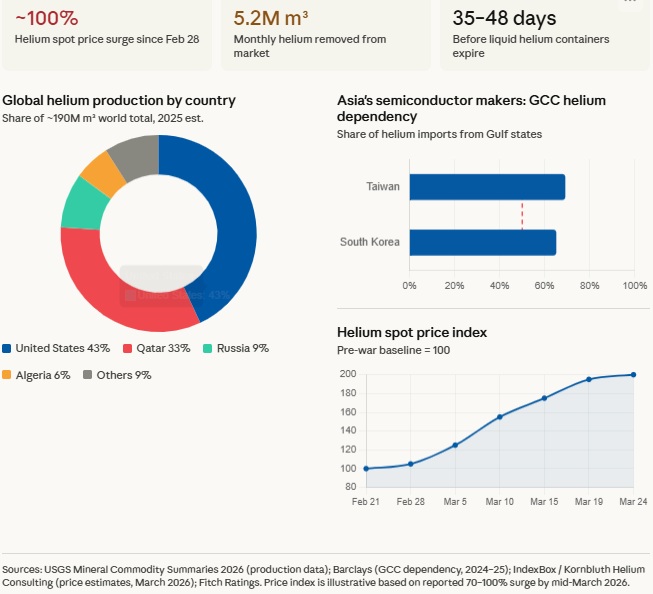
The U.S.-Israel war against Iran comes for us all in the end, including children’s birthday parties. The culprit is helium. Yes, the stuff in party balloons. It turns out helium is also indispensable to modern industrial civilization. Chipmakers use it to cool silicon wafers during fabrication — blowing it across the back of the wafer to draw away heat during the etching process, where transistor structures are carved into the chip. Helium also cools the superconducting magnets inside MRI machines, purges rocket fuel tanks for companies like SpaceX and Blue Origin, and supports fiber optic manufacturing. Who knew the gas you inhaled to make high voices is so important? A challenge is that Qatar is a major producer of helium, responsible for roughly a third of the world’s helium. Helium is a byproduct of Qatar’s liquefied natural gas (LNG) processing at the Ras Laffan Industrial City — the world’s largest LNG export facility. That facility was struck by an Iranian drone early in the war and is offline. Since mid-March, the global market has been short approximately 5.2 million cubic meters of helium per month. Spot prices have doubled. South Korean manufacturers sourced 55 percent of their helium from Gulf Corporation Council countries in 2025. Taiwan’s chipmakers sourced 69 percent from the same region in 2024. The U.S. is also a major producer of helium but like oil, helium is a global market. Party balloons and semiconductor chips will become more expensive the longer the war continues. Six-year-olds in party hats won’t be the only ones crying.
Addendum: We don’t mean to ignore oil, but many others are already writing about it. We will say with the Philippines declaring a national energy emergency, Vietnam Airlines canceling flights over lack of jet fuel and long lines at gas stations in India, America might soon be seen as a pariah nation.
Cry for me Argentina Part VII
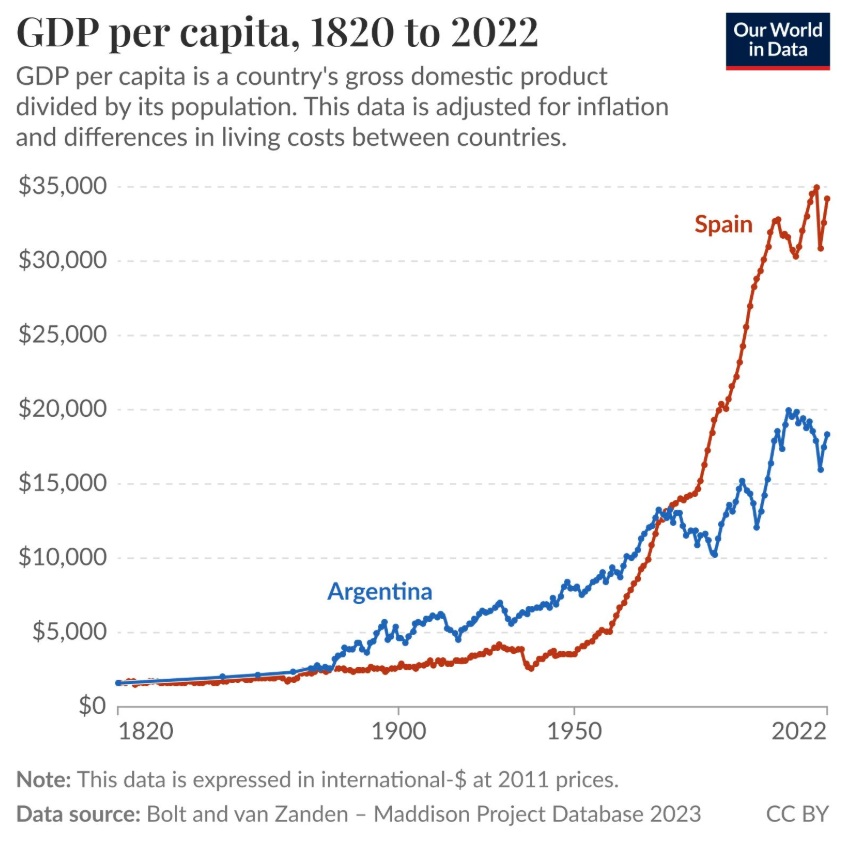
We do not say we are obsessed about worrying the U.S. could follow early 20th century Argentina’s path to economic dormancy–it’s not like Hitchcock or Melville are about to concoct a story about us–but we will admit to raising the subject more than once both here and in our weekly Trump Law-Breaking and Corruption Tracker. We do so again now but it’s not our fault. It’s those darn people at Our World in Data who have posted a comparison of Spain and Argentina. As you can see in their chart below, for the first half of the 20th century, Argentina’s GDP per capita was higher than Spain’s. But in the 1920s, Argentina started electing populists, raising tariffs and turning inwards, and thus its economic growth turned ugly. As the Our World in Data author writes, “Today, Argentina’s GDP per capita is closer to my home country of Colombia than to Western European countries like Spain. This helps us see how much of a difference economic growth can make within just a few generations.” Argentina’s economic downfall didn’t happen overnight. It was like a long Seattle winter, the drip, drip, drip of rain, the drop, drop, drop of wrong-headed policies.
China Corner: GDP Share Increasing or Decreasing?
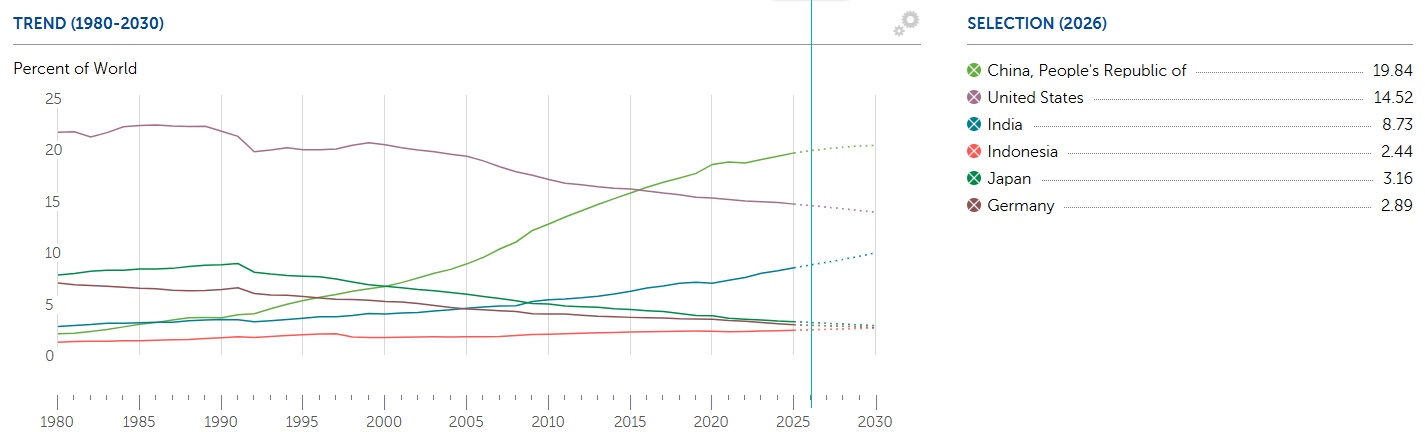
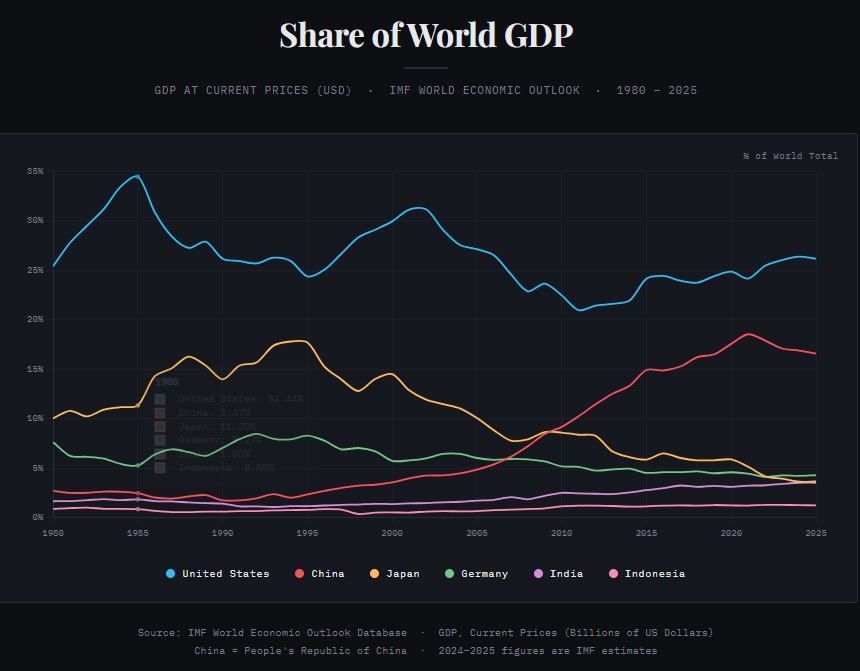
On Twitter (What? Did it change its name?) last week Yangzhong Huang at the Council on Foreign Relations posted a chart showing China’s share of global GDP has decreased since 2021. We were surprised by this and investigated further. It is true when measuring in current prices that China’s share of global GDP has decreased but that is partly a function of currency depreciation, which also helps explain China’s increasing exports. If one measures using purchasing power parity GDP (adjusting for countries’ different costs of living), China’s share of global GDP continues to increase as you can see in the second chart below. You will also see India’s share is increasing too and since 2020 at a faster pace than China’s. You can see in the first chart that when measuring by current prices, while China’s share is indeed decreasing, India’s is rising. Of the 30 largest economies, 17 countries have seen their share of global GDP increase when measuring by current prices. When measuring using PPP data, only ten of the top 30 economies have seen their share of GDP increase. So it’s all a bit more complicated than Huang asserted on that social media platform.