We pulled up to our house just as the mail truck pulled up in front of our mailbox. We waited in our car for the postal worker to finish filling up the box with the flotsam and jetsam of modern-day snail mail. As she drove towards the next set of mailboxes a few yards down the street, not even far enough for a first down, we walked to our mailbox and pulled out an ad and a letter addressed to—the same house number but one street over. This is not an uncommon occurrence. Although we have much respect for the U.S. Postal Service, we have to admit that our postal worker is less accurate than a Major League Baseball umpire. In addition, there are many days when we are supposed to get mail but none is delivered—we assume our mail carrier had better things to do that day. Regardless, we looked up from the misdelivered letter and saw the little postal truck was still at the next mailbox up the street so we jogged over there and tried to hand the letter back to the postal worker in the truck—which completely startled her and she screamed at the top of her lungs.
Before we could say anything, including apologize for startling her, she ranted at us, saying, among other things, “Why the f*** would you run up to my truck?” She screamed some more, dropping a variety of other f-bombs and repeated the question. To which we answered in a very pleasant voice, “why the f*** would you misdeliver this letter?” and again handed her the letter, which to her credit, she grabbed and put onto her lap. She was still yelling as we walked back to our house and we have no confidence whatsoever that the poor resident one block over with the same house number will ever see that letter. And we presume there is a good chance we never see a letter, bill, advertisement, political flyer or any other piece of mail again. But neither snow, nor rain, nor heat, nor gloom of night, nor startled, angry postal workers prevent us from delivering news about Trump’s global food fight, the Iran war’s silver lining or China’s erasing a language. It’s this week’s International Need to Know, saying just the right thing about international information, dropping f-bombs of global data.
Without further ado, here’s what you need to know.
Trump’s Global Food Fight
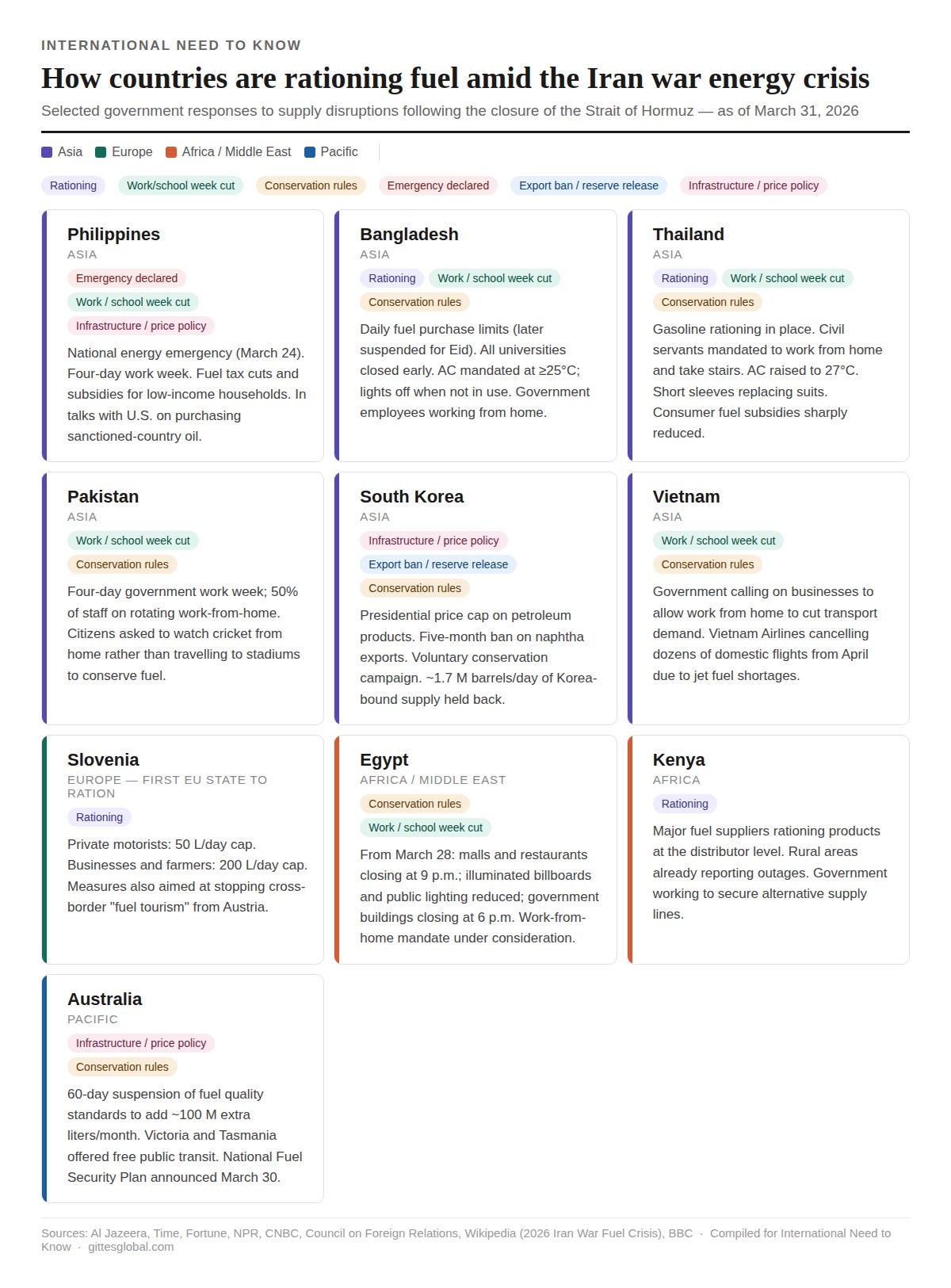
Our freshman year in college, word got out there was going to be a food fight at dinner that night in the Baxter Hall cafeteria. In line to get food, everyone piled their plates as high as possible with Sloppy Joes, Salisbury Steak, shepherd’s pie and other assorted vittles. Students took their seats and then suddenly someone turned off the lights. In the darkness one could hear food flying everywhere, the clattering of dishes and general bedlam and turmoil. When the lights came back on, it was a scene of utter mayhem and destruction. Spaghetti stuck to walls, gelatinous masses plastered people’s faces, gravy lodged in unfortunate crevices. The cafeteria was essentially in ruins. The United States and Israel have created the geopolitical equivalent of Baxter Hall. You can see a sampling of the mayhem this war has caused so far in the table below. Trump on Wednesday said the war will soon be over, which if our Excel spreadsheet is accurate, is the two thousand, five hundred and fifty-seventh time he has said some variation of that statement in the last five weeks. And now he says it’s up to the rest of the world to open up the Strait of Hormuz. The rest of the world is the poor, unfortunate janitors and student workers of Baxter Hall. Trump is the most unlikeable student in the history of college food fights.
Solar Silver Linings
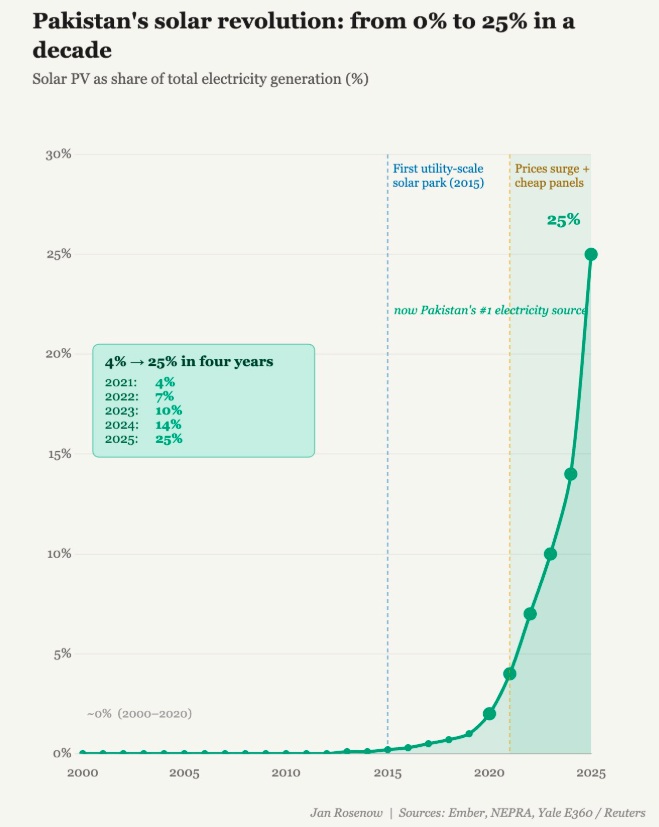
As we’ve chronicled, including this week above, there are many negative second-order effects from the U.S.-Israel war against Iran. But even in the most foolish escapades, there are silver linings, and that is true with this war as well. The spike in oil prices will impel countries to accelerate their installation of solar power. This was going to happen anyway as solar became competitive with and often cheaper than fossil fuels for generating energy, powering vehicles and for other applications, but the increase in the price of oil and instability of oil markets wrought by this war is a kick in the wallet to move even faster. Pakistan, which has tried to broker a peace deal, has seen solar’s share of electricity generation increase from four percent five years ago to 25 percent today. That wasn’t driven by government policy or concern about climate change, it was driven by Pakistan’s inefficient and bureaucratic electricity grid. Pakistani consumers have agency and they began installing rooftop solar. The world will be doing even more of that in the coming years. Consumers around the globe will buy electric vehicles to protect themselves from gas prices, install solar panels and generally turn away from fossil fuels. In the short term, unfortunately, in the face of crisis, some countries will burn more coal. But in the mid-to-long term, this war will accelerate the solar revolution.
China Corner: How To Erase a Language
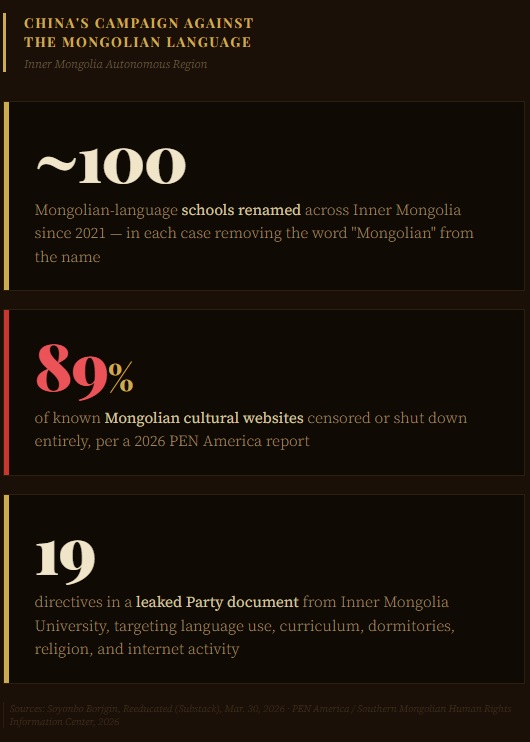
We often hear about China’s suppression of minority cultures in broad strokes. A leaked internal document from Inner Mongolia University shows us the bureaucratic machinery up close. Soyonbo Borjgin, a Southern Mongolian journalist now based in New York who writes the Substack Reeducated, obtained and published a 16-page internal Party directive dated December 31, 2021, stamped “Internal Document — Strictly Prohibited from External Distribution.” In 19 numbered directives, it instructs how to systematically remove the Mongolian language from, as Borjgin writes, “one of the most important centers of Mongolian scholarship in the world.” The directives cover nearly every domain of university life. Item 7 mandates that homework, thesis proposals, lab records, degree theses, exam questions, and research applications all be conducted in Mandarin — effectively ending scholarly production in Mongolian at the university’s own School of Mongolian Studies. Item 8 orders that campus signage and plaques conform as well, and that anything failing to comply “must be corrected.” Even Genghis Khan is not spared. A statue of the conqueror on campus, which bore his name in traditional Mongolian script for decades, had that inscription removed in 2022. This was not an isolated directive. It followed the September 2020 order replacing Mongolian instruction with Mandarin textbooks, which triggered the largest regional protests in decades. The authorities crushed the movement through surveillance and arrest. Document No. 43 translated that campaign into enforceable institutional orders, with every administrator’s promotion tied to compliance. How to erase a language in 19 steps.