We’ve never taken heroin but we can’t imagine it would be more exhilarating than what it felt like earlier this week when for the first time in months we were able to put on and take off a t-shirt without pain. Our physical therapy is paying dividends. We must note, however, that earlier this month, our physical therapist, after doing a thorough check-up, said, “you have a fascinating body.” If our physical therapist was a woman perhaps this might have been an exciting thing to hear. Or, if they were gay, we might have been able to take it as some sort of a compliment. But this physical therapist is a heterosexual happily married male so when he said that our body is fascinating, the comment only emanated negative connotations. Before we could ask what he meant exactly by we have a fascinating body, he had moved onto other tests, talking to himself as he moved our legs or arms or tested various body parts—like we were a used car or an old boat. In fact, it would be better if we were because then it would be far easier to swap out a part. We can think of any number of body parts that could be swapped out for newer versions.
At one point our physical therapist felt our ribs and in the interest of science and medicine we had to admit that we are missing one. Yes, we are one rib short. When we were younger, we would often make the obvious joke that we are responsible for the creation of women, but still jittery from the “fascinating” description, we kept quiet. We should note that he is a structural physical therapist—a sort of mechanic for the body. We’ve had good luck with such physical therapists in the past and the pain-free t-shirt donning and doffing gives us hope for this one too. We like to think of ourselves as a physical therapist to the world, which right now is definitely fascinating, and like our body, we don’t mean it as a compliment. But fascinating it is, including the latest theory on why fertility rates are falling, the continued mess in the Gulf, and a fascinating Chinese book list. It’s this week’s International Need to Know, like Victor Wembanyama, dominating in the middle and from the outside on global data and information.
Without further ado, here’s what you need to know.
Fertility Phone Home
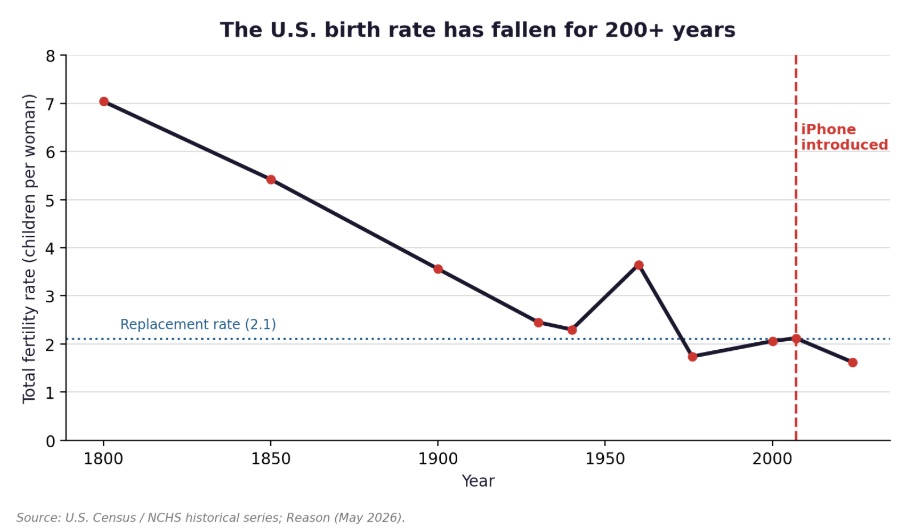
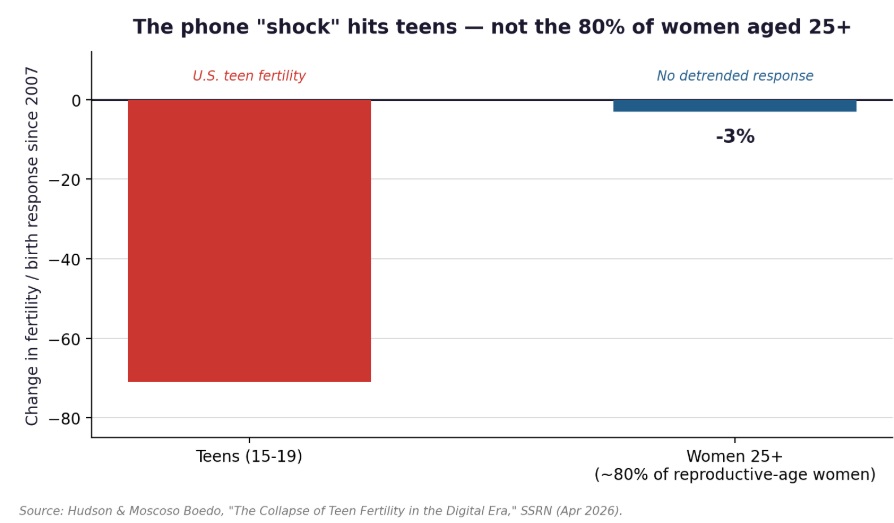
For some people it’s the phones. It’s always the phones. They believe smart phones have ruined humanity, including, now, blaming them for lower fertility rates. University of Cincinnati economists Nathan Hudson and Hernan Moscoso Boedo find that in the United States, variation in broadband and 4G coverage identifies a causal effect on teen fertility, with in-person socializing roughly halving while digital leisure roughly tripled. Americans aren’t having kids, the argument goes, because they spend all their time alone on their phones. The Financial Times’ John Burn-Murdoch then took it global, noting that birth-rate breakpoints line up country by country with the mass arrival of the smartphone. But others point to the first chart below showing American fertility has been falling since roughly 1800 — from 7.04 children per woman to 3.56 by 1900, long before anyone livestreamed anything. It even rose during the 1960s baby boom. Whatever phones are doing, they joined a trend already two centuries deep. Also, although fertility fell in countries as they adopted smart phones, these were also countries packed with other factors—such as living density, increased wealth, and high education levels—that track with lower fertility. The Cincinnati study itself is narrow in its assertions, claiming the smartphone shock is affecting only teens — the entire 25+ population, roughly 80 percent of reproductive-age women, shows no effect. Thus far the evidence points to phones affecting teen pregnancy, not all ages fertility rates. Meanwhile, Economist Jesús Fernández-Villaverde argues phones are just one part of various modernity factors that cause fertility rates to fall. The cost of having babies outweighs the benefits for more people. We used to write a lot about fertility rates and aging demographics in INTN but less so now that everyone else writes about them. But along with AI, aging demographics caused by the fall in fertility rates is likely to be the most impactful trend for humanity’s future. So get off your phone and study it—but maybe don’t read studies on your phone, we’re not sure
Oil in a Jar
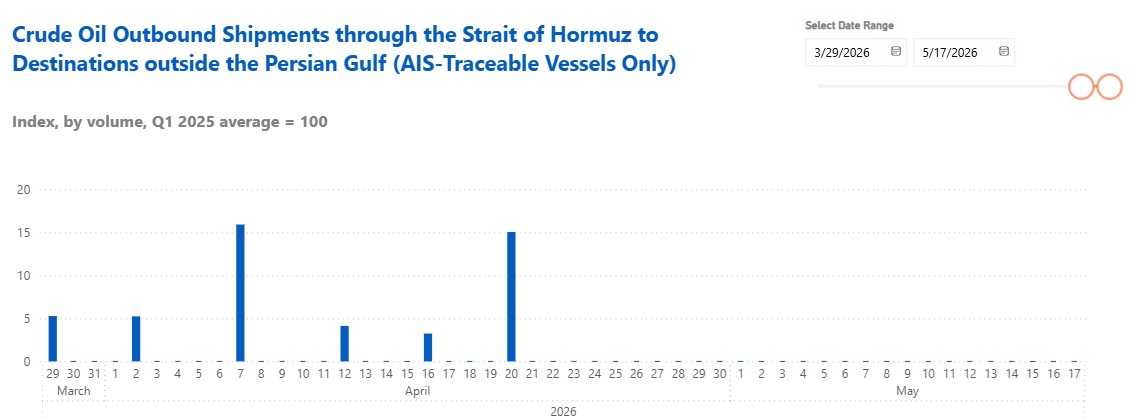
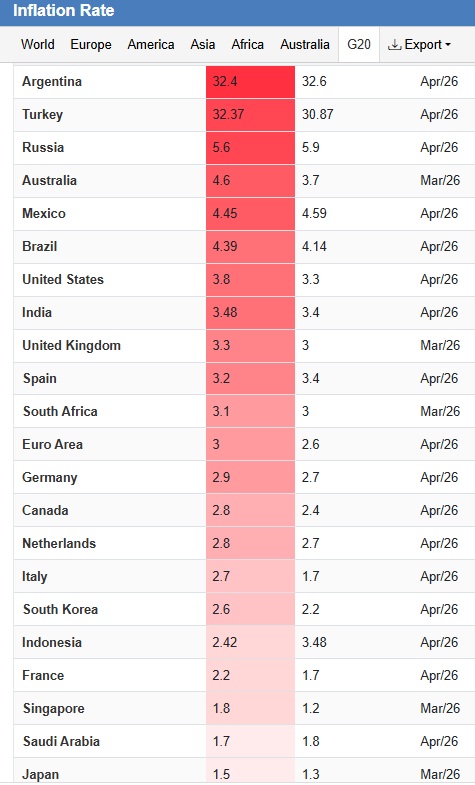
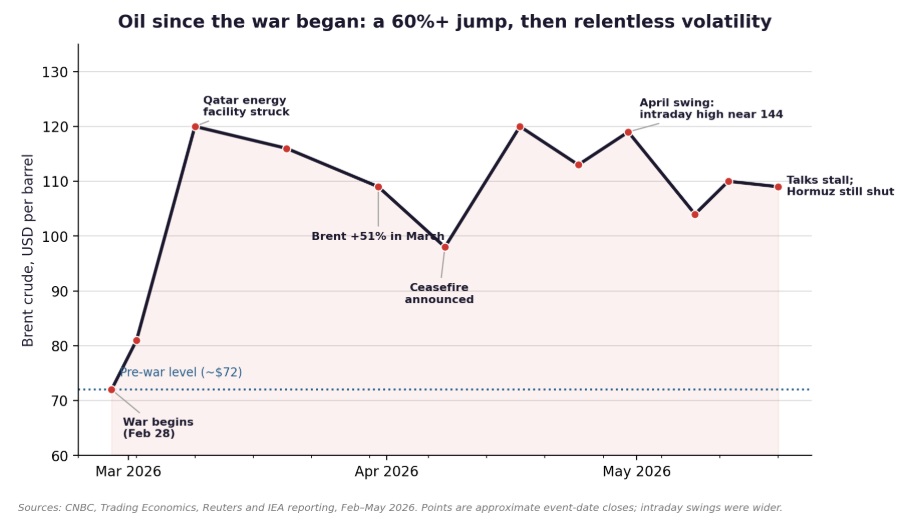
As you can see in the first chart below from the WTO Hormuz Tracker, oil and other goods are still not flowing through the Strait of Hormuz. America is a bit like a bear which sticks its head in a jar of honey and can’t get it off. We warned at the beginning of the war about the possible dire consequences to the global economy. While parts of the world are facing real problems, the global economy thus far is more resilient than some of us anticipated. That’s partly because oil, while still important, is not as important as it used to be. A Deloitte economist notes, “…the world uses 60 percent less oil per dollar of real gross domestic product than in the 1970s.” But the war is having an effect on the global economy, even if it did not devastate it. Inflation is up around the world (including in America) as you can see in the second chart. Oil shortages continue to affect countries, especially in Asia. Flying has become far more expensive due to the war. Since Trump returned from China, jar still firmly affixed to his head, he continues to send chaotic messaging about the war. The ceasefire holds but he threatens bombs will soon ensue, then backs away from doing so, then holds meetings on what to do next. Honey never tasted so sour.
China Corner: Complicated Book Lists
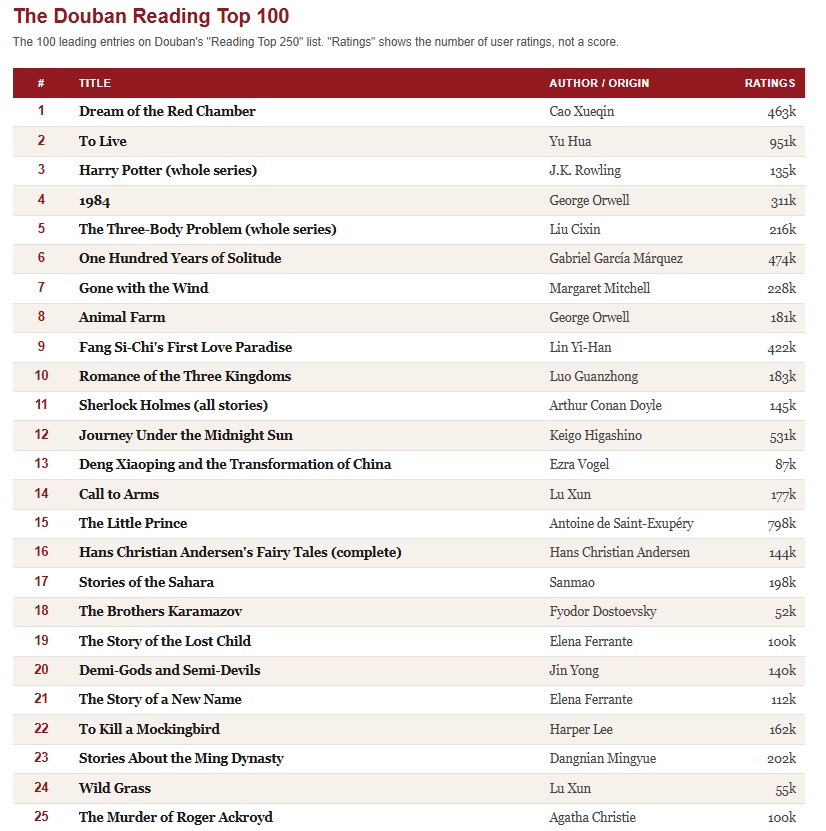
Recently we keep seeing lists of the greatest novels of all time, including one by the Guardian. Since none of them include Munsrat Lives, we ignore them. However, we are interested in a list of the “highest rated” books on Douban that Ella Dorn, a columnist for The New Statesman, posted. Douban, launched in 2005, is one of China’s largest cultural review platforms, where roughly 200 million registered users rate and discuss books, films, and music. Its book section is often described as the Chinese equivalent of Goodreads. The list below is from Douban’s “Reading Top 250,” generated by an algorithm that weighs both each book’s user ratings and the number of people who have read it — so it reflects popularity as much as pure score, rather than being a strict ranking of the highest-rated titles. It’s a fascinating and surprising list. Sure there are Chinese classics at the top such as Dream of the Red Chamber and To Live. And we suppose the Harry Potter books are inevitable. But we’re surprised the censors (who, yes, are on Douban like everything else) allowed 1984 to be ranked number 4. In fact, Orwell also scored with Animal Farm at number 8. But, wait, what’s that at number 7? Gone With the Wind? We have many interpretations for why that ranks so high, but frankly you won’t give a damn. Douban, we are told, is representative of China’s young intellectual class. We feel one could write a whole book, perhaps even a novel, about what books are deemed great in China.