We were in Arkansas two weekends ago for our niece’s wedding. We flew into Little Rock via Atlanta (thanks Delta for re-routing us so we had to fly two hours past Little Rock). From there we drove an hour west to Hot Springs, a charming hamlet that back in the day was a Mafia hangout. The nuptials were wonderful, held in Anthony Chapel, which is primarily made of wood and glass, making it almost an extension of the surrounding Garvan Woodland Gardens. Arkansas was the only one of the 48 contiguous states we had never been to. We admit to a little suspicion of the place, our main knowledge of the state was the TV show Ozark and the good ole boys of the Clinton days. But in our brief spell there, we found it charming—the accents alone worth the price of admission—and the natural beauty stunning and unexpected.
On the way home, we were waylaid in the Little Rock Airport due to thunderstorms in Atlanta (again, we can’t thank Delta enough for unilaterally changing our route through Salt Lake City to Atlanta—just first-rate work on their part). If nothing else, it provided a chance to examine a photo of the Airport Commissioners on the wall, two of whom were women who looked like they could be the daughters of the Little Rock Nine who bravely integrated the schools in Little Rock nearly 70 years ago. Indeed, we saw the fruits of integration throughout Hot Springs, Arkansas, couples and friends of many races enjoying the spas, restaurants and amenities of the town. As always, there are multitudes of challenges in this crazy little world of ours, but there is also lots of progress. We celebrate it even as we confront the challenges. We also tentatively celebrate Morocco moving up the EV supply chain, wonder about the challenges of data centers, and then celebrate the return of our U.S. – China Index. It’s this week’s International Need to Know, preparing our Annual Seattle Mariners Temper TantrumTM, even as we explore global data and international information.
H/T to the Estey brothers for this video of Glen Hansard at the end of a show at The Moore Theatre in Seattle, busking in the street, something he often did, and which reminds us of our story of an Irish busker we will someday tell (re-tell?). It is as delightful a 2-minutes as you’ll experience today, and poignant in light of Hansard’s passing yesterday. RIP
Without further ado, here’s what you need to know.
Morocco Moves Into EV Manufacturing
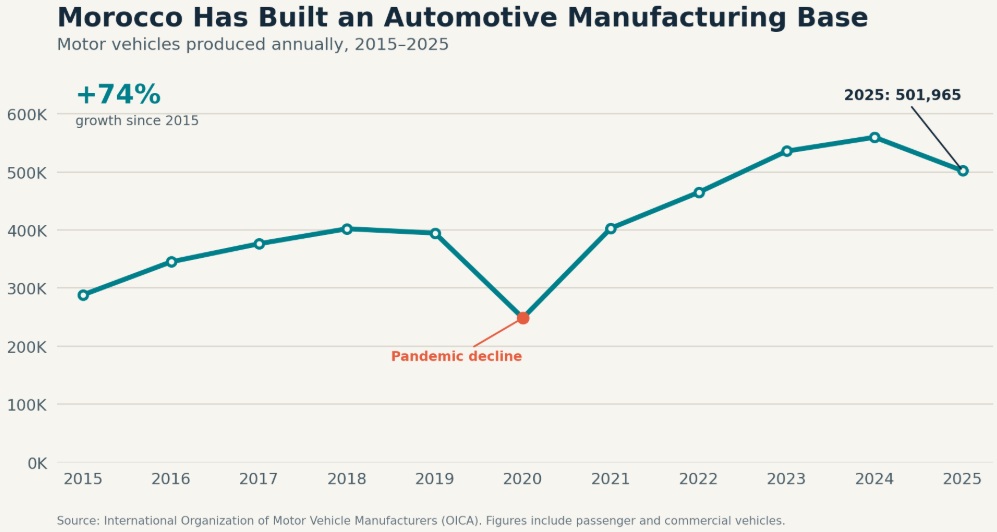
We’ve longed for some African Lions akin to the Asian Tigers of yesteryear. Countries in Africa that fully develop going through the manufacturing/supply chain phase. Perhaps Morocco might achieve this as it increasingly has good ports and is assembling autos—with China’s help. The African Development Bank has approved a $114 million loan to help finance what will be Africa’s first integrated electric-vehicle battery gigafactory. The $1.3 billion first phase, being built by China’s Gotion High-Tech near Kenitra, will initially produce 20 gigawatt-hours of batteries annually, with plans to eventually reach 100. It will make lithium-iron-phosphate batteries as well as cathodes and anodes—the higher-value components that Africa usually imports. Most of the output will be exported to Europe. Morocco is not new to car manufacturing, it already produces more than 500,000 vehicles a year, up 74 percent since 2015. Renault and Stellantis operate major plants there, and automotive exports reached a record $17 billion in 2024. A Stellantis expansion is expected to help push Morocco’s annual vehicle-production capacity above one million. Morocco’s advantages include ports, proximity to Europe, preferential access to European markets, a free-trade agreement with the United States and an established network of automotive suppliers. Chinese battery companies get a bridge into European markets; Europe gets a nearby alternative to producing everything in China; and Morocco gets more of the value. We examined Morocco a few years ago for a potential client. We’re glad to see things continue to progress there.
Data on Data Centers
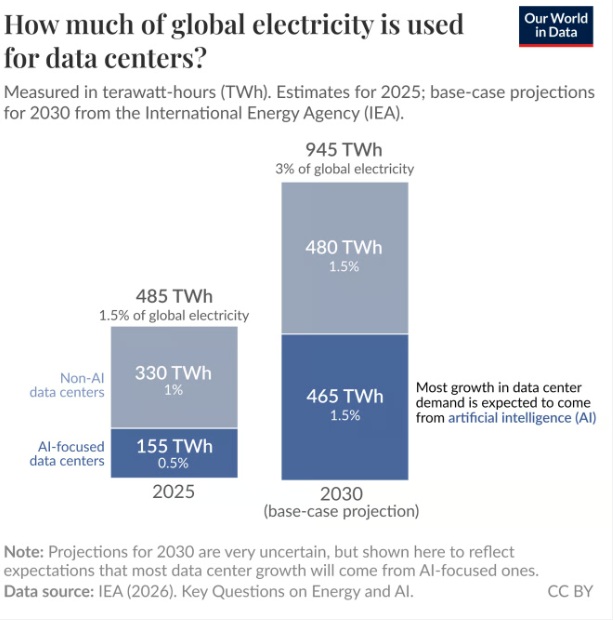
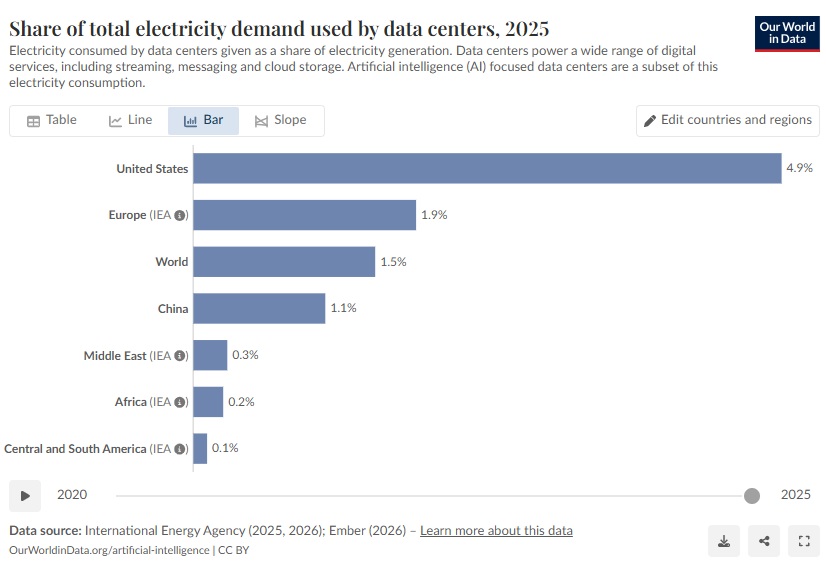
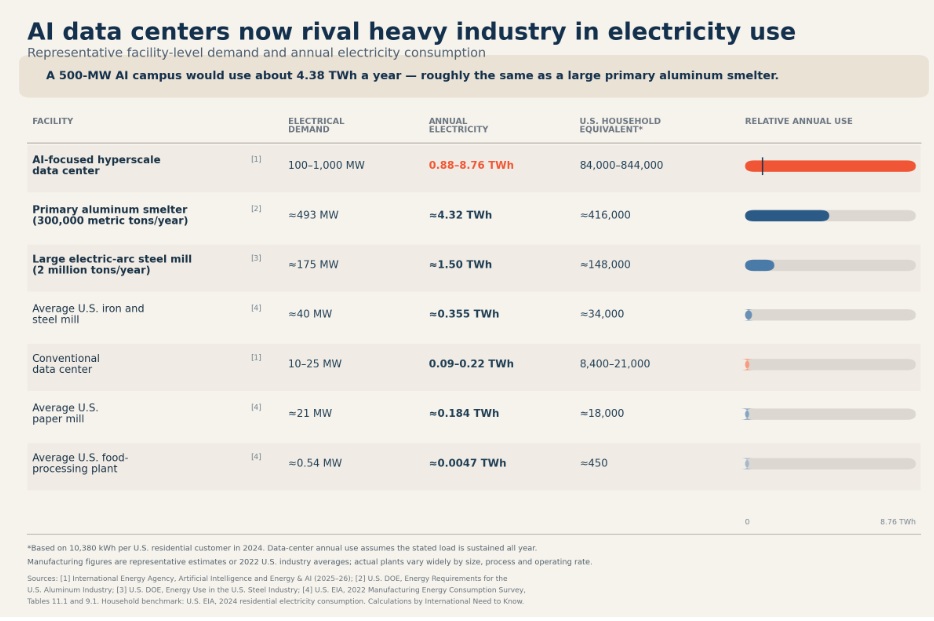
We are old enough to remember people saying data is the new oil.* So does that mean data centers are oil wells? And do they damage the environment like oil wells? Our World in Data (OWID) has an article about data centers. First, OWID defines what data center electricity consumption it’s measuring: “It’s the electricity consumed for both training and running the models (called “inference”).” It then points to International Energy Agency (IEA) data that data centers consumed around 485 terawatt-hours in 2025, which is about 1.5 percent of the world’s electricity generation. This is including all data centers, not just those devoted to AI. Below you can see OWID’s chart for all data centers and AI data centers for 2025 and projected for 2030. The next chart shows that the U.S. leads in the share of electricity consumed by data centers. In the third chart, that we created with AI research help, but which squares with what we’ve seen elsewhere, you can see that data centers consume less electricity than aluminum smelters, steel mills, and even paper mills. An AI-focused hyperscale data center, however, does consume more electricity than these other factories. To our minds, we should be focusing more on building solar, batteries and new generation nuclear to allow us to do all sorts of cool things, including powering data centers for new intelligence. The worry about data centers, here in the United States and elsewhere, is a symptom of our ongoing lack of ambition, rather than a worry about the environment.
*The smart-aleck in the back is wrong that we’re old enough to remember people saying oil is the new oil. There will be blood for that heckler.
China Corner: New U.S. – China Index
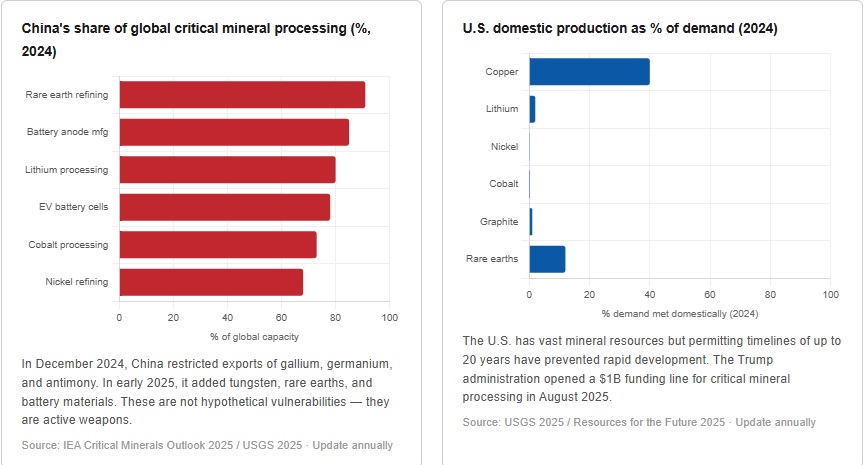
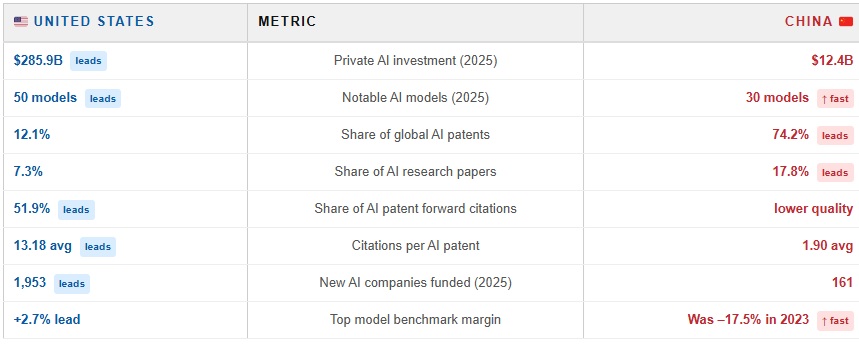
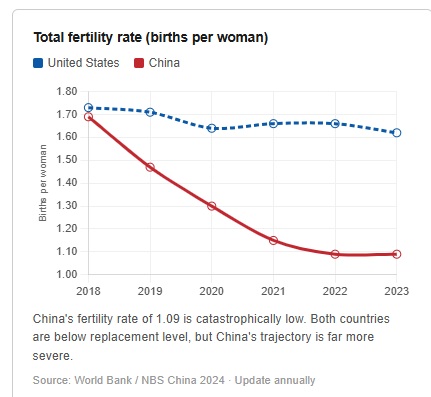
When our book Challenging China came out, we created a U.S.-China Index on our website. The idea was to quantitatively track the competition between the U.S. and China. Unfortunately, it was difficult to keep updated. And then Trump was elected to a second term and the competition grew even more complicated. Plus, we were never satisfied with the measurements in the Index, so we let it lapse. But we have found a way to use AI to make updating the Index easier. And it allows us to scrape additional data more quickly so we can put more, better measurements into the Index. This is all to say that the U.S. – China Index is back! Check it out. It now consists of 11 categories, seven of which are new. For example, we now have a Critical Minerals section with two measurements. We have an AI category, of course, which includes an easy-to-read scorecard of a variety of AI measurements (see below). We are hoping to add an AI measurement on monthly benchmarks but are still figuring out which ones to use (send us suggestions). We continue to maintain old categories such as demographics with charts on fertility rates and other measurements (see chart below). Check out the whole shebang. And provide us feedback on the format, additional measurements you would like to see included and other suggestions. Some of the data will be updated monthly, some quarterly and some annually. Our hope is it will be a useful tool. These are the two most important, powerful countries in the world with lots of assets and lots of challenges. It behooves us to keep a close eye on them.