As we leaned back against the open window of the Canal Streetcar Line in New Orleans, we felt a hand on our shoulder and a voice saying to the International Need to Know spouse and me, “You two look so great.” We are accustomed to our wife receiving such compliments, but rarely are we included. But that day we had donned our seersucker jacket, dark pants, white shirt, yellow tie and white pocket square and we looked, as the streetcar driver said to us as we exited a few stops later, “incredibly dapper.” Indeed, as we descended the escalator in the hotel earlier that day, hotel employees greeted us with a smile and a how-do-you-do, which did not occur other mornings. We believe that seersucker jacket bestowed certain superpowers upon us, at least in New Orleans. We had a wonderful experience there last week, as we always do, seeing soul-enriching music, eating delicious food and imbibing the friendly laid-back culture like refugees from a careworn world. One afternoon, a cab driver originally from Santa Monica complained to us that people in New Orleans are lazy. But that’s not quite right. No people work harder at having fun, as we saw Saturday morning when the Krewe of Femme Fatale invaded a conference room in our hotel for a fundraiser, dressed to the nines in striking red dresses, grooving to the brass band, even on a 90-degree-plus day. New Orleanians are not lazy, but they know how to relax and how to have a good time. Years ago, on another trip, we asked a guy who had lived all over the place, including working for a large company in Seattle, why he had moved back to New Orleans. He said, “people just don’t know how to relax elsewhere.”
Our New Orleans trip relaxed us after just having returned from a work trip to Vietnam. On a trip to Vietnam last year, we had the seersucker jacket made, expressly so we could wear it on our next dining experience at Commander’s Palace, a New Orleans restaurant, nay a Shangri-La of hospitality, an oasis of epicurean delights. There, too, we felt our superpowers even as we sipped gumbo, munched on redfish and shared not one, not two, but three desserts with the INTN wife, as we celebrated our anniversary. We celebrate you, dear reader, asking why Vietnam is still so important, examining its electronics manufacturing and casting a skeptical eye on the possibility of an AI agreement with China. It’s this week’s International Need to Know providing beignets of international information, mixing Pimm’s Cups of global data.
The great and wondrous Zane, our 91-year-old Mom’s cat, who we wrote about in May upon his 21st birthday, succumbed to old age on Tuesday. He ruled the assisted living facility where our Mom lives, demanding pets and treats from all staff and visitors. He is missed by all who came into his presence. RIP

Without further ado, here’s what you need to know.
Still One of Seven Most Important Countries
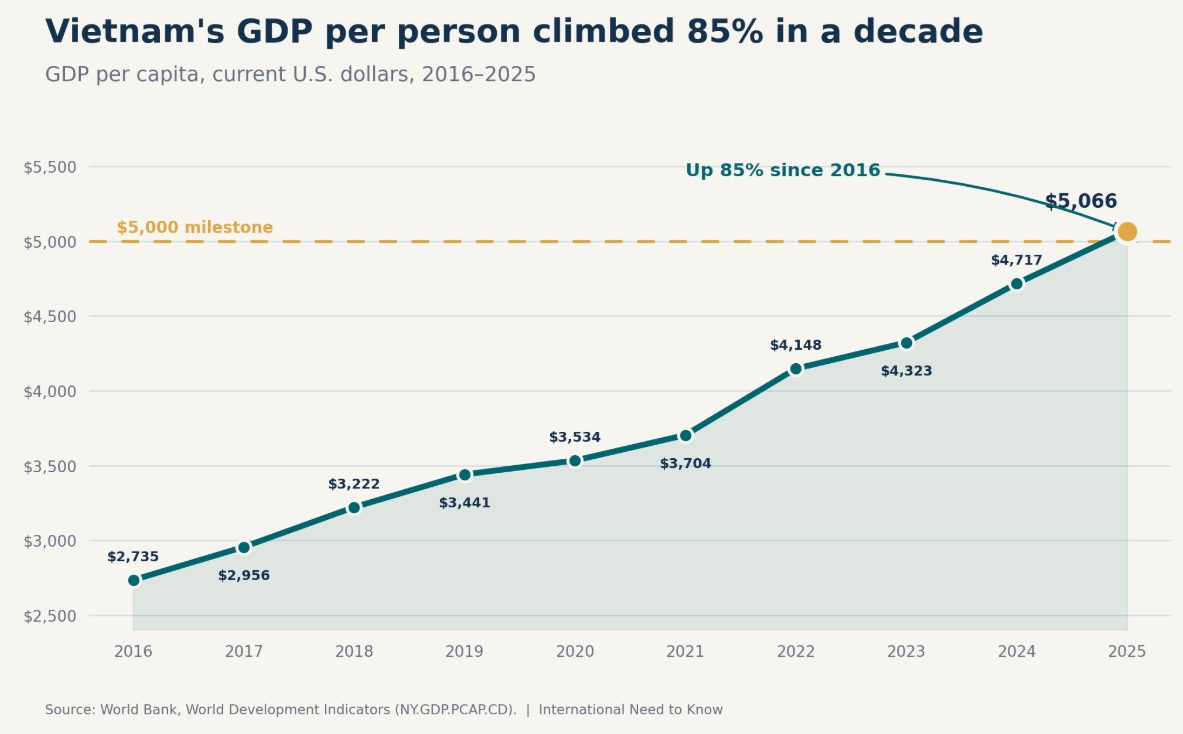
When we first traveled to Vietnam over 20 years ago, we saw lots of rice paddies, very few cars and not much infrastructure. City streets were scooter mayhem. They dashed and swerved everywhere. Lanes did not exist, nor did crosswalks. We saw many accidents and after one of them observed an informal street trial regarding who was at fault. Vietnam has changed tremendously since we first started traveling there but it continues to be one of the seven most important countries in the world. Vietnam, if it continues to develop economically, can follow the path of Taiwan, South Korea and other countries and liberalize politically. Or it can follow the new path of China and become more authoritarian even as it grows economically. Tô Lâm, the newish General Secretary and President of Vietnam, has consolidated power and engaged in corruption crackdowns a la Xi Jinping. And yet, Vietnam remains far freer than China. We can access most websites in Vietnam and there is not the all-pervasive surveillance in Vietnam that exists in China. But perhaps that is because Vietnam does not have the technology to do so. Vietnam’s GDP per capita is now above $5000, an economic threshold when Taiwan began to democratize and South Korea started to consolidate its young democracy. The rest of this decade will tell a lot about Vietnam, and about our world’s future.
Electronics for the Win
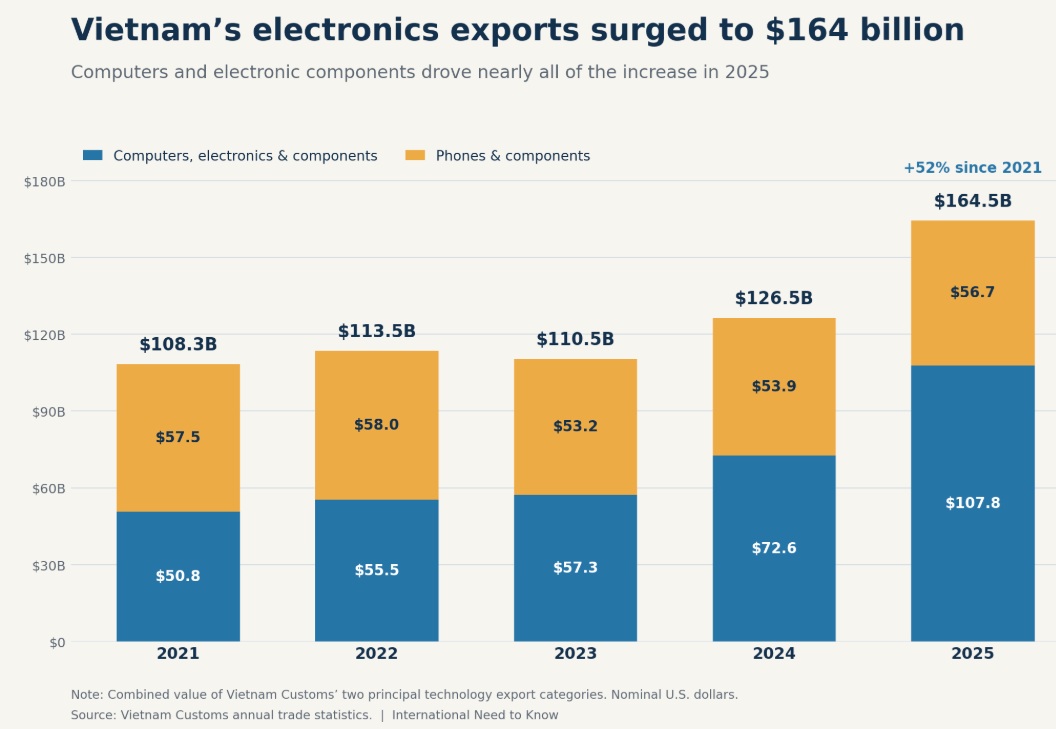
Our trip to Vietnam was to the south—Ho Chi Minh City and its environs. But a lot of the electronics manufacturing is centered in the north, around Hanoi and Haiphong. Vietnam has seen a 54 percent increase in its electronics exports this decade as you can see in the chart below. Much of this is final assembly. About 80 percent of the value of Vietnamese electronics exports consists of imported components. China probably accounts for around one-third of the value of those components. South Korea is a big part of the rest. The usual path is for a country to start off in final assembly and then gradually start to make the components. If Vietnam is going to get to high income status, like Taiwan and South Korea did (China is almost there), it will need to continue to move up the value chain. But China continues to want to be the factory for everything, including electronics. We hope to write a longer piece about how China is playing a far different role than the U.S. did for developing countries. Stay tuned!
China Corner: AI Cooperation Unlikely
Xi and Trump are meeting, perhaps even as you are reading this. One of the issues they are apparently discussing is AI. People continue to call on China and the U.S. to negotiate an AI safety agreement. That would be a good idea but don’t hold your breath. Those calling for such agreements often point to the U.S. and Soviet Union negotiating nuclear agreements. But China is not the Soviet Union and this is a far different America than the Cold War era one. The United States and China have never had a bilateral nuclear-arms-control treaty, have never agreed to limits on one another’s arsenals, and still do not have a regular strategic-stability negotiating process. The Biden administration repeatedly sought talks with China on “strategic stability” and nuclear risk reduction. China continued to resist bilateral arms-control negotiations, arguing that the much larger U.S. and Russian arsenals should be reduced first. The Biden administration continued to make proposals but China after briefly engaging walked away over U.S. arm sales to Taiwan. Perhaps China will treat AI differently from nuclear arms, after all it did agree that only humans not AI should make decisions on the use of nuclear weapons. Perhaps there will be a Reykjavik-like breakthrough this week or sometime in the future—but Xi is no Gorbachev and Trump certainly no Reagan. As we have written before, unfortunately powerful AI rises when the two most powerful countries are an authoritarian China and a chaotic America. If only AI could solve that problem.