If you want to understand why humans best-laid plans fail like a Damon Lindelof TV-show plot, step with us into the laundry room on the second floor of our Mom’s assisted living facility. There in the laundry room’s utility sink, just below a large sign with big bold text warning residents “Not to bring or leave dishes in the laundry room” is a stack at least a foot and a half high of…dirty dishes. We regret we did not take a photo of this scene–what we believe should be posted to the door of every political-economy professor’s door as a reminder of what happens when policy meets reality. We all devise complicated plans to achieve various goals, to build our pet projects, to accomplish some worthy aim. But these elaborate, intricate, well-developed plans don’t survive encountering the wonderfully crazy, obstinate, lazy, and predictably unpredictable species known as homo sapiens. No matter your best-laid plans, you will always find a stack of dirty dishes in the sink. Take, for example, our plan to get a lot of work done while commuting via light rail this week in Seattle. We found ourselves utilizing this form of transportation this week due to our car being in the shop. It meant an hour and a half commute each way, but we thought, mistakenly as it turns out, that we could be very productive working on our laptop while riding the rail. But, much to our chagrin, Seattle’s light rail system does not have Wi-Fi. Our best-laid plans faltered on the reality of idiot humans—in this case the overseers of Sound Transit, who somehow, someway believe Wi-Fi is an unnecessary accessory for today’s commuter. They essentially dumped us and our fellow commuters like a stack of dirty dishes into the sink of a transportation laundry room. But we, dear readers, provide you a full meal of stories about AI, fully human written, including dishing on what happens when robots train on real world data, the global supply chain of AI, and Chinese loving AI. It’s this week’s International Need to Know, always washing and putting away the dishes of international information and global data.
Without further ado, here’s what you need to know.
Here Come The Cylons?
Over two years ago, we speculated what would happen when robots train on real-world data rather than just the internet. Most of AI today is built on the collective information (and misinformation) of the web, which has created incredibly powerful tools. So powerful that it is freaking many people out. And there are reasons to be worried. We wrote about the danger of engineered viruses over ten years ago (not yet published, but soon), and now other people are catching up, including Noah Smith. When our world really becomes weird (and perhaps dangerous) is when AI affects the physical world. That is occurring through today’s AI’s trained on Internet data and being applied to physical world issues. It will happen even more when AI robots, who live in the physical world, are trained on real world data, which is now starting in earnest. For example, China has built more than 60 government-funded “so-called data factories where workers in VR headsets and exoskeletons wipe the same table hundreds of times a day so humanoid robots can learn from them. In the U.S., Figure AI trains its robots on video of people moving through real apartments, and the startup Physical Intelligence has robots learn from their own mistakes on the job. Ukraine’s former defense minister, for very practical reasons of national survival, wants to create an army of robots who might be trained on real-life (and death) data. We may someday enter the world of cylons, but even more likely, non-humanoid robots who have been trained on real world data will become pervasive. Then our world becomes very weird, maybe fun, and maybe dangerous.
AI Supply Chains Are Global
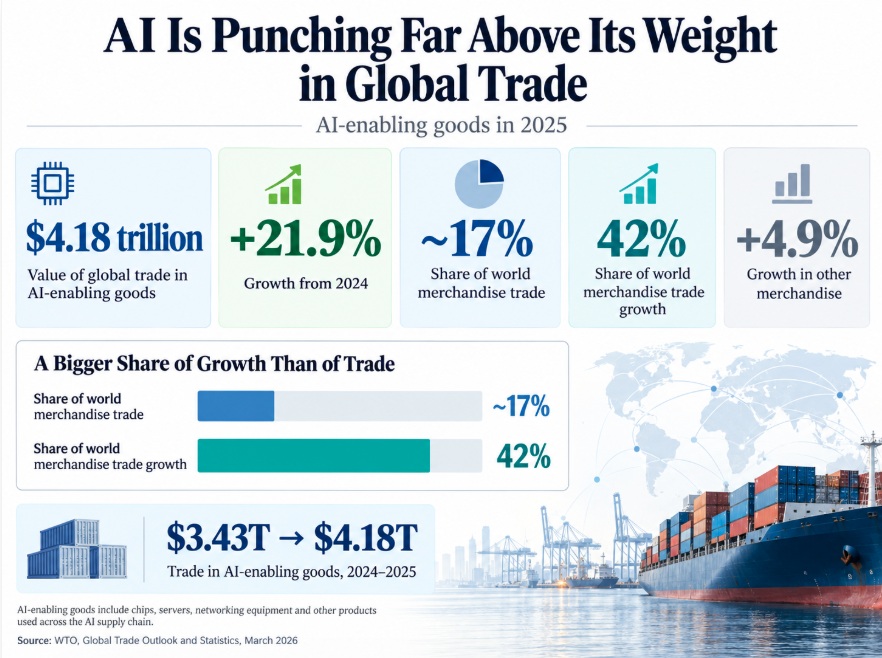
Of course, AI has already entered the physical world beyond robots. We tend to think of AI as a digital phenomenon, but even digital products are produced by a bunch of physical goods and components moving around the world. According to the World Trade Organization, trade in “AI-enabling goods” leaped 21.9 percent last year, from $3.43 trillion to $4.18 trillion. These goods accounted for only about one-sixth of world merchandise trade but generated an astounding 42 percent of its growth. What is being traded? Almost everything needed to build AI: from raw silicon and specialty gases to semiconductor-making equipment, chips, processors, servers and telecommunications equipment. Asia—optimistic Asia (see story below)–is at the center of it all, accounting for 62 percent of AI-enabling trade. Even so, the AI supply chain, like nearly all supply chains, is global. A chip is designed in one country, manufactured in another, packaged and tested in a third, installed in a server somewhere else and ultimately shipped to a data center halfway around the globe. This supply chain is expanding. The value of AI-enabling trade increased more than 40 percent year-over-year during the first quarter of 2026. People continue to besmirch trade, including and especially in the highest reaches of the U.S. government (although that same government is optimistic about AI), but globalization continues, including for the hottest new technology, with a sprawling, new international supply chain.
China Corner: McLovin’ AI
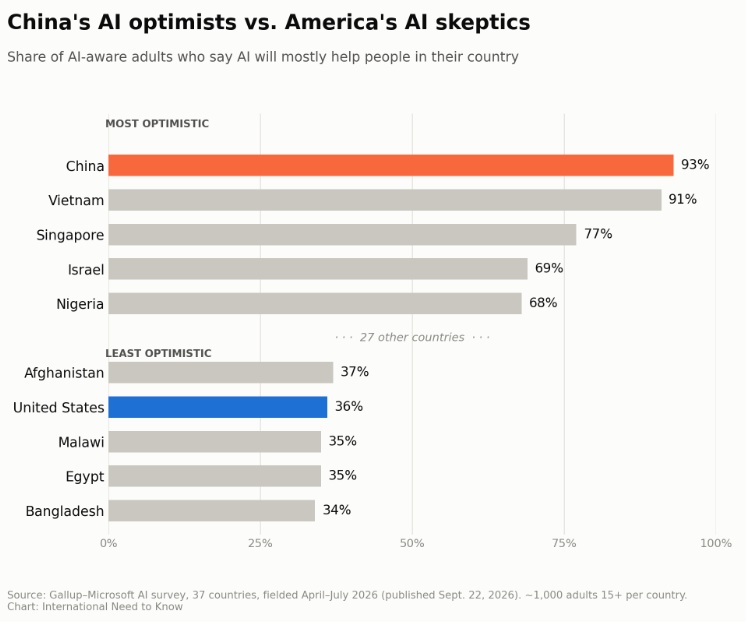
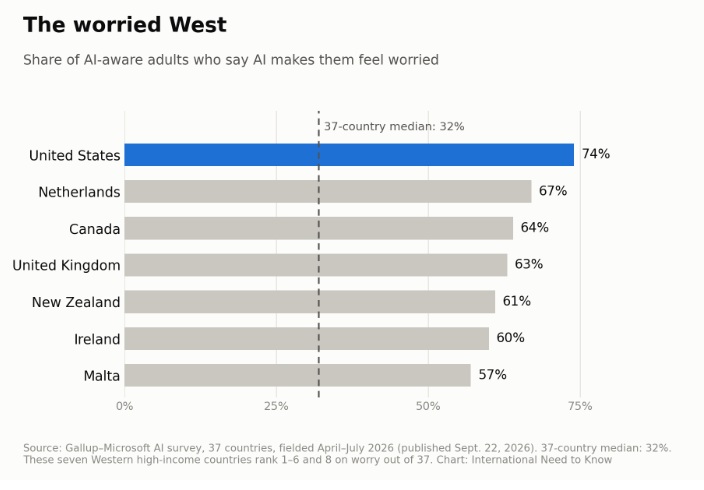
They say that it is detrimental for your well-being to hang around negative people. If that applies to countries, perhaps we need to start avoiding Bangladesh, Egypt, Afghanistan, Malawi, and the United States of America. These are the five populations who are most dubious that AI will help their countries, according to a Gallup-Microsoft global AI survey. In China, 93 percent believe AI will mostly help their country, followed by Vietnam at 91 percent, Singapore at 77 percent and Israel at 69 percent. Of course, one should always take polling in China with a grain of iodized salt since Chinese might be saying what they believe their leaders want them to say. Still, it is striking to see the optimism of Asia and the pessimism of other countries, including the leader in developing AI, the U.S. In addition to the worried countries listed above, the other countries most worried about how AI will affect their countries are the so-called “West,” including the Netherlands, Canada, the U.K., New Zealand, Ireland and Malta. The West had a good run, but its continued fear of the future is the best indicator that success in the 21st century lies elsewhere.