
We understand the advantages of being big. Large businesses, as Matthew Yglesias explains, have the advantages of economy of scale, which can benefit us all. The economist Tyler Cowen wrote an entire book about the beauty of big business (it’s his weakest book). If you want to be a NBA player you better be tall. But there are also issues of fairness and the good of the whole to consider. We get that Seattle is a much smaller city than New York, Los Angeles and Chicago. And Detroit is smaller than these places too. It’s a strange dichotomy that the Seattle Mariners are playing the Detroit Tigers.* The Motor City eroded dramatically over the years and is just now getting back up on its feet.
Meanwhile, Seattle’s leaders somehow viewed Detroit policy that led to its industrial downfall as a blueprint for success and have been following its path the last decade. Even granting all of this, we protest vehemently that Major League Baseball has scheduled Seattle and Detroit for the absolute worst times throughout the first round of the playoffs. During the week all of the games are played during the work day while the Yankees, Dodgers and Cubs get the primetime slots. It’s not fair that Seattleites have to get off work for every game. Indeed we have a crucial work event on Friday during the deciding Game 5.** So, Yankees, Dodgers and Cubs? We’re coming for you and beating you…if not this season than soon. And Major League Baseball and its chief weasel, Rob Manfred? You can go to hell. But with objective, reasoned analysis we discuss the world economy, the evil farmer and China spying. It’s this week’s International News to Know, too large to fail, too small to care.
*For our many international readers, baseball is an American sport that was once considered the national pastime back when America was a beacon of democracy. It has been replaced by football, a fascist sport now that much of the US government is the same.
**Fortunately, the Yankees lost and so the Mariners game has been moved to the evening and we’ll be able to attend.
Without further ado, here’s what you need to know.
The World Economy Abides
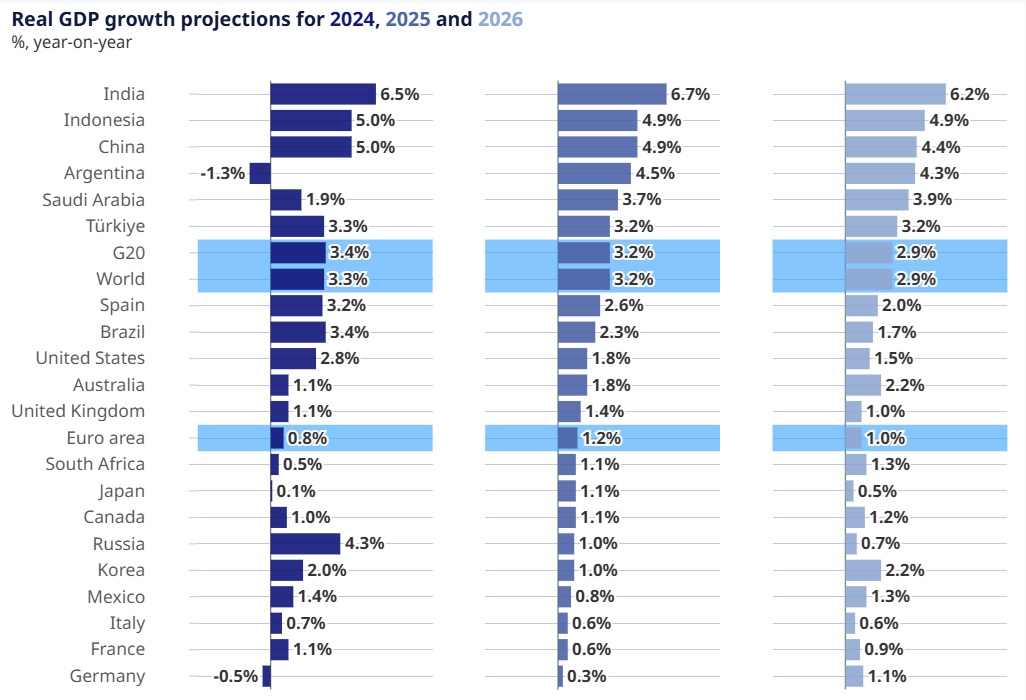
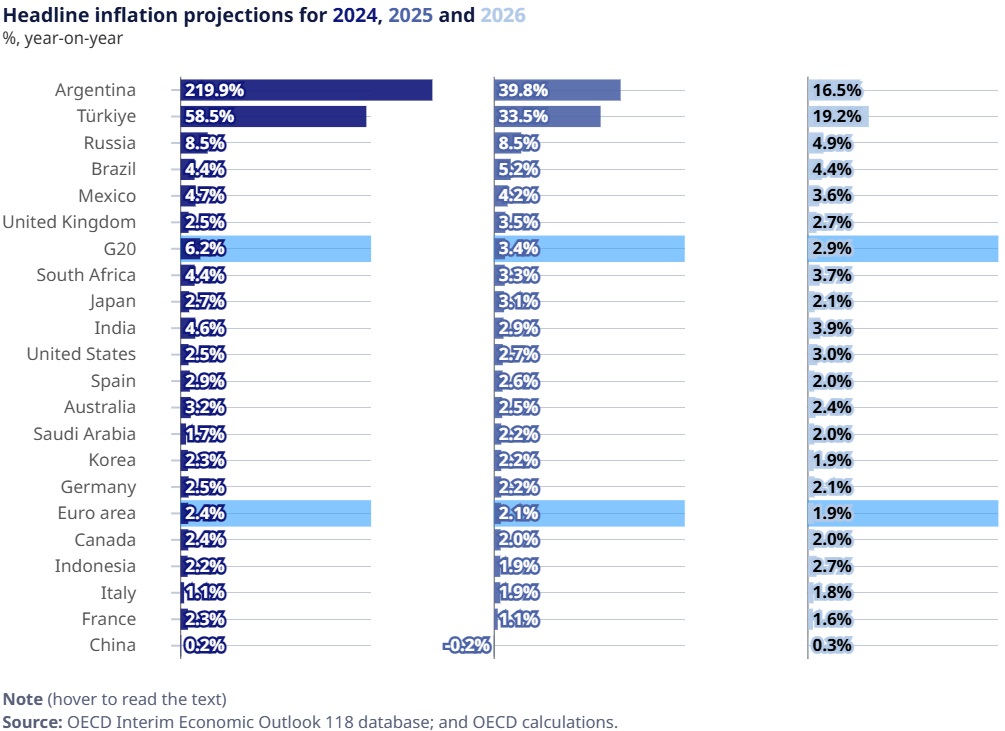
Despite a trade war, despite the United States becoming a third large malevolent force in the world, despite the continued Russian war on Ukraine, despite strife and conflict in the Middle East, Africa and elsewhere, the world economy, like a stoner in a bathrobe, abides. Or at least many of the major economies continue to grow. The OECD published an update of GDP and projections* through the rest of this year that shows most G20 countries are growing. India is the fastest growing large country with Indonesia a couple percentage points behind. China claims 4.9 percent growth though we bet it’s closer to 3 percent. The world as a whole, if trends continue, will grow at a 3.2 percent clip in 2025, which is not so bad. Germany, however, is barely growing at all, and France, Italy and Mexico are all growing slowly. At the same time that world economies are growing, the average inflation rate for the G20 is 3.4 percent (second chart below). Argentina and Turkey continue to suffer from high inflation and China from deflation, but overall the inflation rate is also not so bad. Something is tying together the world economy room. Let’s hope it keeps doing so.
*We are dubious of any economic projections for 2026 but include the OECD’s for kicks.
Farmers Portend Evil
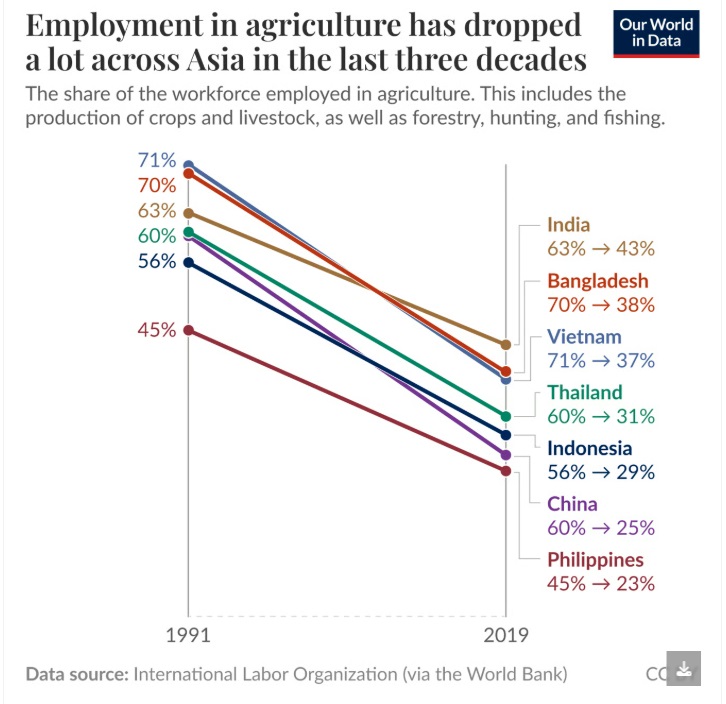
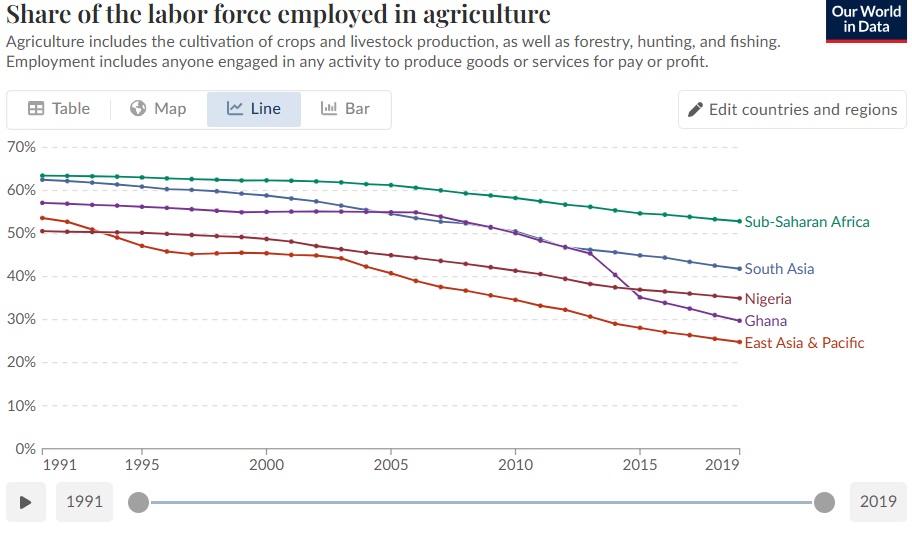
People romanticize farmers. Since Thomas Jefferson, it has been the case that we extol the salt of the earth farmers as doing real work and insist we must protect them and their way of life. Nothing against those who farm, but the fewer people farming in a country the better that country is doing. As a country develops economically, the labor force transitions into more sectors and this is good. Farming is hard work and the fewer people that can produce the food that a country—the world—needs the better. As economies develop, people live longer, healthier, more enjoyable lives. Asia has been a dramatic example of that over the last half century—from Japan to Taiwan to South Korea to China and now places like Vietnam and Indonesia. In the first chart below from Our World in Data you can see that “In the early 1990s, almost two-thirds of the labor force in South Asia was employed in agriculture, and more than half in East Asia. Today, this is just 40% in the former, and one-quarter in the latter. In the second chart below you can see that Africa as a whole still has more than 50 percent of its labor force working in agriculture. There are a few exceptions such as Nigeria and Ghana, the latter of which has made great progress over the last decade. We look forward to fewer farmers in Africa over the next few decades.
China Corner: Spy Boy
As China continues to ascend as the first or second most powerful country in the world, it continues to build its power across multiple domains, including spy craft and intelligence activities. All countries do this, large countries with ambition especially so. The challenge with China, however, is that it is an authoritarian country which wants to make the world safe for authoritarianism. And there is no longer a democracy-promoting, democracy-model America to counterbalance it. China spies intrusively around the world in multiple ways. OpenAI reported this week that it “…banned several ChatGPT accounts with suspected links to the Chinese government entities after the users asked for proposals to monitor social media conversations.” In the UK, “China is turning off the water supply to the British embassy in Beijing to force the UK government to cave to demands for a Chinese ‘mega-embassy’ in London.” In addition, the Guardian reports that “China threatened to retaliate against the UK government if ministers targeted parts of its security apparatus under foreign influence rules.” And during the recent UN meetings in New York, the Secret Service claims to have found “300 servers capable of crippling New York’s cell system.” There is lots of suspicion that China is behind this effort. Compounding the China spy challenge is that it manufactures so many tech components and products that the world uses. These products and components allow China to spy in those countries, or sabotage critical infrastructure. Authoritarianism is in the catbird’s seat.