Many, many years ago, I walked into the executive’s office with the organization’s PR director. Our subject was a delicate issue that was attracting media attention. The executive started rambling and I took the occasion to enjoy the view from his corner office. He rambled some more and amidst the torrent of words he told us what he was going to say to the media. Eventually the meeting ended, I walked out with the PR person, turned to her, and said, “You can’t let him talk to the media.” To her credit, she didn’t. To her detriment, she made me do it. Still, I did better than the executive would have, who was in the midst of a long-running mental breakdown. It was sad. Once, before this incident, I sat at a table at an event with some board members of the executive’s organization. They were cracking jokes about the guy. I didn’t find them funny—seemed like instead of making fun of him they should have been doing something to address the issue. The situation was not good for the executive nor the organization, nor if they thought about it more deeply, for the board members.
Months later, one brave board member took it upon himself to find a delicate, humane way to find an exit for the executive. Not too long after this, I was working late and as I prepared to head home I ran into the executive. He began talking to me. And continued talking and kept up a steady stream for over half an hour with my saying nary a word. My wife called wondering where I was since I said I was headed home. As I whispered into the phone, the executive continued to talk—about this and that and everything under the sun, in a sad manic episode. After about an hour, I found a way to extricate myself. While I walked to my car, I pondered mental illness and its cruel symptoms and thought fondly of the board member who found a way to resolve an untenable situation. We could use more board members like that in today’s world. We could also use analysis of a future new world order, how to break autocratic resilience, and how to crack China’s black box…you’re in luck–it’s this week’s International Need to Know, breaking the ice of winter with cold, hard global data, warming our feet at the flames of international information.
Without further ado, here’s what you need to know.
Who Builds The New World Order?
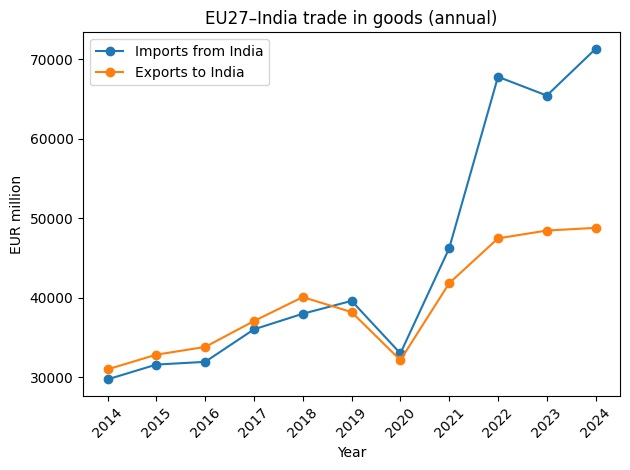
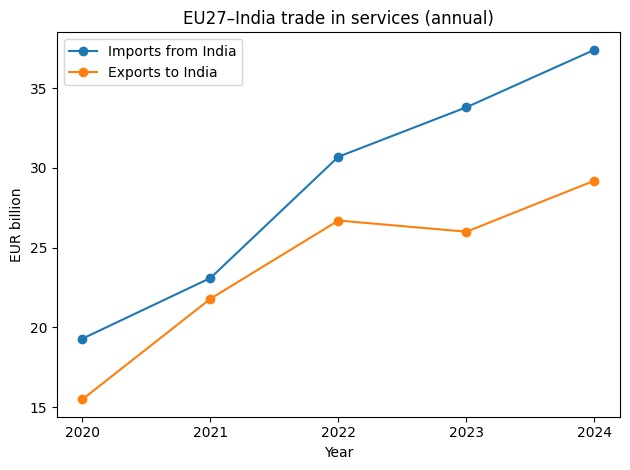
Earlier in the week, we listened to a podcast discussing the end of the rules-based international order and what comes next. The host and guest talked a lot about China and Europe and even the United States. Conspicuously absent in their analysis was the most populous country in the world, with the fifth-largest economy, and one of the ten-largest militaries, depending on how you measure military size. We speak of India, of course. China is the most powerful country in the world at the moment although Xi Jinping has again fired the leadership of its military (see third story below). The U.S. is the second most powerful country although at the moment it acts like a drunken squirrel running around the yard randomly looking for acorns, forgetting where it stores its main stash, and harassing rabbits hopping around while ignoring the coyotes lurking nearby (admittedly the U.S. is much less cute than a squirrel). India, meanwhile, is steadily reforming its large bureaucracy, growing its economy, and building alliances around the world. Most recently India completed a trade agreement with the European Union. Of course, this is the EU and India we’re talking about, two entities with more bureaucrats stuffed in a meeting room than clowns can fit in a car–so, according to The Week*, “Legal scrubbing of the text will take 5-6 months; formal signing will be done post that.” Nonetheless, if one wants to understand what the world order will look like in the coming years, especially in the second half of the century, you better examine India.
*Not to be confused with The Weeknd, though likely able to produce much better music and one with a better voice
Autocratic Resilience
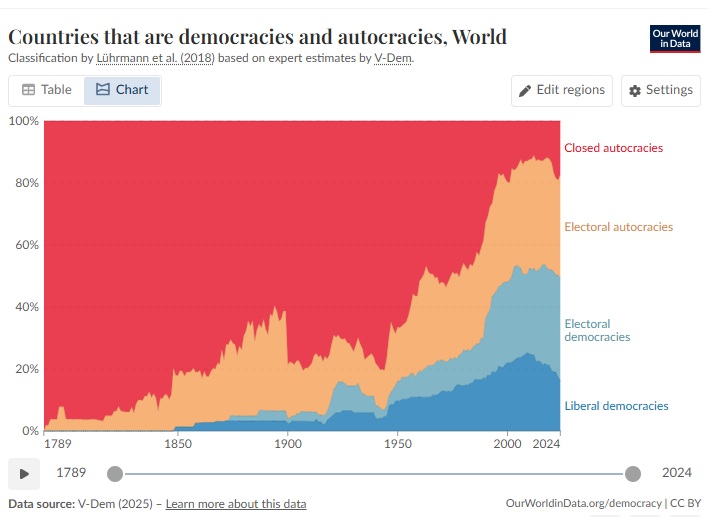
A grim task is determining how many people the tyrannical Iranian government murdered during the recent widespread protests. The estimates range from 3000 to more than 20,000. Iranian State TV claims 3,117 people were killed during the crackdown. Time Magazine cites Iranian Ministry of Health sources who claim the death toll is perhaps tens of thousands and overwhelmed “the state’s capacity to dispose of the dead.” Whatever the number, Iran’s government massacred its own people and its security apparatus has preserved the current government’s rule. This, unfortunately, is not an isolated example. Autocracies are far too resilient. Thirty-five-years ago, there was a wave of democratization with the fall of the Soviet Union. It all seemed so easy and the arc of justice sure seemed to be bending the way it ought. But the ark of the democratic covenant is broken. Perhaps there has been too much focus on how to depose leaders and not nearly enough on how to overcome the security apparatus of authoritarian governments. Today’s security apparatuses are better armed thanks to technological advances, technology once thought to be liberalizing. To see more transformations of autocracies into democracies, new tools to dislodge the security apparatus of these countries must be developed.
China Corner: Open The Box
Xi Jinping has been shaking up the military leadership again, essentially sacking all but one of the leaders of the Central Military Commission. Over the weekend, the Wall Street Journal reported that the most startling firing, that of Zhang Youxia, who has a lifelong relationship with Xi, was because he had leaked nuclear secrets to the U.S. and accepted bribes for official acts. It’s important to note that the Wall Street Journal’s sources for these accusations against Zhang come from China’s government. These sources provide information that they want out in the public. Whether Zhang really did leak nuclear secrets or accepted bribes is unknown. We have seen lots of speculation from many quarters about why Xi continues to fire military leaders and what it means. The truth is that nobody outside of Xi’s inner circle knows. This story reminds us of questions we asked five years ago that no one has yet been able to answer. How is Xi making these decisions? Who is advising Xi? Is he alone in making these decisions or is a small cadre helping him? The inner circle of Xi Jinping and how he makes his decisions remains a black box. If we had answers to these questions it would help us understand why he continues to revamp the military and what the consequences will be.