Yesterday we made a rare visit to a U.S. Postal Service office to mail something that needed to be postmarked that very day. We can neither confirm nor deny this had something to do with yesterday being Tax Day in America, though if you are looking for him, our tax lawyer can be found in the corner of the dive bar on 15th, a stiff drink—likely his third double bourbon—firmly in hand. We can confirm this has nothing to do with the postal worker who screamed epithets at us a few weeks ago. When we went to enter the post office, we saw this sign on the door:
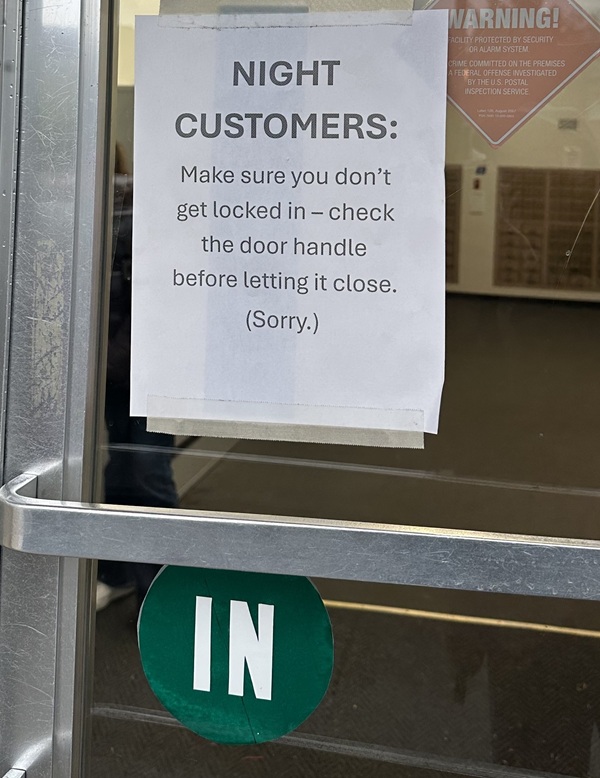
This, as you might expect, led to lots of questions on our part and not a little bit of speculation. This being the post office, we had plenty of time to speculate while we waited in the longish line. When our turn came, we couldn’t help ourselves and asked the postal worker about the sign. He said they had been having problems with the door lock for weeks and weeks. We asked if someone had actually locked themselves in the lobby. He answered yes. We can neither confirm nor deny whether we laughed, though we can confirm an eyebrow was raised by the postal worker at our response. We asked whether the poor schmuck was stuck inside all night or somehow broke their way out. He said no, the trapped soul called the fire department and was rescued forthwith.
Ahh, the blessing of cell phones. They save us from all sorts of trouble even if many feel they are the ruin of modern society. Cell phones are definitely the ruin of good stories. Most plots of movies in the past would make no sense if the characters involved had cell phones. So, while we are very glad the poor soul who became trapped inside the post office was saved in good time by the heroes of the Seattle Fire Department, a small part of us—the imp of our soul, undoubtedly—laments what was lost. But we dial up nonetheless stories about what people in Southeast Asia think, why the fan might soon be meeting excrement in the Middle East, and the perils and promise of China’s manufacturing prowess. It’s this week’s International Need to Know, looking for silver linings of international information, glad to be trapped in a building of global data.
Hungary Like The Wolf Update
We wrote last week about Hungary’s then upcoming elections and JD Vance’s support of Orban..We were pleased to see opposition leader Péter Magyar defeated Orban. We noted in our article Orban’s suppression of media. Jerusalem Demas points out, “I don’t think it’s sunk in how insane it is that an American vice president was promoting a man who banned his opponent from appearing on TV.” So we should especially savor this victory for democracy. More to come, we hope.
Without further ado, here’s what you need to know.
What is Southeast Asia Thinking?
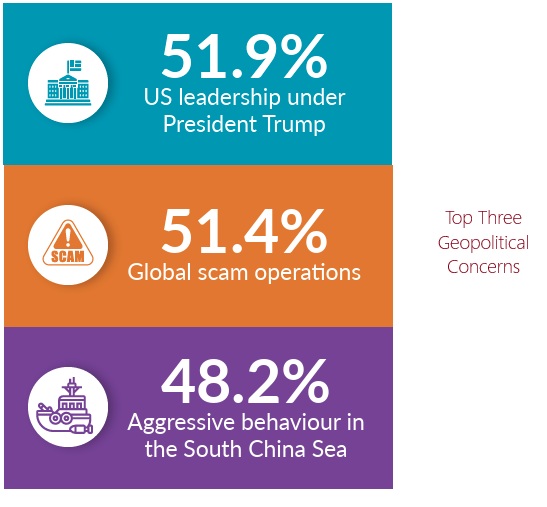
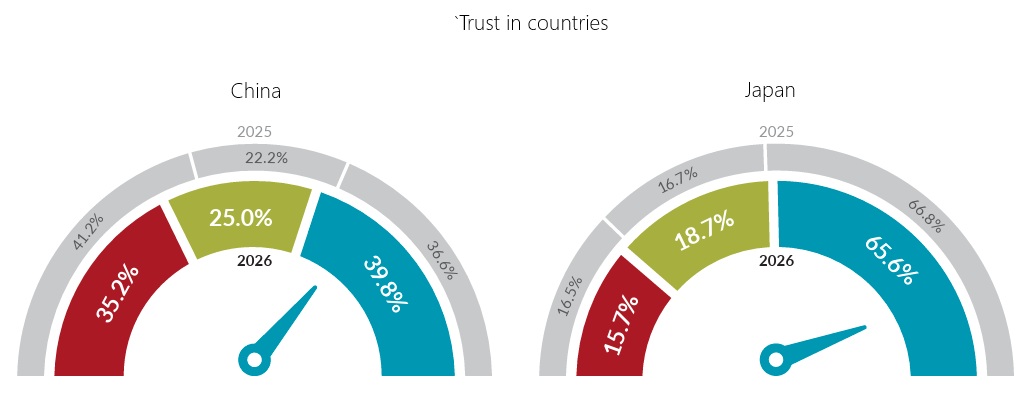
You may have noticed a lot has been happening in the world over the last year. What do people think about it? Thanks to the Yusof Ishak Institute in Singapore, we can learn what folks in Southeast Asia think, or at least its elite. The Institute conducts an annual survey of opinion leaders of the region across a variety of international issues. It’s worth noting the respondents are comprised more of professionals than those who are poor (CNN is one of the respondents’ top sources of news). Still the results are enlightening. The top three geopolitical concerns, as you can see in the Institute’s graphic below are a) U.S. leadership under President Trump; b) global scam operations; c) aggressive behavior in the South China Sea. Pretty impressive that Trump can make China’s aggressive actions against these countries play second fiddle. Perhaps because of this, “a slim majority of ASEAN respondents selected China (52.0%) over the US (48.0%) if the region were forced to align itself with one of the two strategic rivals.” Also interesting is that Japan is “the most trusted power in the region (65.6%), with a significant share of the respondents (41.4%) viewing it as a responsible stakeholder that respects and champions international law.” The world is changing and the views and actions of countries are too.
Fan Meets #$%^?
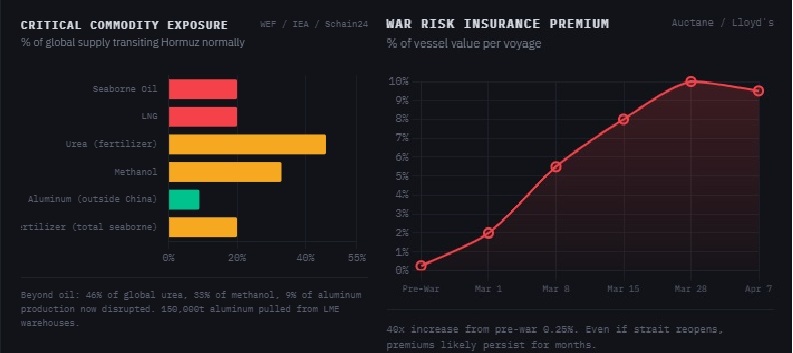
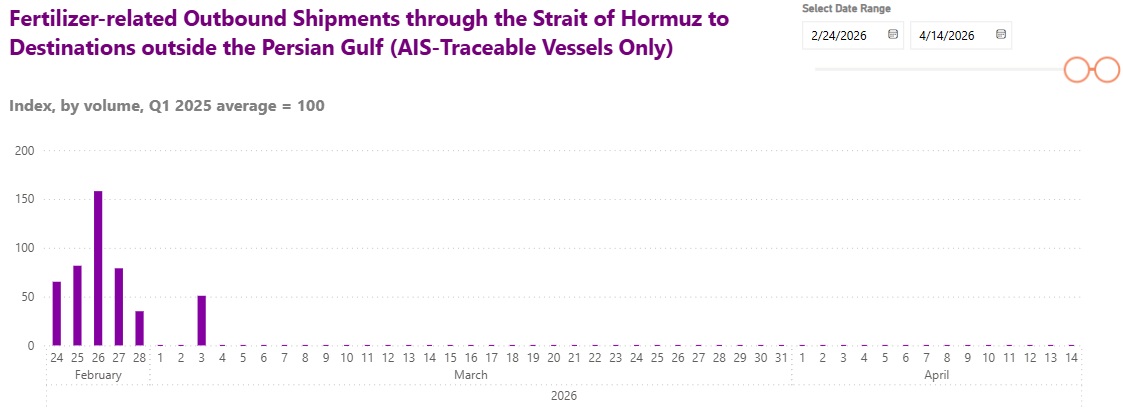
Don’t catastrophize, any decent therapist tells you. But we have been watching the data coming out of the Strait of Hormuz with increasing unease, and some serious analysts are now saying what the numbers are already suggesting: the global economy may be about to experience something worse than a price shock. University of Chicago political science professor Robert Pape, who studies economic sanctions and blockades, posted last week that we have crossed from step one—price spike—into step two: physical shortage. He asserts we go from “price spike → physical shortage → economic contraction.” Pape is not alone. The World Economic Forum, the International Energy Agency, the Institute for Supply Management, and logistics analysts at various companies are all tracking data that supports Pape’s framework. So, what does the data actually show? We know vessel traffic has collapsed since the beginning of the war. Brent crude hit $103.72 earlier this week — up 57 percent year over year — after peace talks collapsed and the U.S. announced a naval blockade of Iranian ports. Jet fuel has more than doubled, from $95 to $197 per barrel since February. War-risk insurance premiums have gone from 0.25 percent to 10 percent of vessel value per voyage — a 40-fold increase. And the disruption extends well beyond oil: 46 percent of global urea exports and a third of seaborne methanol normally transit Hormuz. As we’ve written about, fuel shortages are already being reported in parts of South Asia and Europe. Keep an eye on the Strait of Hormuz Tracker we posted last week. And watch the price of Brent crude, container spot rates on Asia-Europe lanes, and global urea prices (you know you’ve always wanted to track urea). If transits don’t recover meaningfully, Pape’s step three is not a prediction. It’s a schedule. We assume Trump wants to a) avoid economic disaster; and b) put all this behind him before his May 2 China visit. Will he be able to?
China Corner: China Economy Uber Alles
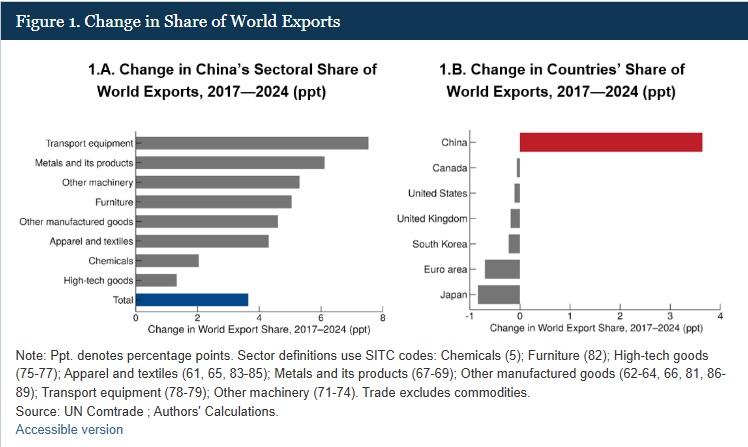
China continues to dominate global manufacturing (29 percent) and global exports (18 percent). One remarkable aspect of this that economist François de Soyres points out is that China has in recent years increased its market share in high technology sectors but has not lost market share in lower-value sectors. Soyres says, “It’s not moving up the value chain, but rather “expanding dominance to *all* sectors”. Soyre’s study for the Federal Reserve puts it this way, “China has gained global export market share in nearly all manufacturing sectors over the past decade. These gains span low-value-added consumer goods, such as apparel and textiles, as well as advanced products including automobiles.” As we’ve written about and noted in speeches, this is purposeful on China’s part. Through its Made in China 2025, Dual Circulation, and other policies, China has explicitly tried to master new strategic industries but still remain the factory to the world for all other production. China says it does this so it can be resilient and not at risk to outside forces. But among those outside forces are other countries wanting to grow their economies and technological ability. That’s true, of course, about developed economies such as Europe, the United States and Japan, but also for developing economies, whether in Southeast Asia, Africa and other locales. Many developed countries, especially if acting in concert, could push back against China and build up their manufacturing prowess across various sectors. But what about developing countries? China’s policies essentially prevent these countries from developing the same way China did. We predict this equilibrium will not hold.