While others call for a pause on AI, try to ban data centers, worry it will put us all out of work, and generally think it will end humanity as we know it, we use AI to create a chronological timeline of Coppola, Spielberg and Scorsese movies, use it to do a deep data dive on why the NBA is unfixable (stay tuned for forthcoming Substack article), work with it to develop a new way to understand foreign direct investment, and generally continuously use it to good effect in our work and personal lives. So even though we also worry AI will be used to develop a novel virus that kills us all, until then we are here to condemn a different, more malicious technology: streamers. We hate them. They are a net negative for society and we ask you to redirect your protest energy to seek to destroy and bury them into media hell. Twenty years ago as everything went digital, the promise was that it would allow us to watch anything anywhere. Streamers do the opposite. They have been a disaster for sports fans. To watch all of the NBA playoff games we would have to subscribe to at least two streaming packages, maybe three, and find a cable package, or other service such as Fubo, to be able to watch all the playoff games. And unlike on cable—this is how bad streamers are that we are praising Xfinity in contrast—the fast forward functionality sucks. We can’t see the game as we fast forward so have to guess when to hit stop and then rewind and fast forward when we inevitably misjudge. Not to mention it’s impossible to flip back and forth between different games and you’re forced to watch commercials because it takes too long to exit and enter the streamer.
And what about that Coppola/Spielberg/Scorsese timeline? We had Claude include where we could watch the movies. But you have to subscribe to a thousand different streamers to do so. People complain that social media has separated us into a million different micro cultures but streaming is just as guilty if not more so at dividing our nation. Down with streaming, down with streaming, down with streaming…but up with stories about the U.S. Energy Secretary being dead wrong, deciphering what kind of Straits we’re in, and examining China’s schizophrenic AI policies. It’s this week’s International Need to Know, the prestige TV drama of international information, the PBS Ken Burns documentary of global data.
Without further ado, here’s what you need to know.
U.S. Energy Secretary Wright Died Last Year
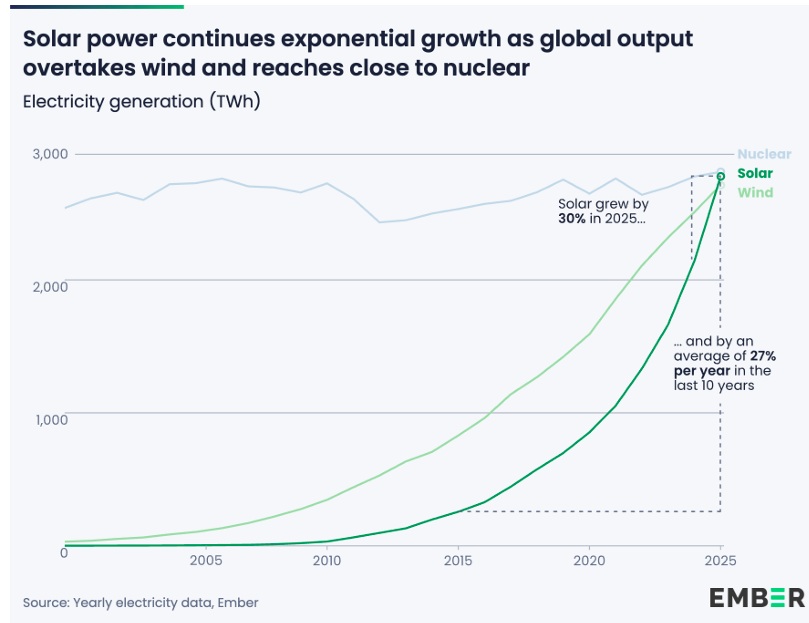
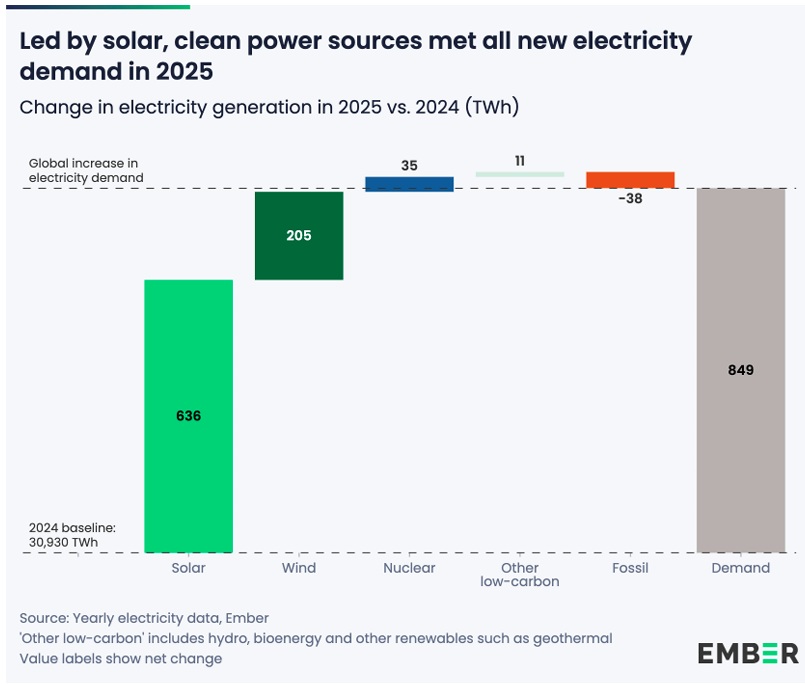
At a recent U.S. Senate hearing, U.S. Energy Secretary Chris Wright said, “I’m pretty confident coal will lead the world in global electricity production when I die.” We regret to inform you that apparently Wright died before making that statement. Maybe it’s one of those quantum mechanics time things or maybe he’s just always been brain dead. Because Ember’s Global Electricity Review 2026 released last week reports that, “In another global milestone, renewables overtook coal power in 2025. Solar, wind, hydropower and other renewable sources together contributed more than a third of global electricity generation for the first time in the modern power system. Conversely, the share of coal power fell below a third for the first time in history.” Okay, it was a combination of renewable electricity generation outpacing coal, not just solar, but I’ll bet you if Wright eats well that solar will surpass coal before he dies. As you see in the first chart below from Ember, solar continues its exponential growth. As you can see in the second chart below, renewable energy met all new electricity demand in 2025. Solar power along with its spouse, batteries, is powering more and more of the world—in China, certainly, but also India and countries everywhere. It will take over in the United States too no matter what its leaders think and say or even do—it’s simple economics. Solar is cheaper than the alternative and batteries allow for storage when the sun doesn’t shine.
What Kind of Straits Are We In?
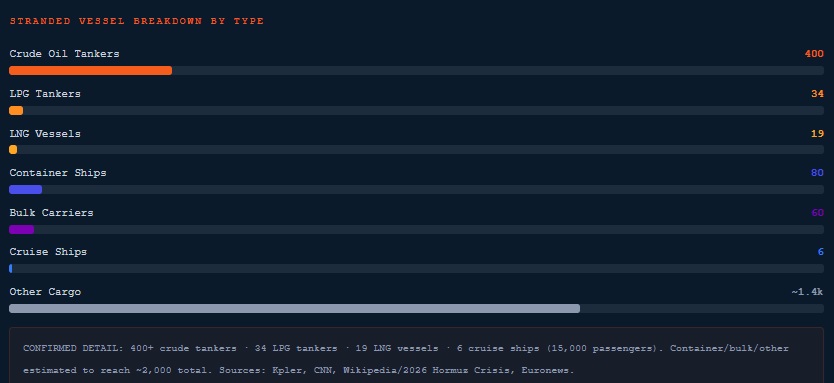
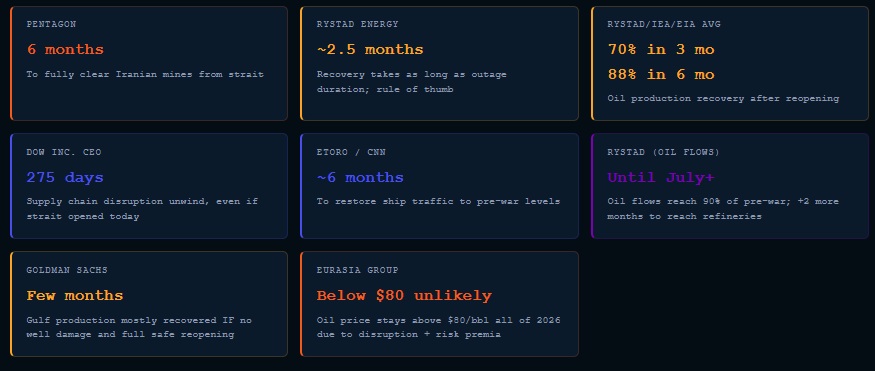
We’ve seen any number of analysts asserting that even if the Strait of Hormuz opened tomorrow for business completely unhindered, the ramifications for the economy will still last for months and months. We don’t necessarily dispute this but want to understand the argument better. Part of the reasoning is that it will take a while for ships to clear—there is a big backlog to unwind. According to an article in Al Jazeera, there are around 2000 such ships waiting to go through the Strait. What types of ships are these? CNN reports that “Over 400 tankers, 34 LPG tankers, and 19 LNG vessels remained stranded.” The other 1400 are container ships, bulk carriers, and general cargo. So how long will it take to work through this backlog? It depends. Iran has allegedly mined the strait. The U.S. Department of Defense has said it will take six months to clear mines it believes have been laid by Iran, and any such operation is unlikely to be carried out until the war ends. But if the war ends couldn’t Iran, which presumably knows where these mines are, help expedite this? But then you’ve got to get all those ships through the Strait and build additional capacity. And how quickly will companies be able to get insurance? Some estimates, as you can see in the second chart below, believe it will take three-quarters of a year to unwind all of this. Other analysts believe it will happen more quickly. Of course, as of today, the Strait of Hormuz is most definitely not open as you can see on the Trade Tracker we’ve linked to previously. And there are economic effects of this continued closure—how long they will last is still an open question.
China Corner: Loving and Hating AI
Everyone hates AI all of a sudden, including certain Chinese regulators. We could have sworn the U.S. and China were in an epic death battle to see who would get to AGI first and thus rule the planet. But now Americans and Chinese are worried that AI will leave them jobless. Recent polling shows 65 percent of Americans say “government regulation of AI is necessary to protect the public interest.” Meanwhile the Beijing Bureau of Human Resources ruled that “AI replacing a position ≠ legal dismissal.” Chinese and Americans worries about AI might affect how the competition to dominate AI technology plays out. Yes, China is not a democracy but the government still needs to keep the people at least semi happy. The Global Times further reports, “A Chinese expert said on Sunday that the ruling provided reassurance to the vast number of workers, noting that against the backdrop of accelerating AI penetration and workplace concerns about being replaced by AI, the arbitration has a positive exemplary effect, helping alleviate employees’ anxiety about AI, which is expected to help the stability of the labor market.” But if workers can’t be let go even if their work is being done by AI, what impact will this have on innovation and dynamism in the Chinese economy? And, what does China forcing Meta to unwind its acquisition of Manus mean for innovation in the AI sector? Manus was founded in China, then moved to Singapore where it incorporated as a Singaporean company, and then sold itself to Meta. Of course, the U.S. government has threatened Anthropic and will increasingly feel pressure to regulate and control AI companies as Americans become more worried about it. The great AI game is likely to be more complicated than originally thought.