In the paint section of Lowe’s we collected the gallon can of tint we ordered, grabbed some tape, found the plastic sheeting we needed and as we prepared to exit looked for the free wooden paint stir sticks—oh no! Holy crap! What the #%#$?!!! They’re charging for them now? We reeled in the aisle—like a 19th-century Jane Austen heroine with consumption—not believing our eyes. For as long as we can remember, a part of the painting ritual of life—whether exterior or interior, walls or doors, ceiling or some other structure—has been for Lowe’s or Home Depot or name the store of your choosing to provide these handy-dandy wooden sticks that you use to stir the paint can. It was like a natural law, an inalienable right, something we are as accustomed to as gravity. It had been a year or two since we did a painting project so we’re not certain when this change occurred. We suspect perhaps it was due to the high inflation of the early 2020s when companies, rather than raising prices, quietly reduced quantity while charging the same price, and this was an act in the same vein. Or maybe tariff liberation day last April was the final straw that required increasing revenue somehow, someway, including violating the basic human right of the free wooden paint stir stick. Or maybe it’s more recent than that and Iran War-induced inflation impelled these stores to cross the Rubicon into wooden stick-stirring nihilism.
Or more likely some nebbish executive with the AI financial equivalent of a sharp pencil and green visor, after a few too many shots of espresso during his mid-morning break, had an “aha moment” and rushed to email a spreadsheet to the Board breathlessly explaining that he had invented a new source of much-needed revenue. Whatever the reason, we stand athwart history and yell stop! We demand the return of the free wooden paint stir stick. We call the mob to drive to their nearest big box home supply store and take matters into their own hands. Except in Seattle they will damage their car on one of the new speed bumps the city has erected on—and we can hardly believe this is true and yet, yes it very much is—arterials—incentivizing citizens to drive on neighborhood streets lest they damage their cars on the way to enact justice at Lowe’s. Good God, this new era of America is a catastrophe. But we welcome the new electric car era (fewer parts means they’ll be less damaged by speed bumps?), ask who is really the military escalator in Asia, and speculate on the larger meaning of Chinese marriage and divorce rates. It’s this week’s International Need to Know, the Rembrandt of international information, the Dale Earnhardt of global data.
Without further ado, here’s what you need to know.
It’s Electric
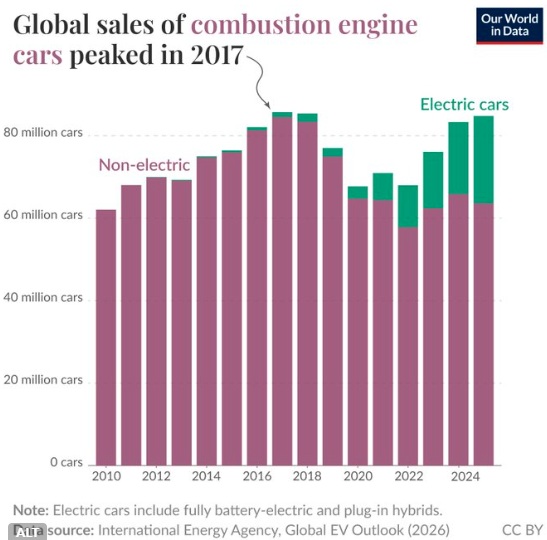
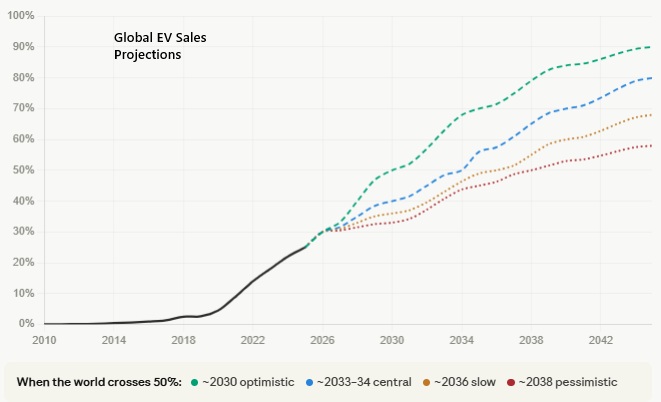
A colleague recently bought an electric car and it wasn’t a Tesla or a Rivian, which are the two U.S.-made electric cars we’re most familiar with. It was a Lucid. With gas prices remaining high, and a, well, unpredictable U.S. administration, we bet anyone lucid will consider an electric vehicle, or at least a hybrid, when buying a new car. However, the emergence of electric vehicles and the descent of the internal combustion vehicle is not new. Our World in Data reminds us that “Global sales of combustion engines peaked in 2017.” Yeah, almost a decade ago. And the reason ICE car sales are on the wane is not because people are driving less, it’s because electric cars are ascending. Sales of EVs have doubled since 2022. They now make up more than a fifth of all new cars sold (on pace in 2026 to account for a fourth of all sales). We’ll bet you a Matchbox or Hot Wheel that EV’s market share of sales will cross 50 percent by the early 2030s. The big question is whether the S-curve continues to bend up sharply or whether it flattens as it runs into so far harder-to-electrify markets such as the U.S., Japan, India, and much of Africa. Some folks are pessimistic. For example, BloombergNEF lowered its forecast last year because of U.S. policy reversal—eliminating the EV tax credit among other policies. But we bet economics defeats policy—electric vehicles are simply better than ICE now. Below are four scenarios projecting future EV car sales. Which one do you believe is most accurate?
Wait, Who is Escalating Militarily?
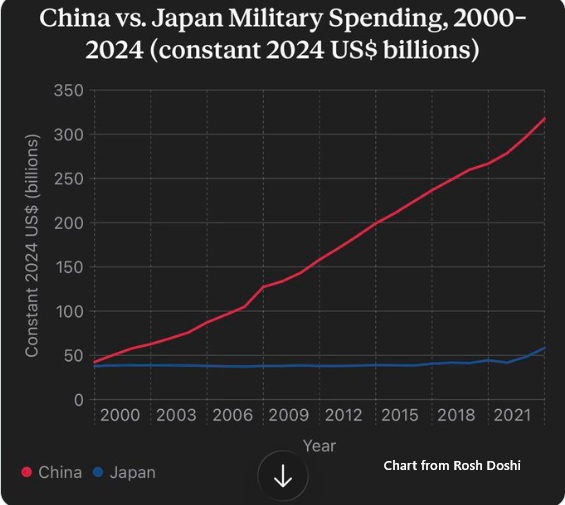
I’ve been talking to folks who were in China recently. One of the striking things they’ve experienced is the harsh anti-Japanese attitudes from both officialdom and people on the street. This is consistent with years of Chinese government-stoked nationalism directed at its island neighbor. So, it was not surprising, but still jarring, when at his recent summit with Trump, Xi Jinping reportedly castigated Japanese Prime Minister Sanae Takaichi to Trump for Japan’s “remilitarisation” in what the Financial Times described as an intense diatribe. Xi has long used Japan as a domestic foil—invoking World War II grievances to rally nationalist sentiment at home. There’s just one problem with Xi’s alarm: the chart below, produced by Rush Doshi, makes a mockery of it. Since 2000, China’s military spending has increased more than fivefold in real terms, rocketing from roughly $45 billion to over $315 billion. Japan’s spending over the same period? It sat nearly flat for two decades, nudging up only recently—and even now barely clears $55 billion. China outspends Japan on defense by more than 5 to 1. Japan’s modest military expansion in recent years is a response, at least in part, to China’s own buildup—and to an increasingly aggressive Chinese posture in the region. Japan should probably be remilitarizing even more.
China Corner: Married to the Mob
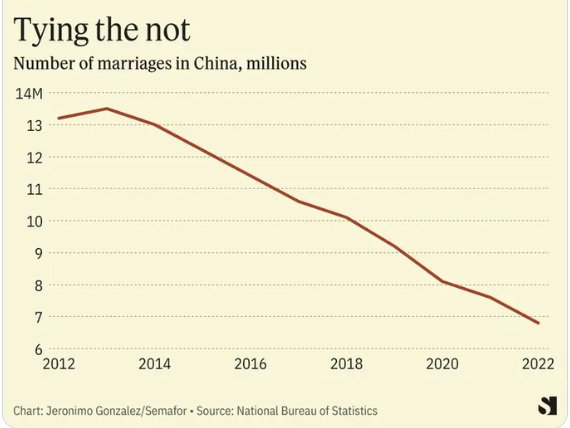
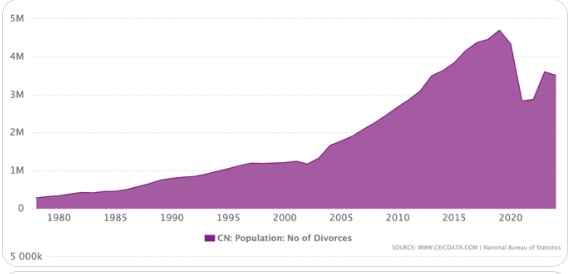
There is a tendency to view China right now as unstoppable, like they are the Oklahoma City Thunder in the early part of the 2026 season when they were 24 – 1. China is dominating in more and more industries, from robotics to electronics of all kinds. It’s built up its military. It might very well be, as we have asserted, the most powerful country in the world, surpassing the United States. But how is that working out for the Chinese people themselves? Being powerful might be great for the ambitions of leaders and their warped ideologies but your average Chinese, like your average person anywhere, cares far more about good, well-paying jobs, quality of life, and being able to plan for a happy future. Lots of analysts focus on low consumption numbers when noting all is not golden for folks in China. But Eleanor Olcott, a reporter for The Financial Times, notes that not only are half as many Chinese getting married as they did a decade ago but also that the number of divorces has more than doubled in the last 20 years. All of that will affect China’s already incredibly low fertility rates. But we wonder if it is also an indication of happiness and faith in the future. Oh, and Oklahoma City is in a hotly contested series against San Antonio.