Our experience with Australians is vast and long. When we were young and traveling around the world it seemed like every hostel we stayed at was run by an Australian—they are inveterate travelers in our experience. In one hostel as we had a drink in the bar/common area while penning a postcard (what the hell are those?), a man stumbled in who had been stung by a jellyfish. The Australian bartender calmly laid him out on top of the table and performed an amateur operation. During a trip to Kangaroo Island years ago, we repeatedly complimented our tour guide’s Crocodile Dundee-like hat. At the end of our stay, she gave it to us and we wear it to this day when working in the yard. An Australian who interned for us many years ago decided to climb Mount Baker with some new-found American friends and asked if he could borrow our car to meet them at the base of the mountain. We said sure and when he came to get the car he was wearing yellow dishwashing gloves he’d bought as part of his equipment to climb the mountain. As we watched him drive away—on the wrong side of the road—we assumed we’d see neither him nor our car ever again. But return he did and showed us photos of himself on the summit, yellow dishwashing gloves shimmering in the reflection of the snow.
So we should not have been surprised when, last week at a bar before a Seattle Mariners game, an Australian friend of our friend told us that, on his flight over, the American sitting next to him asked if he liked to fish and shoot guns. The Australian said, yes (although he’d never shot a gun before in his life). The American invited him to stay at his house, which the Australian did. He showed us photos of himself with the family—shooting guns and catching a 40-pound salmon, though we were a bit disappointed nary a yellow dishwashing glove was in sight. Given our experience, we were indeed not surprised by this Australian’s experience, rather perhaps thrilled and even a bit envious though we have neither the constitution nor personality to be a man or woman from Down Under. But we are very glad they exist and we are very glad to bring you the difference between the World Cup and Olympics, how democracy is in the eye of the beholder, and the possibility that the EU Strikes Back against China. It’s this week’s International Need to Know, the Koala Bear of international information, the Tasmanian Devil of global data.
Without further ado, here’s what you need to know.
World Cup and the Olympics
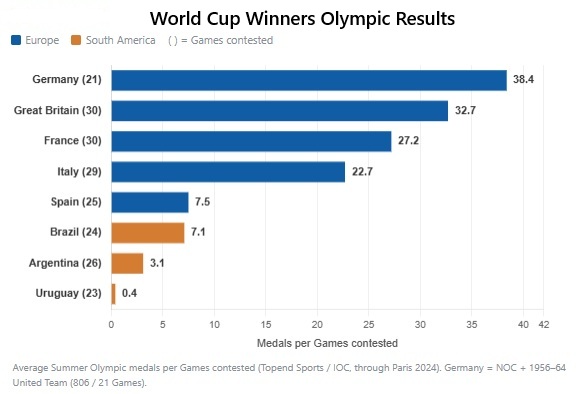
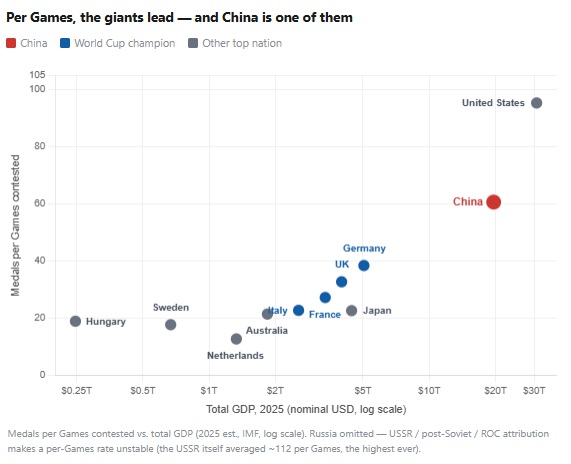
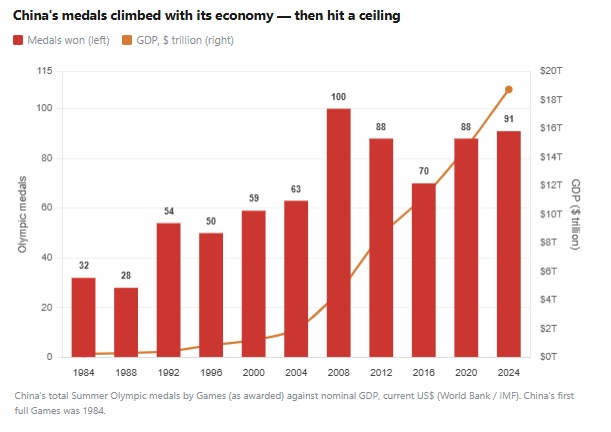
Last week, we analyzed the economies of countries successful in the World Cup and found that football tradition is more important than wealth or size of country in relation to whether a country wins. Our soccer maven friend, Brian, asked how all of this relates to countries which are successful in the Olympics. The Olympics are a very different beast than the World Cup (although arguably the IOC and FIFA are two of the five most corrupt organizations on planet earth, so they have that in common at least). But unlike the World Cup, economics very much is a factor in Olympic success. Last week we plotted the countries that have won the World Cup. The five wealthy World Cup winning countries also win lots of Olympic medals but not the poorer ones as you can see in the first chart below. Let’s look at the Olympics more broadly. Measured per Games, the two largest economies on earth — the United States and China — sit alone at the top. China provides a good example of the link between economy, size and medals. In 1984 China contested its first full Olympics and won 32 medals; its economy that year was about $260 billion. Forty years later it took 91 medals in Paris — tying the United States for the gold-medal lead — atop an economy of roughly $18.7 trillion. Medals rose with money. The World Cup is a monument to tradition — pour a nation’s passion into one pipeline and you can beat the rich without being rich. The Olympics is a monument to economic breadth–the surest route to a pile of medals is to be a very large economy that has decided to care.
Democracy and Beholder Eyes
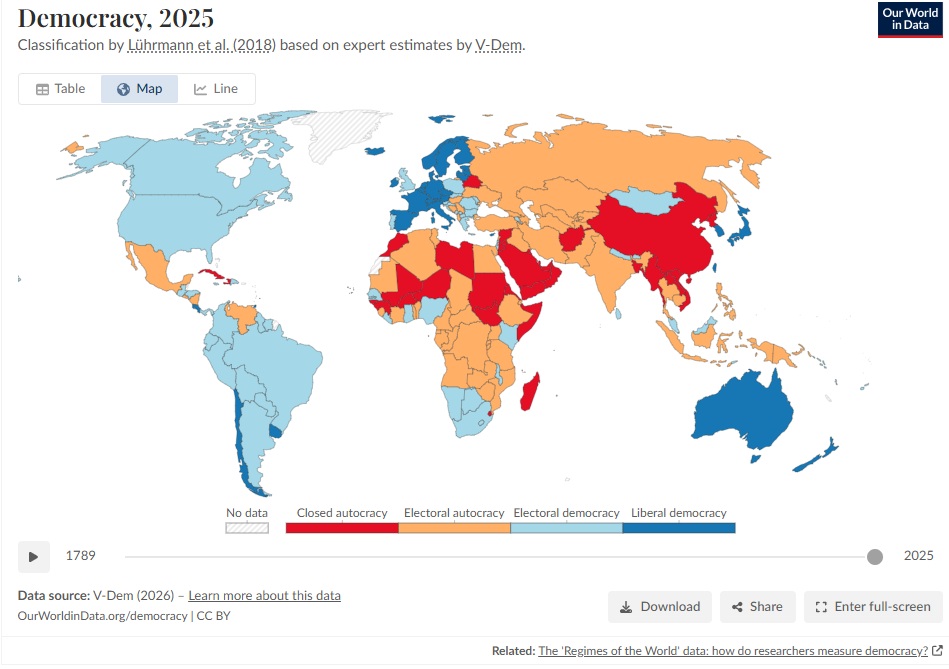
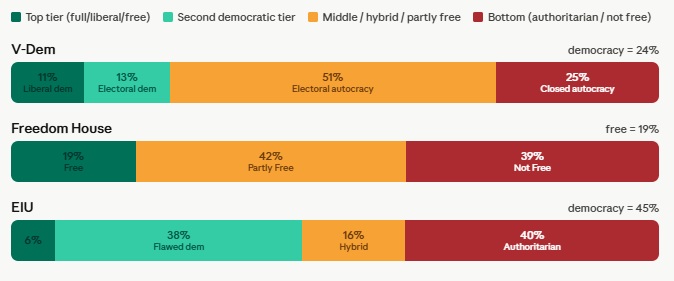
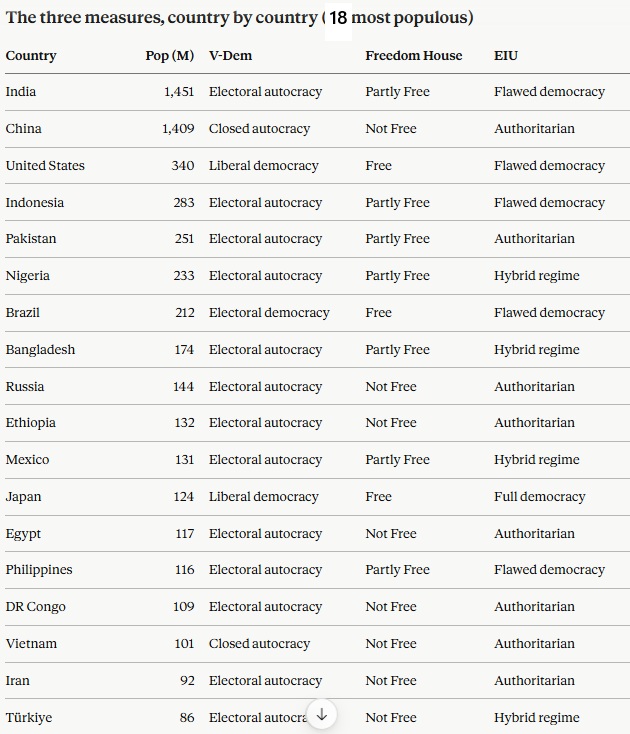
We were traipsing through Our World in Data a few weeks ago and saw they had a new article on the state of democracy in the world. The headlining map graphic, reproduced below, is not a sunny one. Far too much of the world is autocratic tan and red and not nearly enough shades of democratic blue. However, that map is based on V-Dem data. V-Dem classifies India and Indonesia “electoral autocracies.” So if you download V-Dem’s data into an Excel spreadsheet as we did during the Senegal-France World Cup Game (France can go to hell), and look at the percentage of the world that is living under free societies and which are not, the numbers, much like the score of the France-Senegal match, suck (for reasons not entirely clear, we have adopted Senegal as our team this World Cup—as a Mariners fan we apologize deeply to all Senegalese). V-Dem asserts that nearly three-quarters of the world live under autocracies. Again, that is all an artifact of how they categorize the most populous and fourth-most populous countries in the world. Whatever these two countries’ challenges and faults, neither is an autocracy. Fortunately, V-Dem is not the only democracy-rating game in town. There are also places like Freedom House and the Economist Intelligence Unit (EIU). Freedom House ranks both India and Indonesia “partly free” and the EIU dubs them “flawed democracies.” Of course, every human institution of one sort or another is flawed to a certain degree, but we take the EIU’s point and believe it is a more accurate picture of the world. That map in Our World in Data would look far more hospitable with these measurements. Either way, democracy needs a brand ambassador.
China Corner: The EU Strikes Back?
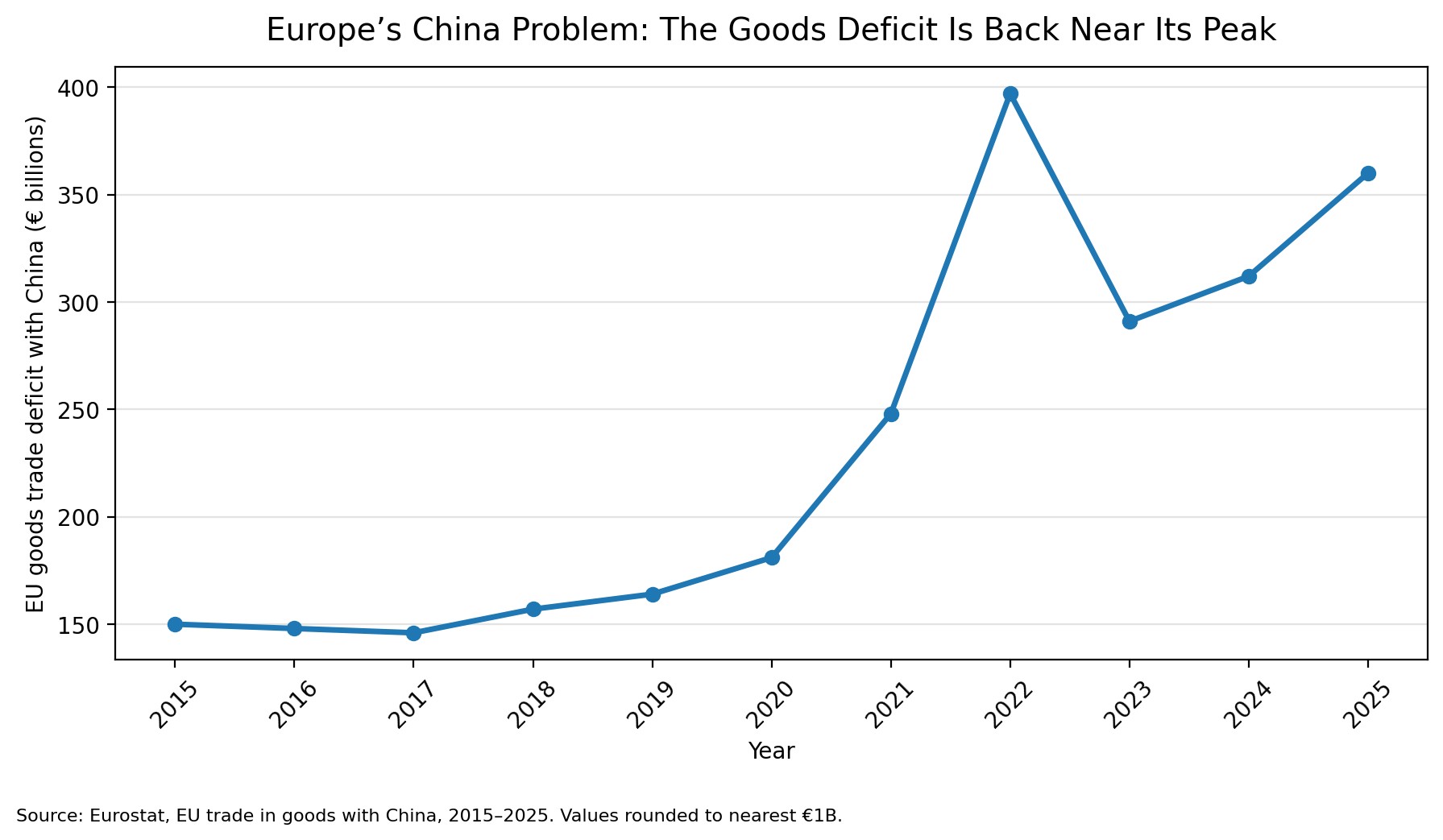
On more than one occasion we’ve noted that China’s exporting more and importing less might not be geopolitically sustainable. Lots of countries have been pushing back on China’s efforts to make everything and sell it to the rest of the world. Increasingly Europe is saying it will be one of the shovers. Europe being Europe it is very deliberate, i.e. bureaucratic, in its approach. It will talk and talk about de-risking, strategic autonomy, economic security, but in practice Europe is buying more from China and selling less to China. In 2025, the European Union exported €199.6 billion in goods to China and imported €559.4 billion. That left a goods trade deficit of €359.8 billion. That is causing Europe industrial anxiety. The problem is no longer simply that Europe buys too many cheap consumer goods from China. It is that China is now a giant supplier of the things Europe wants to make itself: electrical equipment, machinery, vehicles, chemicals, green technology, and the inputs that go into all of them. China and Europe are meeting next week. A far more effective way to counter China’s desire to manufacture every single thing, from low-cost clothes to high tech machinery, would be for Europe, Japan, the U.S and others to cooperatively counter China. But, well, that isn’t likely to happen with current U.S. leadership. To be fair, under Biden, Europe was not ready to push back against China. In fact, German industry wanted to engage even more (still do). Perhaps in a few years Europe and the U.S. will be in sync.