So this guy showed up on our back deck yesterday morning spying on our cat, Willow, who was sound asleep in her lair at the time. At nearly 20 years old she sleeps even more than the usual feline, a species that generally shuns wakefulness and overexertion. They are essentially The Dudes of the animal kingdom. This gray cat’s appearance would not have been a big deal a year ago. Cats of all kinds would come around our house back then: from an aggressive orange cat who tried to dash into our house to a black and white cat we dubbed ‘Stache because of the black marking under his nose (if he had been kinder his moniker might have been Chaplin but he often launched himself into the deck door trying to scare Willow).
Unfortunately, the Rise of the Coyote in Seattle has endangered outdoor cats. On one hand, we like the coyotes because they have reduced the number of rabbits who more or less destroyed our Japanese garden in recent years. But we miss our cat visitors. When we told this to someone recently they pointed out that outdoor cats kill an enormous number of birds. It was a good point and in fact we miss the birds who built a nest in the crook of our deck three years ago but not since, perhaps because of the frequency of our visiting cats. So we can see our friend’s point about cats massacring birds. At which point the worms say, what the hell, man? A remarkable thing about our world is that harmony is achieved by our all killing each other at the right rate. Or as a character in our forthcoming novel says, “To be alive is to be cruel.” But with the utmost kindness we present how a stat going around the Internet is misleading (crazy, I know), who in Africa might get rich, and how China is sinking the Global South. It’s this week’s International Need to Know, loving all animals equally just as we do international information and global data.

Without further ado, here’s what you need to know.
Same As It Always Was
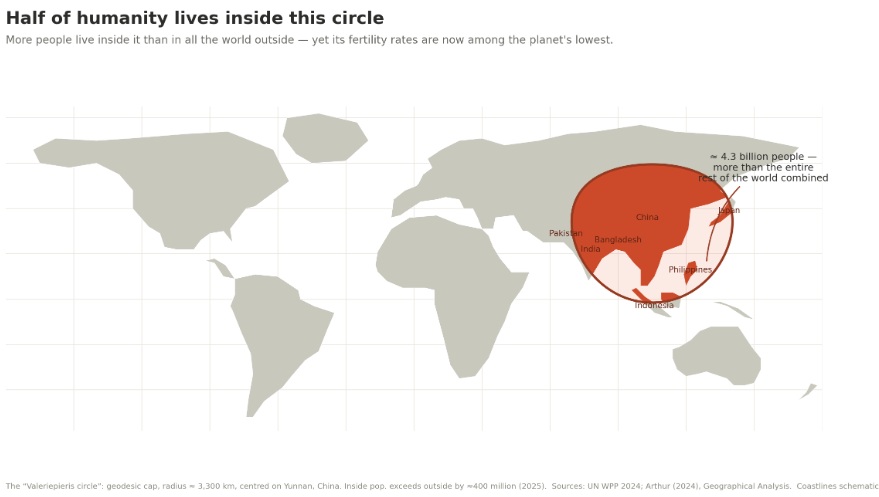
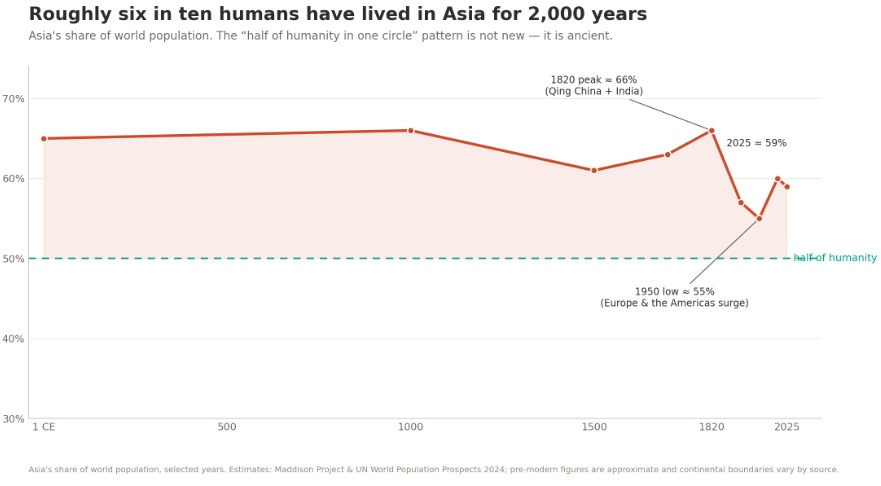
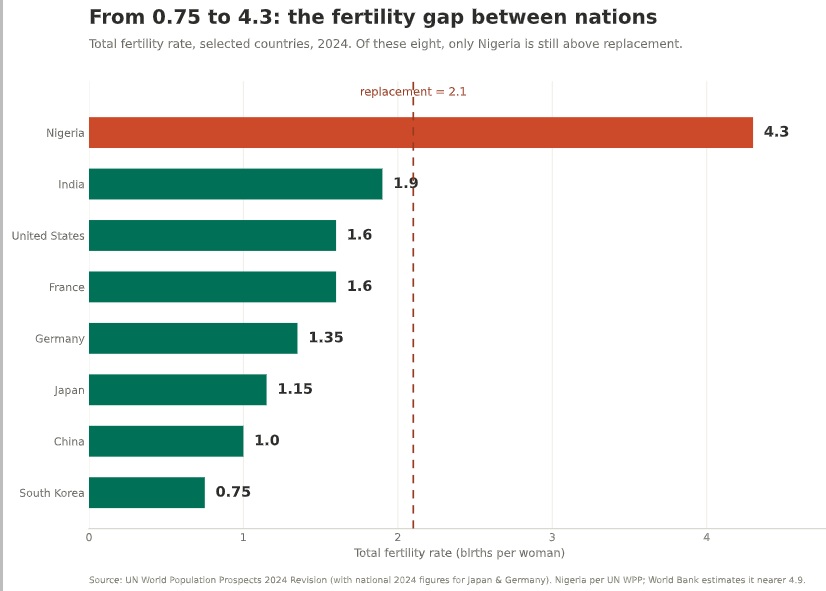
A stat has been making the Internet rounds showing that 85 percent of the world’s 2026 babies will be born in Asia and Africa, against just 8 percent in Europe, North America, and Oceania combined. Asia alone claims about 49 percent, roughly 65 million births. This is supposed to make people think Europe and North America are falling behind. But the thing is this is not new and distorts what is really happening. Asia dominates the birth count not because Asians are having many children, but because there are simply so many Asians. More people live inside a 3,300-kilometer circle centered on China’s Yunnan province — the “Valeriepieris circle” — than in the entire rest of the planet combined. Half of humanity, in a shape that is one-third ocean. If we look at the per-woman numbers, the vitality story collapses: South Korea sits at 0.75, China at 1.0, Japan at 1.15 — all beneath the United States (about 1.5) and most of Europe. Asia produces half the world’s babies while posting some of the lowest fertility rates ever recorded. In addition, that most people live in Asia is not new. The pattern is roughly two thousand years old: China, India, and their neighbors have held something near six in ten of the world’s people since antiquity — through the Song dynasty, the Mughals, the Qing, and the Raj alike. Asia’s share peaked around 66 percent near 1820 and slipped to about 55 percent only when Europe and the Americas industrialized and multiplied in the twentieth century. The map of where humans live has barely moved in a millennium. Only the total has. The whole world is eschewing children. Africa’s fertility, still the planet’s highest, is falling too. Global births already peaked: 142 million in 2016, down to 129 million by 2021, and world fertility is on track to slip below replacement around 2030. By 2100, the Lancet reckons, a mere handful of countries will remain above it. So admire the circle while it’s full.
Who Will Grow in Africa?
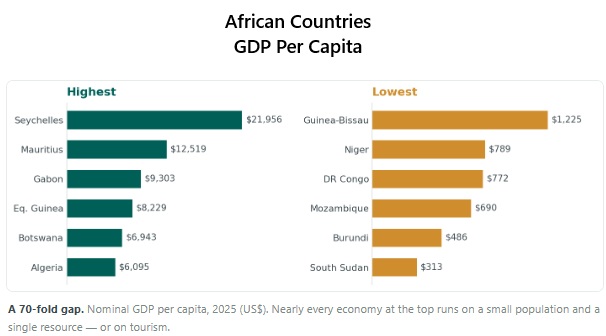
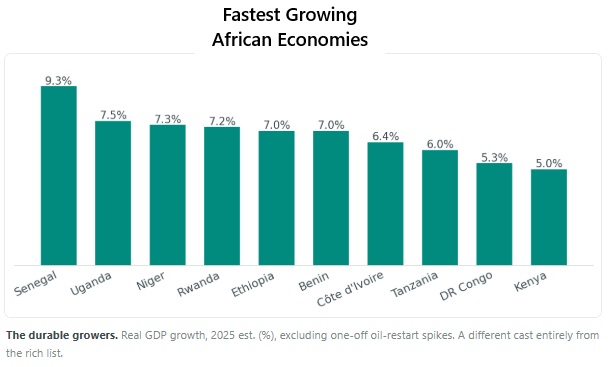
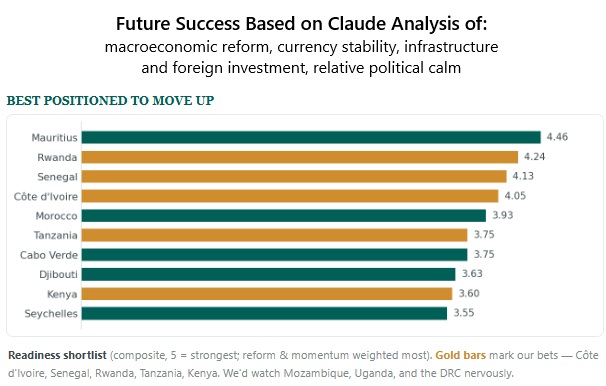
We spend a lot of time staring at GDP-per-capita tables (what are you doing with your spare time?), and this week we stared at Africa’s. The top countries looks impressive until you notice what it’s made of. Seychelles ($21,956) and Mauritius ($12,519) lead, trailed by Gabon, Equatorial Guinea, Botswana, Libya, and Algeria. Strip away the two island economies and the “rich” list is mostly small populations sitting atop oil, gas, or diamonds. High income, it turns out, is often just large rents divided by few people. These are currently the largest economies but what are the fastest growing ones? Mostly not the largest ones. The countries actually growing—Senegal, Rwanda, Côte d’Ivoire, Benin, Tanzania, Niger, Ethiopia—are lower-income reformers, not incumbents. (We set aside South Sudan’s 27% and Libya’s 16%; those are oil restarts bouncing off collapsed bases, not trajectories.) What separates the movers? It appears, according to Africa watchers, mostly boring policy stuff such as macroeconomic reform, currency stability, infrastructure and foreign investment, relative political calm, and a young population with plentiful job opportunities. What about the future? Can we forecast Africa? Probably not. Mauritius and Gabon began the 1970s in similar places; one diversified and one didn’t. The variable to watch isn’t how much oil or cobalt a country holds—it’s whether the revenue gets reinvested or captured. On that test, based on Claude analysis, it turns out Senegal, our World Cup team, scores pretty well (along with a few other countries). Let’s hope its economy fares better than its soccer teams. It would be good for the world if an African Lion emerged over the next ten years like past Asian Tigers.
China Corner: Kicking Away The Ladder
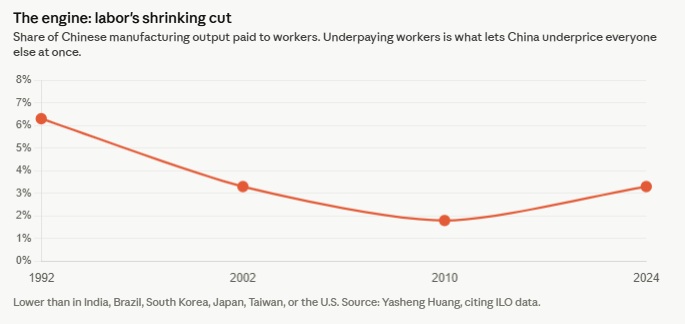
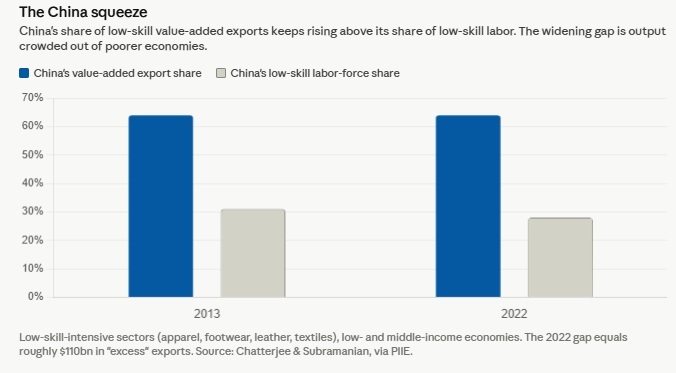
America and Europe are upset with China’s obsession with making everything and exporting it while importing very little. But you know who is really getting screwed by China? Developing countries. For seventy years the development playbook read the same way. Poor countries start with textiles and shoes, bank the wages, then climb toward machinery and chips while the next poor country grabs the bottom rung. Japan handed textiles to Korea, Korea to China. The ladder worked because whoever moved up vacated the space below. China declined to vacate. Yasheng Huang calls it an “absolute advantage economy” — a country that competes with America in AI and with Malawi in t-shirts at the same time. Across ninety-eight industries spanning every level of skill and labor intensity, Chinese competitiveness rose almost everywhere between the mid-2000s and 2023. Between 2012 and 2023, electric vehicles became more competitive — but so did knitted fabric. China remains the largest textile exporter in the world, and textiles are still its number one export. In Africa, Chinese textile imports flipped from helping local producers to crowding them out, raising the specter of “premature deindustrialization.” The engine, Huang notes, is wage suppression: labor’s share of Chinese manufacturing output sits near 3.3 percent, lower than in India, Brazil, or the United States. China underpays its own workers to underprice everyone else’s. We’ve previously alluded to this factor in China makes everything philosophy. China likes to claim other countries should adopt the “China Model” but in reality the China model excludes other countries, including and especially the so-called Global South. The ladder has been kicked out from under them.