It dawned on us this week that Madam: A Novel of New Orleans, is an illustration of James C. Scott’s Seeing Like a State. We generally read two books at a time, a novel and a non-fiction book. Scott’s book asks why so many large-scale, state-led schemes to improve people’s lives have failed, sometimes catastrophically. He argues that modern states want to simplify messy local realities into standardized, measurable forms, in part to control them. Scott’s examples are 18th century German scientific forestry practices, 20th century Tanzanian agricultural policies and Soviet Union collectivization. But he could also have turned to the creation of Storyville in New Orleans, an effort to simplify rampant prostitution into a contained red-light district. Madam tells this story through the life of Mary Deubler, who works her way from the bottom of New Orleans sex trade to become the infamous Madam Josie Arlington, a queen of Storyville. Storyville ends badly and perhaps is additional evidence for Scott’s theories. Or maybe not. Storyville’s demise is a bit more complicated than Scott’s theories. Still, he might have considered the example if only to pull in a few more tawdry readers. It would certainly have made his book more exciting to read (to be clear, we enjoyed it very much, Tanzanian agricultural polices and all). And we hope to lure you with stories of record debt, solar growing faster than demand, and the always sexy topic of local Chinese tax collection. It’s this week’s International Need to Know, pimping out international information, seeing global data like a state.
Without further ado, here’s what you need to know.
Coming Due
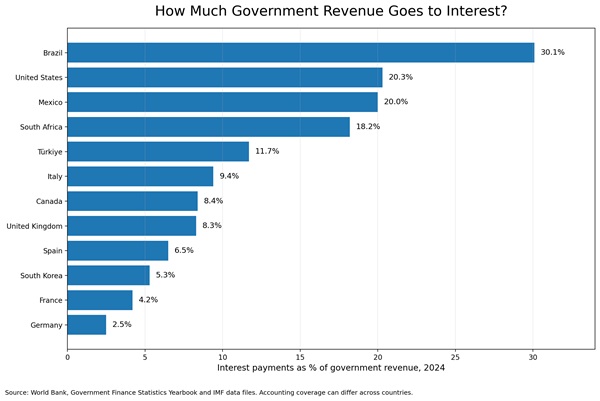
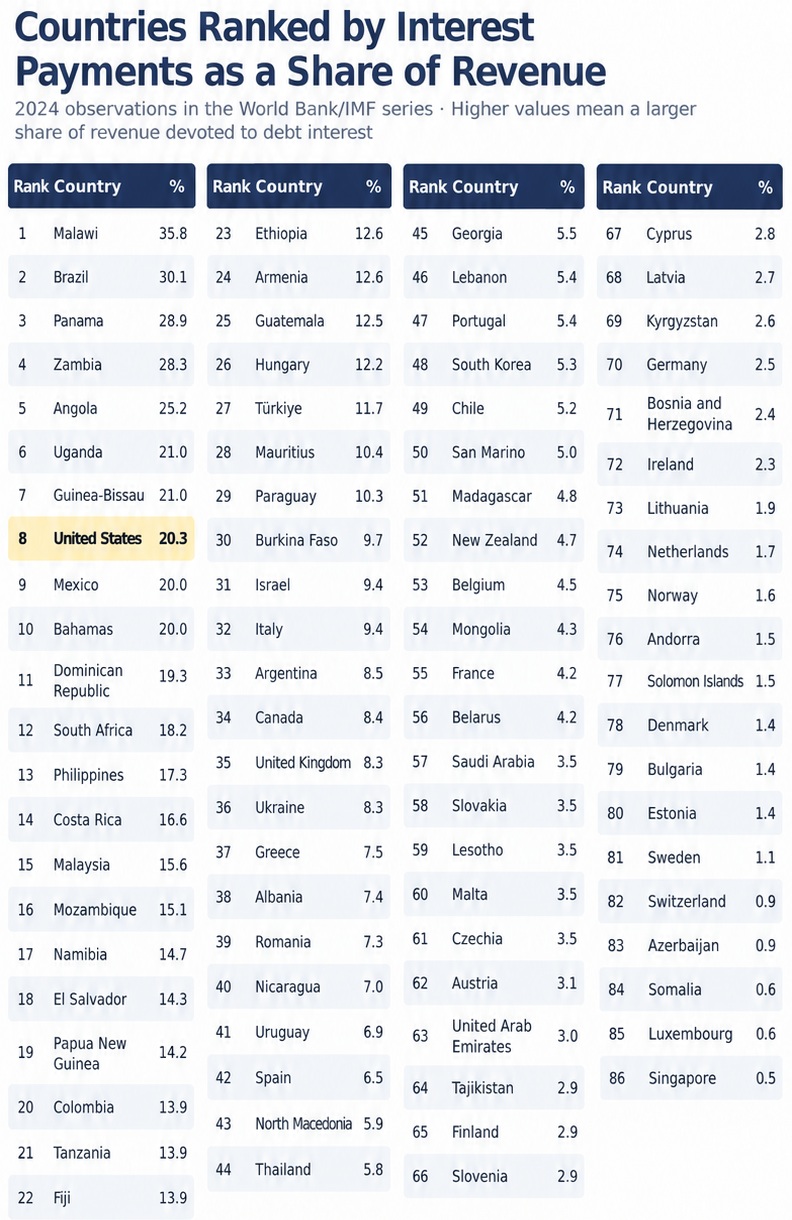
We came across this stat on the socials: “The US government is now spending a record 18.5% of its total revenue just to cover interest on its debt.” We wondered if it was true and if so, how the U.S. compares to other countries. It is true. The U.S. is spending a record amount on interest on our debt–$970 billion–though we point out such data only goes back to 1940. This puts the U.S. in bad company. We looked at World Bank/IMF data which has U.S. interest payments at 20.2 percent (using a different methodology) of U.S. government revenue in 2024. Among major economies, only Brazil, at 30.1 percent, was substantially higher. If you look at all countries, the U.S. is only below a variety of developing countries. So then we started wondering at what percentage things get dangerous for countries. There isn’t a magic number. But there are warning signs in the economic literature. An International Monetary Fund (IMF) study found that advanced economies began responding much more aggressively to rising debt once interest exceeded roughly 11–12 percent of government revenue. A more recent IMF study of Sub-Saharan African countries found that when interest reached 16–19 percent of revenue, the likelihood of subsequent fiscal stress increased significantly. The U.S., unlike these countries, has major advantages, including borrowing in its own currency and the world’s deepest government bond market. The immediate problem isn’t default but rather that paying interest is crowding out other spending priorities. After the financial crisis, a number of countries had to painfully crawl out of their debt problems. Americans are likely to experience some pain in the future.
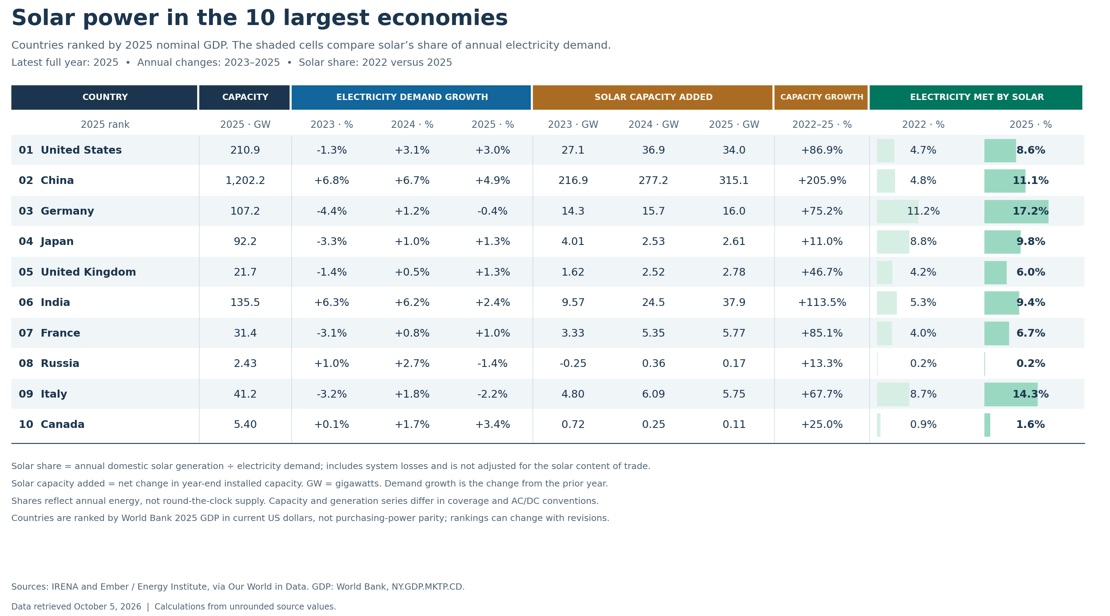
Addendum: Solar power is increasing because it outcompetes other sources economically. Similarly, FedEx just announced it is buying 2000 electric trucks to save money on diesel costs. The world is electrifying no matter your political views.
China Corner: Sexy Tax Talk
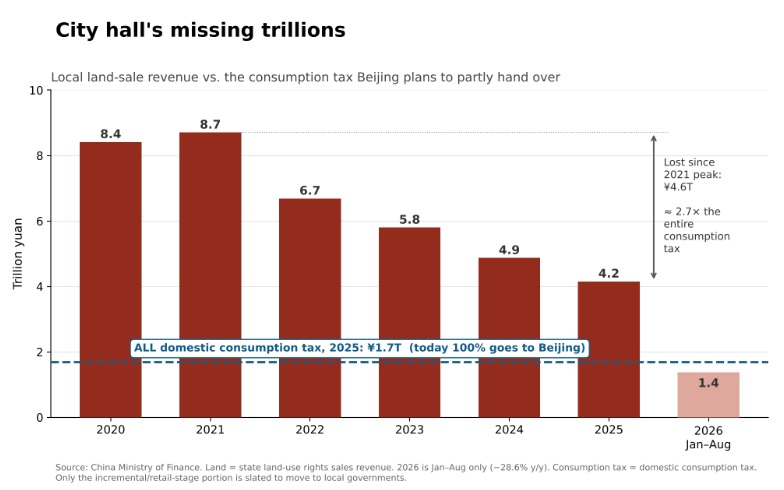
Nothing grabs eyeballs like talk of local tax structures. So try not to faint as we tell you that China is looking at restructuring local tax revenue. Currently, local governments in China get most of their revenue through land sales. They “rent” out land usage rights to developers and buyers while holding onto ownership rights. That worked well when real estate development was going wild in China—partly due to local governments pumping up the market. But since the housing market crash, revenues for local governments have veered into the ditch. Slowly, but not necessarily surely, legislation is working its way through the Chinese Communist system to shift to consumption tax collection that would be shared with local governments. Today the consumption tax is centrally collected, with all revenue going to Beijing. In March, the Finance Ministry said it would accelerate legislation for a local surtax and advance the consumption tax law in 2026. The plan includes shifting part of collection to the retail level and allocating incremental revenue to local governments. That’s probably a necessary step but not sufficient. Land sales revenue dropped nearly a third in the first half of 2026 to 977.8 billion yuan. The proposed replacement, consumption tax, raises 1.7 trillion yuan a year, but localities would only get a slice of that. And, of course, it’s an open question whether this legislation is passed this year or even next. China is doing very well in manufacturing and exporting but the people, and local governments, continue to feel lots of pain.