We crossed our street to retrieve ads and other litter from the mailbox. As we did so we could hear loud muttering from the green truck parked nearby. We’d heard it often over the years, but this day it sounded more desperate, filled with curse words and various laments. The voice belonged to—we’ll call him Randy—the man who lived in the house across the street. He quickly limped up to us. He smelled, as he often did, of alcohol. He informed us that he would be leaving in a day or two, the house about to go on the market. His Dad had died of brain cancer and his step-mom was selling the place. This was a bit shocking. Not the part about selling the house, the part about his step-mom—an old woman who we’d never seen smile, never heard utter a word to anyone in the neighborhood—we’d assumed she was his wife and perhaps this explained his drinking or perhaps his drinking explained her dour, angry demeanor. But the drinking certainly explained why Randy looked so old that we assumed the ancient woman was his betrothed, not his step-mom. Randy, it turns out, is considerably younger than we are (and we are quite young) but a life spent drunk will age you well beyond your years. In fact, Randy admitted as much to us in front of the mailbox—he has cirrhosis of the liver and his doctor told him he won’t make it until 60 if he doesn’t stop drinking. Randy claimed he planned on entering rehab, but we have our doubts. He also expressed regret for his life, noting that he has wasted it, neither married nor a father. Indeed he related much of his life story to us, and it was a wasted one, in both senses of the word.
His right foot was half-clad in a Croc cut out to fit its large swelling. He had broken it recently in two places but the doctors said they could not operate because of his diabetes. He wanted to say goodbye to us, since he was moving to the beach. It seemed, as we inquired politely, that there was no actual house or apartment he was moving to. We worried, as his step-mother moves to a retirement home, with his Dad now gone, with his not being on good terms with half-siblings (his Dad had three children with three women—perhaps yet another reason for the step-mother’s continual, overbearing anger), that the sand might be Randy’s new home. Randy over the years was never a friend or confidant—indeed he was somewhat obnoxious and prone to prejudice, alcohol might contribute to that as well—and we generally did our best to avoid him, though his proximity sometimes made that difficult. Nonetheless, we feel a certain sadness learning of his story, and we worry for his safety, like one does for a stray animal facing the elements, no matter how feral they might be. We offered words of advice that wafted through the old, stale beer air, past him, over him but likely not into him. So we sigh sadly and see that poverty permeates where there is conflict, note where India is popular and examine where Chinese exports are increasing. It’s this week’s International Need to Know, throwing our Annual Seattle Mariner Temper Tantrum(TM) while tossing international information curveballs and global data cutters.
Without further ado, here’s what you need to know.
No Peace No Poverty Reduction
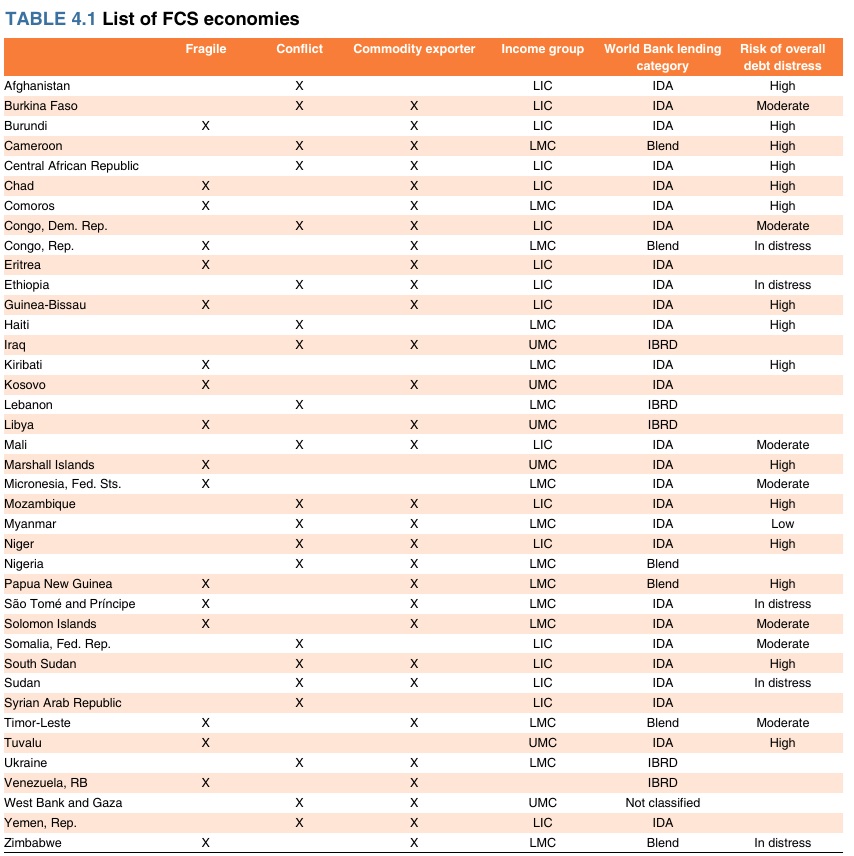
The world has made great progress over the decades, and even in recent years, in reducing poverty, with far fewer people living in extreme poverty. But where extreme poverty persists is in lands embroiled in conflict. According to the World Bank, “In developing economies in general, the extreme-poverty rate has been whittled down to single digits—just 6%. In economies facing conflict or instability, however, the rate is nearly 40%.” GDP per capita levels in these countries are essentially the same as in 2010, while in other developing countries they have doubled to an average of $6900. It’s hard to have a functioning economy in a land at war, conflict or when facing instability and that translates to fewer jobs. The World Bank also reports that “more than 270 million people were of working age in these economies—but barely half of them were employed.” As you may have noticed, conflicts have been on the rise in recent years and these conflicts are not short-term affairs—a night tearing up a motel–with half of them lasting 15 years or more. As you can see from the list below (FCS is a French acronym for counties in conflict), many of these countries in conflict are located in Africa. To solve the remaining extreme poverty issues in the world, we need to resolve conflicts.
Who Likes India?
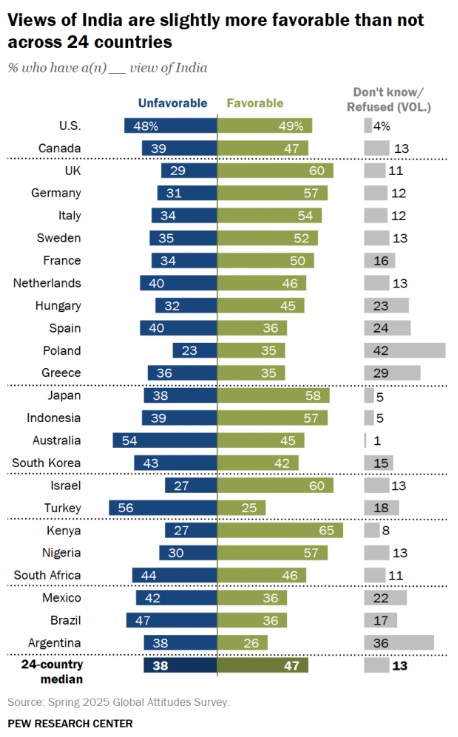
Indian Prime Minister Narendra Modhi was in China this week as part of the Shanghai Cooperation Organization meetings. India joined this organization in 2017, but some folks are wondering if Modi is establishing closer ties with China because the U.S. has imposed 50 percent tariffs on Indian goods. Seems pretty plausible to us but we’re not three-dimensional geopolitical chess players like the Trump administration. Reading this news got us to thinking about India’s popularity around the world, a country we predict will be the most important of the 21st century. Pew Global gives a bit of an answer through a survey of 24 countries conducted in April. Overall, 47 percent of respondents have a favorable view of India with 38 percent having a negative view of the most populous country in the world. India is most favorably viewed in Kenya, followed by its former colonial masters—the U.K. (which is home to many Indians), Israel, Japan, Germany, Nigeria, Indonesia and Italy. Among these 24 countries, India’s ratings are lowest in Turkey, Australia, Brazil and the United States (this poll was taken pre-India-tariffs). Overall, views of India have become more favorable over the past year. It’s worth noting that men are more favorably disposed than women towards India.
China Corner: Into Africa
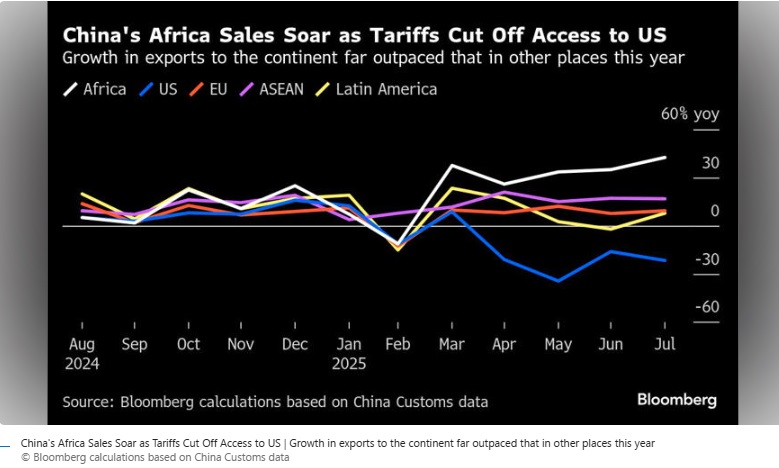
Chinese exports to the United States are down about 20 percent so far this year. But Chinese exports overall increased so far in 2025. In fact, they are up by about 11 percent. Exports have increased to Asia, including to places like Vietnam and Indonesia (only a small percentage of which is transshipment to the U.S.). But China has also increased its exports to Africa. Chinese exports to Africa increased 25 percent to date in 2025. Bloomberg reports that “China’s exports to Africa so far in 2025 are more than in the whole of 2020 and on track to exceed $200 billion for the first time.” We noted in June the huge increase in solar panel imports from China to Africa but China is selling more than that. Africans are buying cars, motorcycles, construction machinery, steel, batteries and more. Nigeria, South Africa and Egypt are the top African buyers of Chinese goods so far this year but a large swath of African countries are importing more goods from China. In 2017, we read an excellent book by Irene Yuan Sun called The Next Factory of the World: How Chinese Investment Is Reshaping Africa. The author wasn’t talking about Chinese government investment but rather individual companies setting up shop in Africa. Africa has not yet become the next factory to the world but there is opportunity there for countries that seize it.