So it’s finally going to happen. We’re going to be canceled. What we’re about to write will send people for their pitchforks and torches. The Savannah Bananas are the lamest cult ever. Yes, last weekend we attended a Savannah Bananas, well, it’s not a game, exactly. We guess some might call it an experience, but it’s in many ways more like a rally or an assembly or whatever you call it when a large cult meets. We were told before attending that the Savannah Bananas are a sort of baseball version of the Harlem Globetrotters. It’s been a long time since we saw the Globetrotters but we remember them fondly whereas with the Bananas we considered requesting a frontal lobotomy during the top of the first inning. The evening certainly epitomized nearly everything wrong with the modern world. It was a constant assault on your senses–no down time is ever allowed for even a second. Something must be happening every single nanosecond during your time at the ballpark, whether warranted or not.
There is singing and dancing involved which we ordinarily heartily endorse but the songs were entirely predictable and of course, this being a short attention span audience–lasted no longer than eight bars. Indeed at the beginning of the game/event/rally/sermon they ostentatiously put up a clock counting down from two hours–the event will last no longer than that–because of course we moderns cannot concentrate on anything for any length of time whatsoever and we need to know exactly when it’s going to end like a 15-second TikTok video. It was also loud, which again we wouldn’t mind except it was mindless, horrible noise, nearly causing one to grab an axe Jack Torrance-like. We are compelled to admit that we were alone in our despair. The crowd around us was generally ecstatic, mindlessly mimicking whatever the lead Banana told them to do, obeying like the good cultists they are. There have been many events and actions this year to give us great concern but through it all we’ve worn a hidden armor of hope. Unfortunately the Savannah Bananas pierced it and even though we left with one hour and 38 minutes left (thank God for the clock to tell us exactly when), we have never felt so hopeless and desperate. The Savannah Bananas? We are utterly doomed. And yet we persevere with three insights from our most recent trip to Vietnam where we were traveling the last few weeks, including increased EVs, love lost for Trump and its complicated relationship with China. It’s this week’s International Need to Know, the wildcard of international information, the AL West Division Winner of global data.
Without further ado, here’s what you need to know.
Rise of the Vietnamese EV
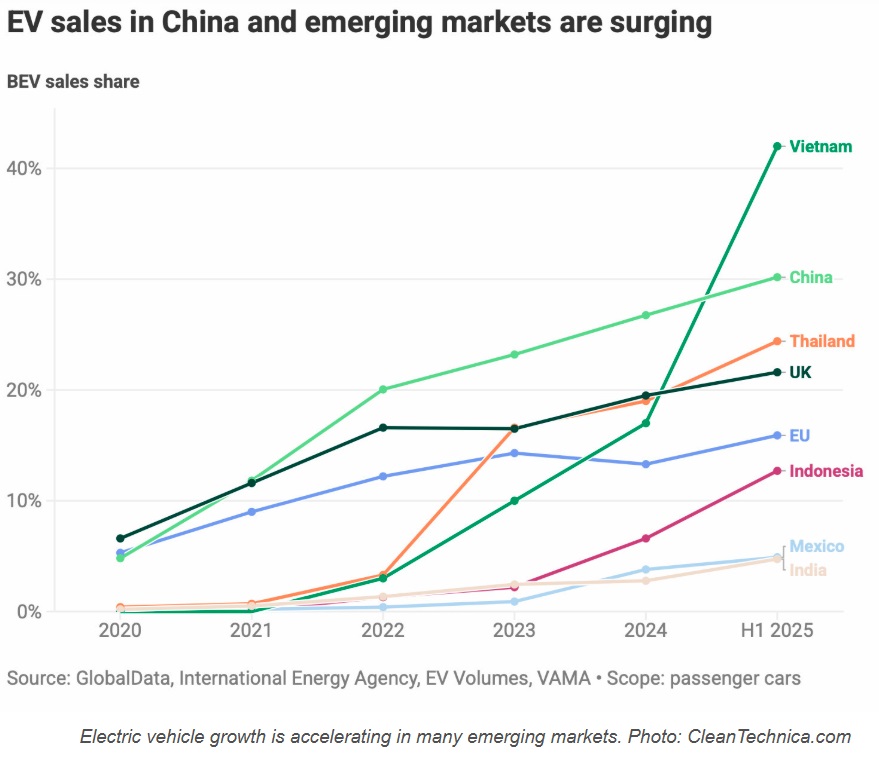
One of the things first-time visitors to Ho Chi Minh City notice is the traffic. It’s challenging. But it’s changed considerably in recent years. There are actual crosswalks and lights in much of the city and sometimes even a semblance of lanes. There are still lots of scooters but also many more cars. There are more electric cars than previously though they are still not the majority. But because autos are just now replacing scooters in Vietnam, likely EVs will quickly be the dominant car in the country. In fact, just over 40 percent of new vehicle sales in Vietnam are EVs, as you can see in the chart below. Of course, many of the EVs sold are motorbikes. Most of the electric cars and motorbikes we saw were made by VinFast, the Vietnamese electric vehicle startup. We rode in a few of them. Vinfast doubled its sales of its electric cars during the first six months of this year. We did not see many Chinese electric EVs despite the fact they are being exported from China around the world at record levels. Indeed, BYD is now one of the largest auto manufacturers in the world. But Vietnam, which last time we checked is right next door to China, is not yet a large market for Chinese EVs. That’s due to policy. Vietnam imposes anywhere from 47–70 percent tariffs on Chinese vehicles. In addition, VinFast beat Chinese autos to the market and have built a vast network of over 160,000 charging stations. Vietnam is electrifying its future, as are many countries around the world.
Losing Their Love of Trump
During trips to Vietnam in 2018 and 2019 we were struck by how popular Trump was among many Vietnamese. They would often bring up the subject with me during conversation, wanting to make sure we knew how much they liked Trump. This was reflected in polling which showed Trump was popular in Vietnam. We have not seen updated polling for Trump’s second term but anecdotally Trump is no longer so popular. This time in conversations the main message we heard is “we are waiting for three years from now.” It’s not surprising that a man who placed high tariffs on Vietnam would lose some of his sheen (an orange one, obviously). The “trade agreement” between the U.S. and Vietnam will lower the original tariff level from 46 percent to 19 percent. We use quotes because despite what Trump has said, there is still no completed trade agreement. A Truth Social post is not an agreement. While we were in Vietnam, negotiations on the details of the agreement continued. Vietnamese don’t yet know what will be in the agreement. In addition to tariffs, we got the feeling Vietnamese were concerned about the general chaos Trump stirs up, something he does as naturally as breathing. When your next door neighbor is China, you crave stability in the counterweight. There is none currently. So Vietnamese wait for three years from now…we didn’t have the heart to say to our conversationalists, are they so sure of the outcome?

China Corner: Looming over Vietnam
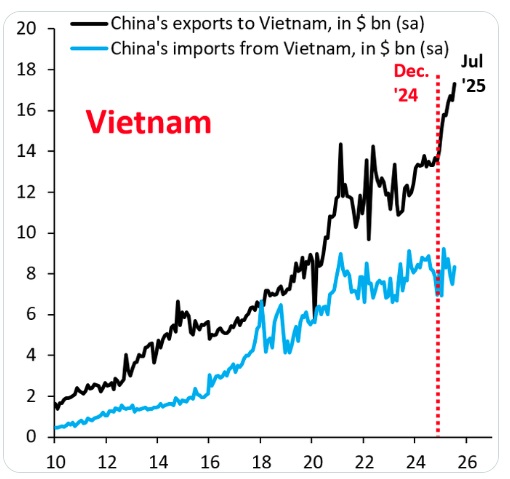
Vietnam practices “bamboo diplomacy” bending to the winds of China and the U.S., but China’s gale is far closer. Indeed, China looms over most things in Vietnam. We toured a shoe factory during our trip, a factory that moved from China to Vietnam in 2014, so well before trade wars and covid. But the factory’s owners are grappling with U.S. tariffs. A finished product under the still being negotiated agreement mandates products containing a certain threshold of Chinese components will be tariffed at 40 percent, not 19 percent. Shoes are assembled in Vietnam with an increasing share of Vietnamese components, though many still come from China. That is likely to change. But how fast can companies make the change? And what will tariffs mean for Vietnam’s role in the supply chain, even at the lower 19 percent tariff level? Meanwhile, Vietnam and China still have disagreements in what Vietnam calls the East Sea and China dubs the South China Sea. During our trip, Vietnamese Deputy Prime Minister Mai Van Chinh and Chinese Vice President Han Zheng met during a China–ASEAN Business and Investment Summit (CABIS) in Nanning. They vowed “to boost strategic, comprehensive, and substantive cooperation.” And the bamboo sways.