We’re retiring…from the NBA. We’re a lifelong fan but it’s a broken sport–business-wise, customer-service-wise and competition-wise. That’s a lot of wises and we might write about this at more length some other day but for now the question is what to do in retirement. We’ll have time on our hands not watching the playoffs. We had romantic notions to raise bees a la Sherlock Holmes but two summers ago we learned (painfully) that we are allergic to the critters. So instead, we are re-landscaping our yard, which perhaps does not entirely protect us from the bumbles, wasps and other stingers but should be relatively safe. And so what did we turn to for advice and help? Claude, of course. Anthropic’s AI Claude to be precise. We took photos of a dilapidated garden bed below a window in our front yard, told Claude this was in Seattle and informed it which direction the space faces. Claude provided us with three options, including images of what it would look like, created a planting diagram and spun up a budget and shopping list. Now if only we had a robot to do the work, our back, knees and shoulders would be in great shape.
Nonetheless, we were pleased with the results and so turned to a spot that was long anchored by a lonely azalea that refused to grow. Voila, it is now transformed (well, maybe not voila—there was a lot of backbreaking toil involved). We then tackled the steppingstones and adjacent rose bush area. They look great now too. We are set to relandscape the rest of the front of the house and perhaps in the fall (with the Mariners seemingly not going to make the playoffs) we will attempt to reinvigorate our backyard’s Japanese Garden that has been ravaged in recent years by an infestation of rabbits (look for us dressed as Elmer Fudd, a rifle in our hands, the neighbor’s children aghast). The only problem is our hamstrings feel like Luka Doncic’s, our back like Victor Wembanyama after a hard fall, and our knees like Jalen Suggs’ on the way into the operating room. Nonetheless, we dig up Japan’s weapons export capacity, see the sun shine on the UK’s Hamlet-like coal usage, and pull out weeds from China’s auto dominance aspirations. It’s this week’s International Need to Know, working on our Seattle Mariner Annual Temper TantrumTM even while providing international information and global data for the willing and the able.
Without further ado, here’s what you need to know.
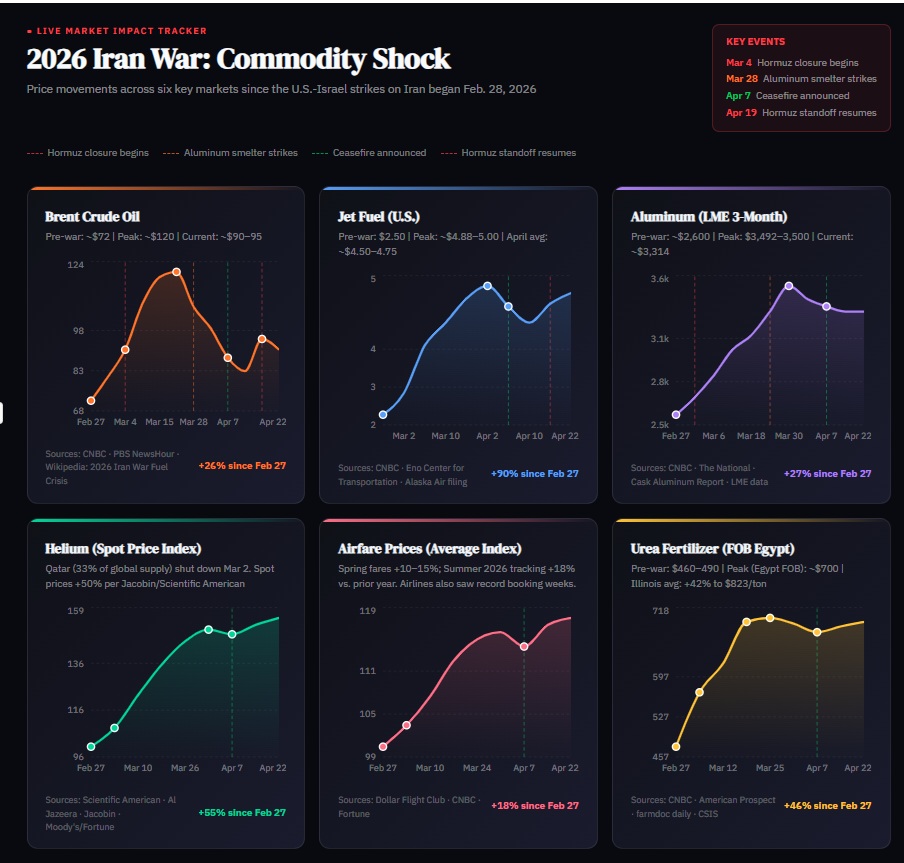
The Strait of Hormuz is still in a straitjacket as you can see in the Hormuz Trade Tracker we’ve previously linked to. At the bottom of today’s missive, we’ve posted an Iran War Shock Tracker. Each day without a resolution will bring more and lasting economic pain for the world.
Changes Not Seen in a Century
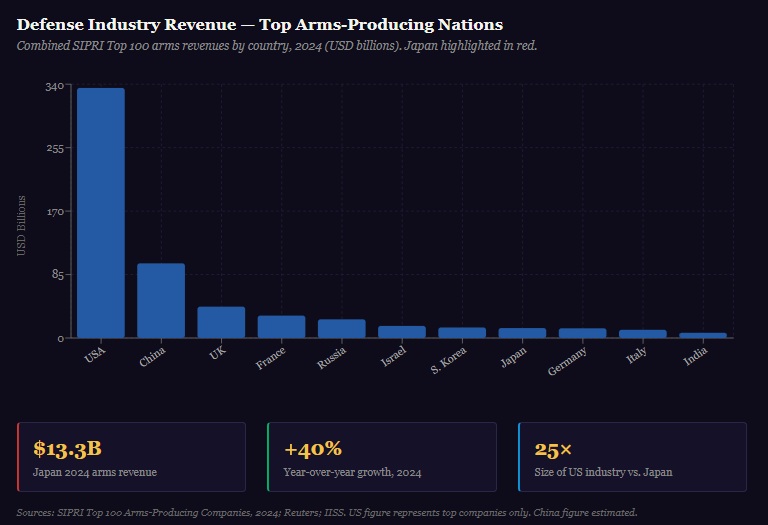
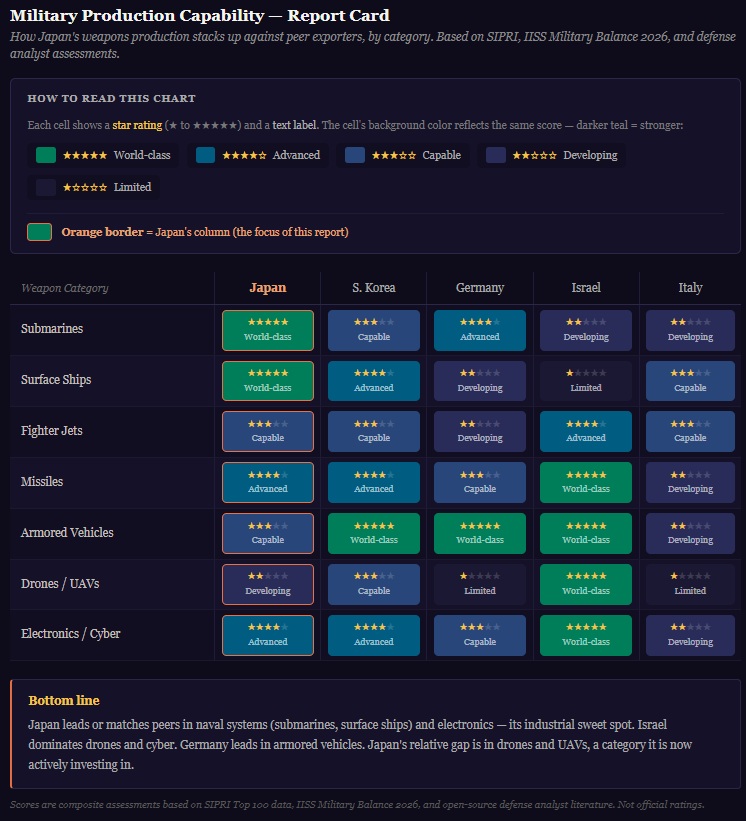
Changes not in seen in a century, old man Xi Jinping has said many times. But change cuts multiple ways. For eighty years Japan has maintained a self-imposed arms-export ban, a penance for World War II written into postwar pacifist policy. Earlier this week, Prime Minister Sanae Takaichi’s cabinet ended the detention. Japan will now sell lethal weapons—fighters, submarines, warships, missiles—to any country that promises to abide by the UN Charter and isn’t currently at war (with some conveniently vague exceptions for “special circumstances”). Timing, as they say in comedy and geopolitics, is everything. The Iran War has strained U.S. weapons production to the breaking point, European allies are rattled by Trump’s ambiguous security commitments, and countries from Warsaw to Manila are shopping urgently for alternatives. Japan’s Mitsubishi Heavy Industries — which just landed a $6.5 billion contract to build three warships for Australia — is very much open for business. Japan, even without exporting, maintained a vigorous defense industry. Japan’s Soryu- and Taigei-class submarines are among the world’s best conventional subs. Its Mogami-class frigates are packed with advanced automation. And it’s co-developing a sixth-generation stealth fighter with the UK and Italy. The constraint is about volume not quality. Japan’s defense industry revenue hit $13.3 billion in 2024, up 40 percent in a single year, just behind South Korea and on par with Israel, and Germany — all without selling a weapon abroad. Yep, changes not seen in a century.
Coal Use at 400-Year-Low in UK
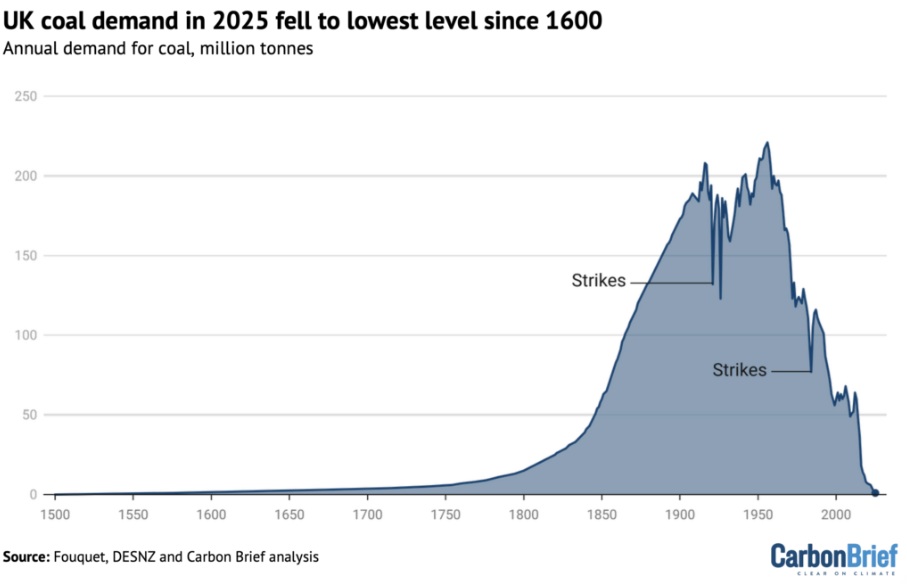
As we’ve documented here in recent months, many countries are at or near a pivot point where their carbon emissions will start to fall. The U.K. is one of those. The country has many economic and social issues at the moment but one bright spot is that it is using far less coal. How much less? As Simon Kuestenmacher wrote, “The UK used less coal in 2025 than they did in 1600, when Shakespeare was writing Hamlet.” Now if only Simon would use fewer letters in his last name we’d really be getting somewhere. Carbon Brief is on the story, noting that the reason for the fall is because gas use is at a 34-year low and coal, as Kuestenmacher notes, is at As You Like It levels. Part of the reason for the fall in coal use is policy leading to a cessation of coal power. But part of the reason is because of the aforementioned challenging economy—various steel factories closing, for example. We see something similar with the decrease in gas usage. Carbon Brief notes it “was mainly down to lower demand from building heat and from industry, likely at least partly related to record-high temperatures and elevated gas prices.” So lower CO2 emissions, while good for the environment, are not happening entirely for helpful reasons.
China Corner: The Kandy-Kolored Tangerine-Flake Global EV Market
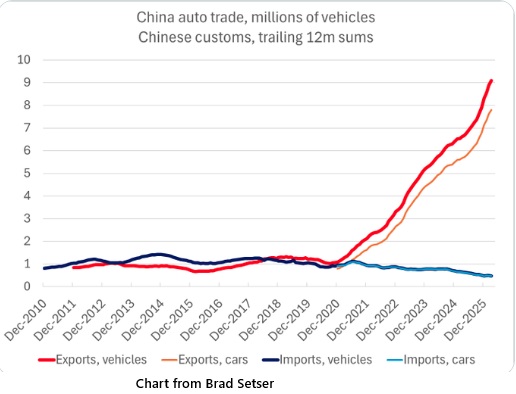
China’s electric vehicle companies are increasingly setting up shop in other countries as they work to gain even more market share globally. Japan did something similar when its auto companies ascended. As part of this effort, China’s BYD built factories in Brazil. However, Brazilian labor inspectors in late 2024 discovered 163 Chinese workers in “slave-like conditions” building what was to become BYD’s largest electric vehicle factory outside Asia, in the northeastern state of Bahia. Workers had their passports confiscated, were forced to work long hours, and had 60 percent of their wages withheld. Brazil’s Ministry of Labor published its semi-annual “Dirty List” update in early April, and BYD made the cut — inspectors concluded the company bore direct responsibility for the workers’ conditions, rejecting BYD’s argument that subcontractors were solely liable. The number of affected workers had by then risen to 224. But this is a pet project of the Brazilian government which is busy building economic ties with China. So, Labor Minister Luiz Marinho told the Secretary of Labor Inspection to hold off on adding BYD’s name, without citing any technical justification. Two days later, a court granted BYD an injunction removing it from the list. The secretary, Luiz Felipe Brandão de Mello, refused to comply and added BYD anyway. He was promptly fired. Chinese EVs are from all evidence fantastic vehicles and may take over the world with good consequences for the environment but dire consequences for Japanese, European and American car companies, all of whom are working to partner with Chinese companies. However, the road to auto manufacturing dominance is littered with labor potholes. Plus various countries worried about their domestic industries may construct dead ends for China. Like one of our road trips, we’ll bring plenty of snacks as we watch this play out from our old Subaru.
Iran War Impact Tracker