It’s that time of year when most weekday late afternoons/early evenings you can find us on our bike riding the Interurban trail, not that you’re likely looking for us. On the trail, in perfect Seattle summer weather, we see people walking dogs of all sizes and types, happy dogs, curious dogs, old dogs and new ones learning old tricks. We even occasionally see someone walking a cat on a leash, something we used to do with the GOAT Putter, much to the delight of the old ladies in our neighborhood, and to the distress of the crows shouting from the sky and trees. This year, on nearly every ride, we see a woman pushing a man lying prone in a wheelchair, his body askew in an unnatural position, his neck also at an awkward angle so that his face looks straight up to the sun shining down on him, unlike the bad luck that cast such darkness on his fate. But we don’t know what led him to this position, whether an accident, an unfortunate illness or bad genetics from the get-go. It is not this man that captures our attention though, but rather the woman dutifully every day taking him on a stroll, pushing him down the path. She appears to be a family member, maybe a sister. Whatever the relationship and history, she is clearly devoted. She does not look burdened but rather privileged at the opportunity to provide the sky, the sun to this man, who betrays no emotion on his face, but will move his neck just a touch for an even greater gaze. We take this all in whilst racing by pedaling and pedaling. But the repeated daily glimpses add to a fuller picture, like individual frames of a movie. Our projector shows how the world really has gotten better, analyzes countries’ commute times and wonders about China’s expanding definition of Taiwan. It’s this week’s International Need to Know, scoring goals for international information, never flopping on global data.
Without further ado, here’s what you need to know.
Yes, Damnit, The World Got Better
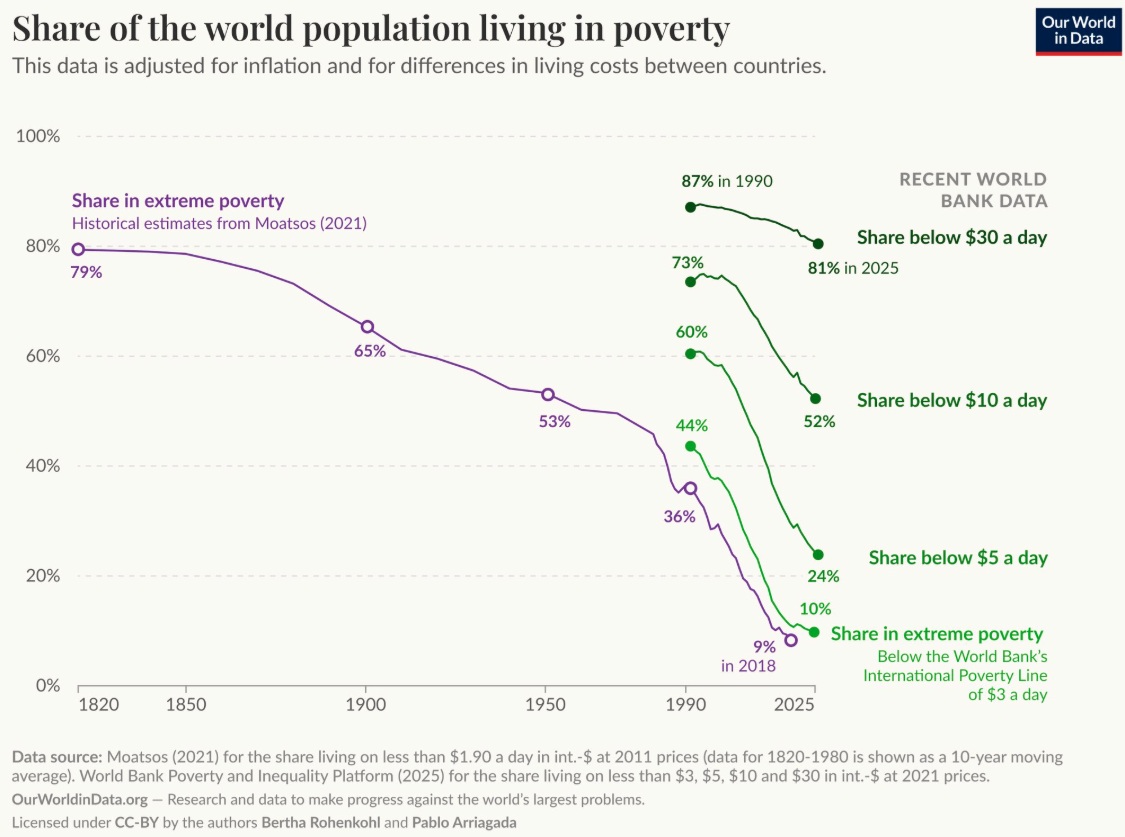
People have no idea how good we have it. We are living in the greatest era in human history and yet all we do is complain. If more of it was constructive criticism, we’d applaud as perhaps it would lead to even greater improvements. But mostly it’s destructive, kvetching about how bad things have become. And that constant whining and complaining has led to today’s governing climate in America and in many other countries where leaderships are indeed implementing policies that could lead to a less bright future. Three weeks ago in our Trump Law-Breaking and Corruption Tracker, we detailed how things have improved, even and especially in recent decades, including in America. Earlier this week, Dina Pomeranz, an economist at Harvard, posted the chart below on the share of the world living in poverty. As you can see, it has fallen dramatically. This is true for various levels of poverty as you can see in the lines in green. And note when the fall was most dramatic: in the last three decades, an era that so many have besmirched so loudly that we are now radically changing the policies and rules that led to that success. It’s madness. Stop it. Acknowledge how helpful the post-cold war era was for humanity and examine the policies that everyone complained about that actually improved all of our lives, even woe begotten Seattle Mariners’ fans.
Who Commutes The Longest?
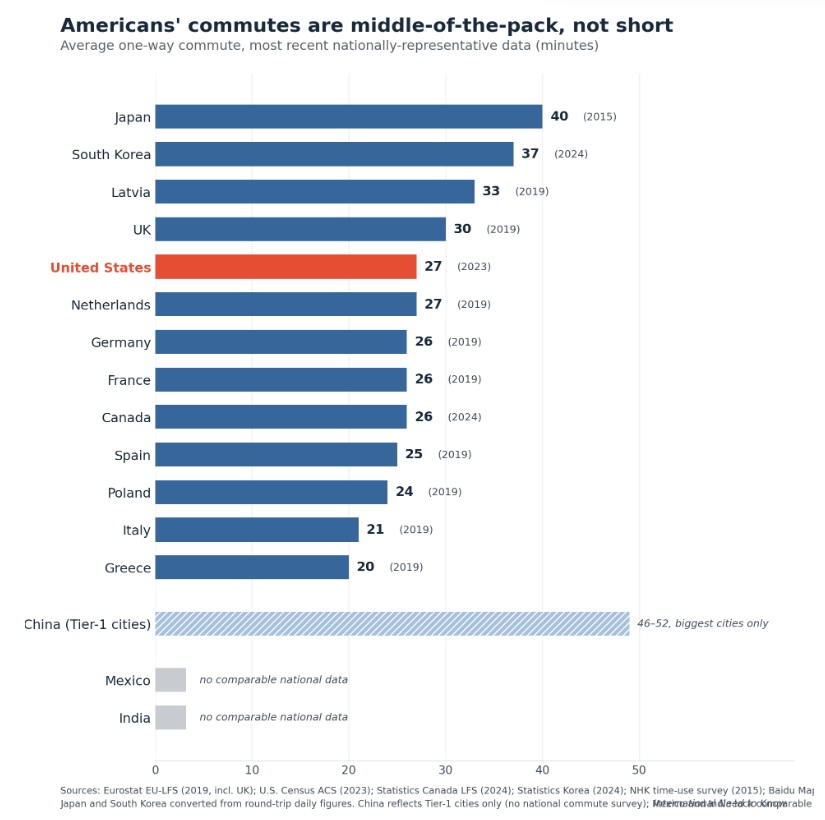
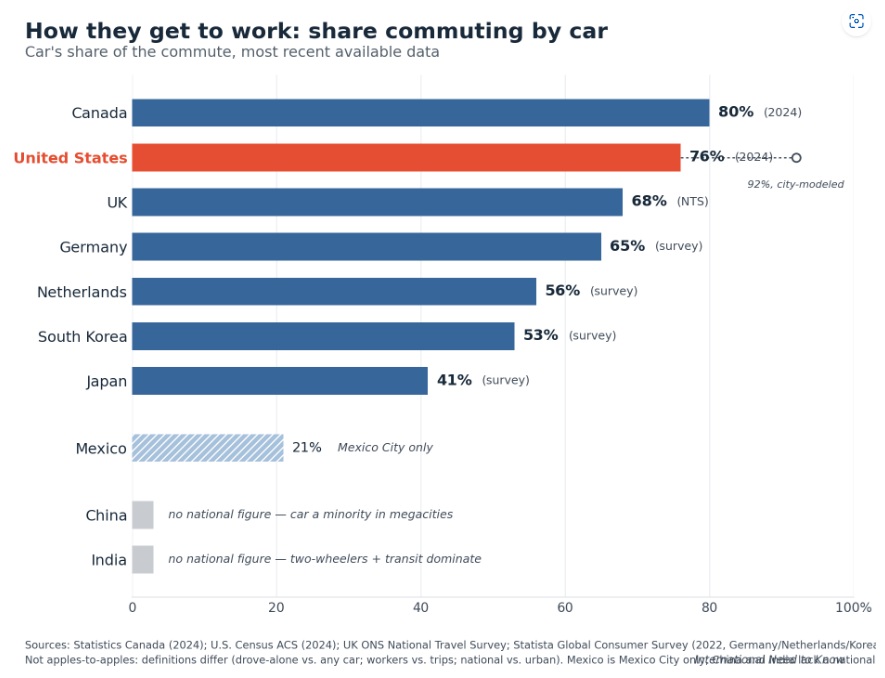
I came across a chart over the weekend showing commute times for OECD countries and was surprised to learn that Americans commutes are on average shorter than most of the rest of these countries. But when I went to the source, I found this was old data and the way countries measure commute times is different. That chart came from the OECD Family Database, and most of its surveys date to 2008–2010. Worse, it counted travel to work or study and included everyone—workers, the self-employed, and people who aren’t employed at all. That diluted the American figure to roughly 20 minutes a day, which is how the U.S. ended up looking so enviably efficient. Surveys built specifically to measure commutes tell a different story. The U.S. Census American Community Survey puts the average one-way American commute at about 27 minutes in 2023—slightly longer than Canada (26) Germany (26), and France (26) (the EU average is 25), not shorter. Only Japan and South Korea clearly out-commute Americans, and even that needs a caveat: those figures are usually reported round-trip, so Korea’s headline 74 minutes is really about 37 each way. Unfortunately, there are not similar methodologies so it is hard to do clean comparisons. Europe and North America run regular commute surveys. China relies on phone-mapping data covering only its largest cities, where one-way commutes run 46–52 minutes. Mexico and India have no comparable national figure at all. Essentially, Americans commute more or less the same as everyone else, which in itself might be surprising given the stereotypes. Now, of course, how people get to work varies as you can see in the second chart. A 40-minute train ride in Japan is different than a 27-minute drive in America and which you prefer might depend on your taste. At any rate, it’s far more complicated than the original chart we saw over the weekend, which is perhaps a metaphor for how people discuss life itself.
China Corner: Everything is Taiwan
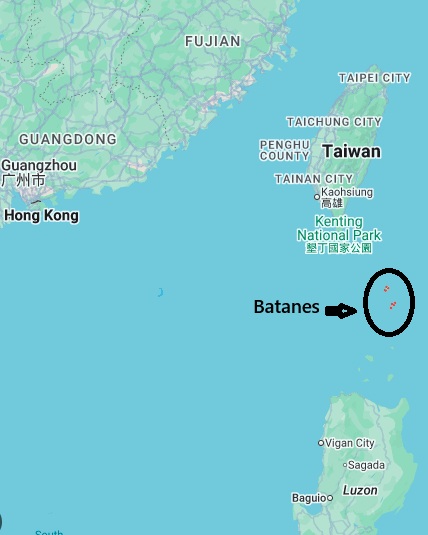
It all looks so peaceful in the photos—wooded emerald hills, rocky coasts and cut-out cliffs—who would have guessed it could be the site of a major international flashpoint. But Chinese academics have placed Batanes square in their sights. Batanes, you likely ask—what is that? Batanes is the Philippines’ northernmost island province, an archipelago of ten small islands in the Luzon Strait between northern Luzon and Taiwan. The entire province has only about 18,937 residents, making it the Philippines’ least-populous province. Batanes sits only about 160 kilometers—roughly 100 miles—south of Taiwan, beside sea and air routes connecting the South China Sea with the western Pacific. That places it near the southern approaches to Taiwan and makes it strategically valuable in any Taiwan crisis. Earlier this month, several Chinese scholars argued at a symposium that the islands were geographically or historically connected to Taiwan and should belong to China. The Philippine government called the argument baseless. Importantly, the Chinese government itself has not formally asserted sovereignty over Batanes, so this was not an official territorial claim—at least not at this stage. However, Beijing has sometimes allowed academics, commentators or unofficial maps to test contentious ideas before the government adopts—or distances itself from—them. So was this merely nationalist academic speculation or an early example of China expanding the historical narratives it uses to justify strategic claims? Keep an eye on Batanes, now that we all know what and where it is.