When you’re old, whether human or feline, you’re likely taking some medications. That’s true for our cat, Willow, who turned 20-years-old today. She takes blood pressure, thyroid and anti-seizure medicine, the last of which two times a day orally. We shoot that dose into her mouth using a syringe which was manageable when done together with the International Need to Know spouse. Typically we hold Willow, prying open her mouth with our hands, while INTNS squirts the liquid through Willow’s open jaws. But last week, INTNS suddenly had to travel for work and we were left to our own devices. We, like any normal person in the 2020s, searched the Internet for video instructions on giving cats medicine. We studied them like NFL coaches examining game film, JFK conspiracists interrogating the Zapruder tape, or trial lawyers watching tape of their own mannerisms and arguments. But nothing is like the real thing. The first morning we scooped up Willow, placed her on our lap, put our hand around her head like the woman in the video, using the same hand to pry open her mouth, and with our other hand squirted the medicine right into Willow like we were a veterinarian who had done this thousands of times. The first few days were easy but perhaps we got cocky or Willow decided to test us because towards the end of the week we medicated our shirt or the floor or other places not in need of anti-seizure medication. We were forced to reload up the syringe and try again, which was stressful to beast and human. But when you are as cute and loveable as Willow, as you can see in these photos with her catnip banana in her beloved lair, you do what you must. And we must tell you about masculinity around the world, how AI hasn’t come for India’s IT jobs (yet), and the decline of manufacturing jobs in China. It’s this week’s International Need to Know, purring over international information, gnawing over global data.


Without further ado, here’s what you need to know.
Masculinity Around The World
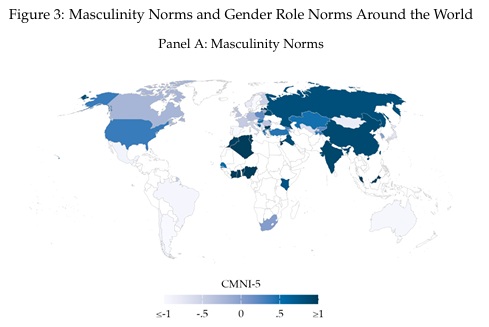
There is a new paper about Masculinity Around the World. Clearly the most masculine act is to write a weekly newsletter about what’s going on internationally. The four researchers who wrote this paper, however, conducted a Global Masculinity Survey with 125,147 respondents across 70 countries that account for two-thirds of world population and 85 percent of global GDP. They measured masculinity across five items: “winning is the most important thing; sometimes violent action is necessary; it bothers me when I have to ask for help; I love it when men are in charge of women; it is important to me that people think I’m heterosexual.” Men who scored higher in these masculinity scores earned higher incomes. However, they have worse mental health outcomes, which we suppose validates 50 Cent’s study, “Get rich or die tryin.” What about the international data from the study? Turns out masculinity is adhered to most strongly in North and Sub-Saharan Africa, the Middle East, and South and Southeast Asia. Europe scores lower on masculinity with Denmark and Sweden at the bottom. Among Western nations, the United States has the highest masculinity score while at the same time having some of the most egalitarian gender-role attitudes. If you’re man enough, read the whole study.
India’s Outsourced Jobs Aren’t Outsourced to AI
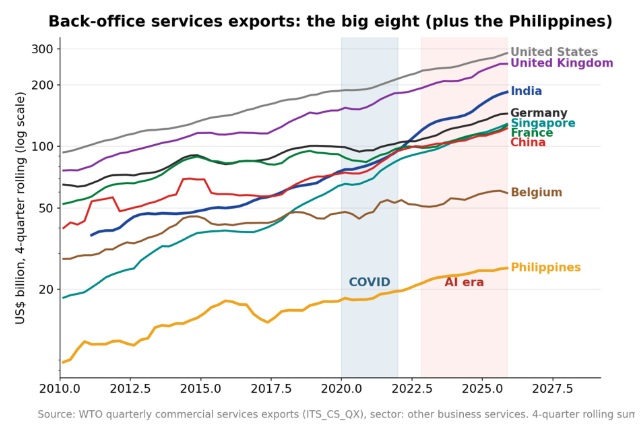
AI is taking all of our jobs. We’re doomed! Or maybe not. In sector after sector so far AI is not eliminating jobs. Lots of folks predicted that the IT jobs outsourced to India would go away. That has not been the case. Economist Richard Baldwin notes that if these jobs were going away we’d see it in the services export data. He writes, “When an American company hires an Indian IT firm to handle its security, the payments to the Indian company show up as an export from India to America. If GenAI really were the fox in the henhouse, decimating the need to offshore back-office jobs, it would show up in the service-exports data.” Guess what? The nine-largest destinations for India’s business services exports have all increased as you can see in Baldwin’s chart below. In fact, India’s back-office exports are increasing at a faster rate the last three years. As Baldwin notes, maybe at some point Indian outsourcing companies will need fewer employees even as their exports increase. But so far that is not happening. AI, again at least so far, like past technologies, is not decreasing the overall number of jobs.
China Corner: Manufacturing Jobs Continue to Fall
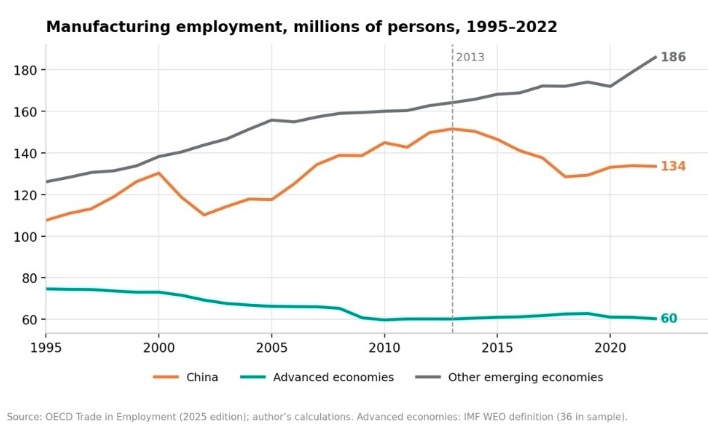
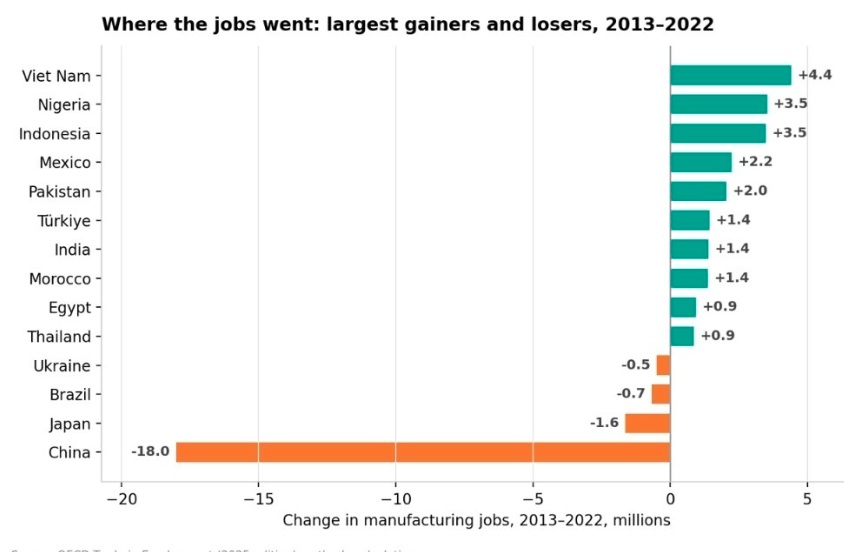
We’ve been on the manufacturing jobs are falling all over the world beat for years. We wrote in this space many years ago that in industrialized countries the number of manufacturing jobs has fallen at the same slope in France, the U.S., Japan—essentially everywhere. We even noted these jobs were decreasing in China. Scott Lincicome of the Cato Institute recently posted a chart showing China’s manufacturing job loss. As you can see from the chart below, the decline in manufacturing jobs has been taking place for over a decade. Now this doesn’t mean China is making fewer products and components. It’s making them using fewer people as these jobs become more automated. We met with a company recently that will be making a product lower on the value chain in China. That factory will be almost entirely automated with very few workers. Note, however, that loss of manufacturing jobs isn’t happening yet in emerging markets. You can see in the second chart below, these kinds of jobs are increasing in Vietnam, Nigeria and Indonesia. But as these countries develop, they will automate more and eventually manufacturing jobs will start decreasing there too. It’s the law of the manufacturing jungle.