We came to Dolly Parton relatively late. We, of course, knew of Dolly Parton, could hum and sing any number of her songs from an early age. Of course, that’s true of every one of us. But we didn’t really appreciate Dolly Parton until seven years ago listening to the podcast, Dolly Parton’s America by Jad Abumrad and Shima Oliaee. That podcast gave us a far deeper understanding of Dolly’s music and its significance, and just as important, of the importance and relevance of Dolly the person. Musically, we now realize that My Tennessee Mountain Home is one of the great albums of the 20th century. Dolly was an extraordinary musician but also a remarkable human being and deeply American in the best ways. We won’t go into all of this in detail—it’s been covered in plenty of obituaries this week. You should really listen to the podcast to gain a better understanding of Dolly, her special role in the country, and what a pioneer she was. As deeply American as she was, perhaps because of how deeply American she was, Dolly was important to the world. We’ve written about her in this space before, including about that podcast, but also about the fact that Dolly is a huge star in Africa. There are musicians in Africa who specialize in singing Dolly Parton songs. The kind of impact Dolly had was evidenced by how diverse were those paying tribute to her upon learning of her death.* But as important as she was to the world, it wasn’t until we learned of her death, that we truly realized how impacted we are by Dolly. We were deep in a mini work crisis, when a friend texted us the news and it stopped us dead in our tracks. It’s a particularly bad time to lose someone like Dolly. Fortunately, Dolly will go on living as long as there are ears to hear her music, eyes to see her performances. RIP to a great and nearly irreplaceable one.

*Who else would have elicited tributes upon their death from Jon Batiste, Sabrina Carpenter, Jane Fonda, Beyonce, James Woods, Barack Obama, Taylor Swift, Donald Trump, Ebony Magazine, Tim Cook, Eminem, Ben Shapiro, Rolling Stone Magazine, GLADD, Pitbull, Aaron Neville, Brandi Carlile, George Will, Queen Latifah…I could go on and on with the most diverse group of people you can imagine.
Without further ado, here’s what you need to know.
Don’t Blame Canada
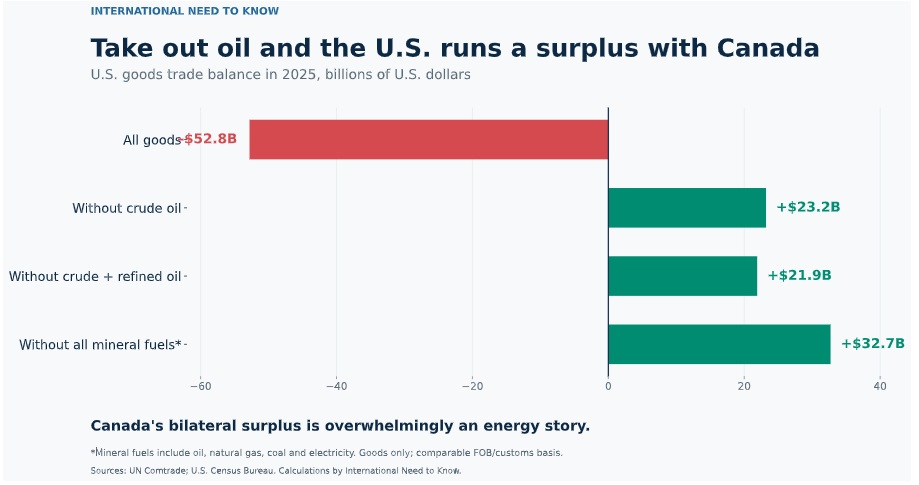
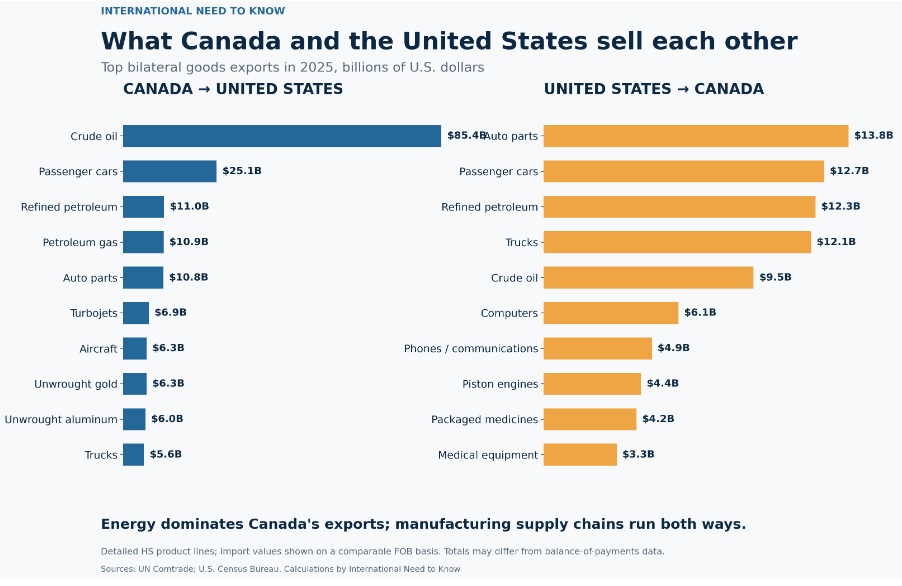
O Canada we stand on guard for thee or at least tried to present some data and facts while in an argument with someone earlier in the week about the current trade shenanigans. We do so now too. We are in the midst of the second time the U.S. has decided to renegotiate an existing trade agreement with Canada.* The first time was during the first Trump administration when the U.S. reopened NAFTA and replaced it with USMCA (Canada, U.S. and Mexico mutually agreed to negotiate NAFTA). To be clear, USMCA did not expire this year, it remains in force until 2036 unless a country withdraws. But the U.S. did not agree to renew it, which forces negotiations that lead to either a resolution or termination of the agreement. It is understandable that Canada, and any country, would be leery of renegotiating provisions in a treaty they know could be re-opened for additional negotiations at any time given recent history. Now let’s look at U.S. – Canada bilateral trade data. As you can see in the first table below, when removing oil from the equation, the U.S. has a trade surplus with Canada. The second table shows you what the U.S. and Canada trade with each other. Yes, Canada exports $25.1 billion in cars to the U.S., but between 25 – 50 percent of the value of those cars is American components. And, of course, a lot of the American vehicle exports to Canada contain Canadian parts. It is a mutually beneficial auto supply chain between the two countries. We saw the other day that for the first time ever a majority of South Koreans have an unfavorable view of America. They are not alone. The most international thing you need to know is we are living in a completely different era from any of your lifetimes, no matter how old you are (and we know almost every single one of our readers is extremely young).
*Well, there was one other time: way back in 1866 when the U.S. unilaterally terminated the Reciprocity Treaty, an early free-trade arrangement with British North America. What a pain Uncle Sam can be sometimes.
Which Countries At Peak Population?
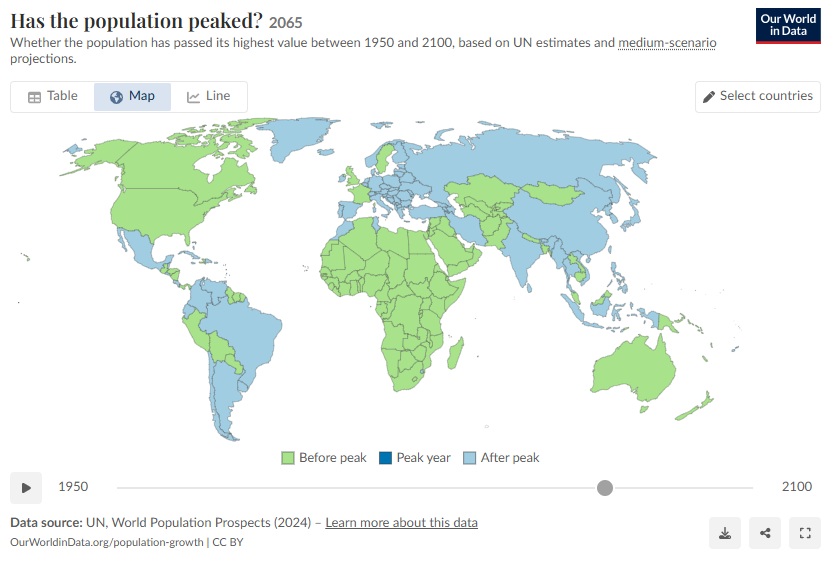
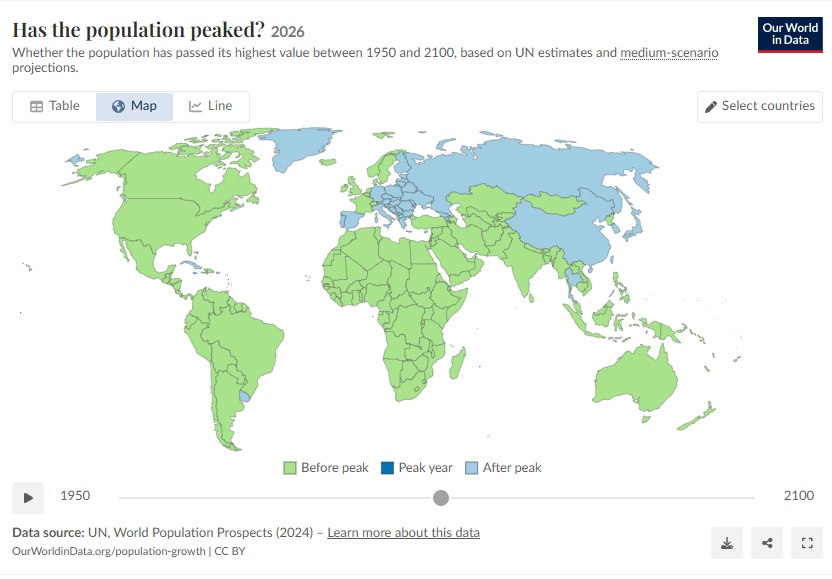
It’s no longer a secret that the world will soon be getting smaller, or that is, the human population of the world will be. We used to cover that extensively before it was cool. Now it’s a common topic. But which countries are already at peak population? Our World in Data provides the answer. It turns out that of nearly 200 countries in the world, an astonishing 64 are already at peak population. As you can see in Our World in Data’s map below, most of these countries are in Europe and East Asia. If trends continue, we’ll see a restructuring of world population by the end of this century. Our World in Data notes that, “South Korea and China’s populations could more than halve. Italy could shrink by more than 40%. Spain and Thailand, by a third.” The second map below shows what other countries’ populations will peak under current trends. Essentially it’s everywhere but Africa, the United States (if we start letting immigrants in again), the Stans, a few hold-out South American countries and Australia. But they too will see their populations peak before the end of the century. It’s going to be a lonely world in a few years.
China Corner: Keep Your Eye On Imports
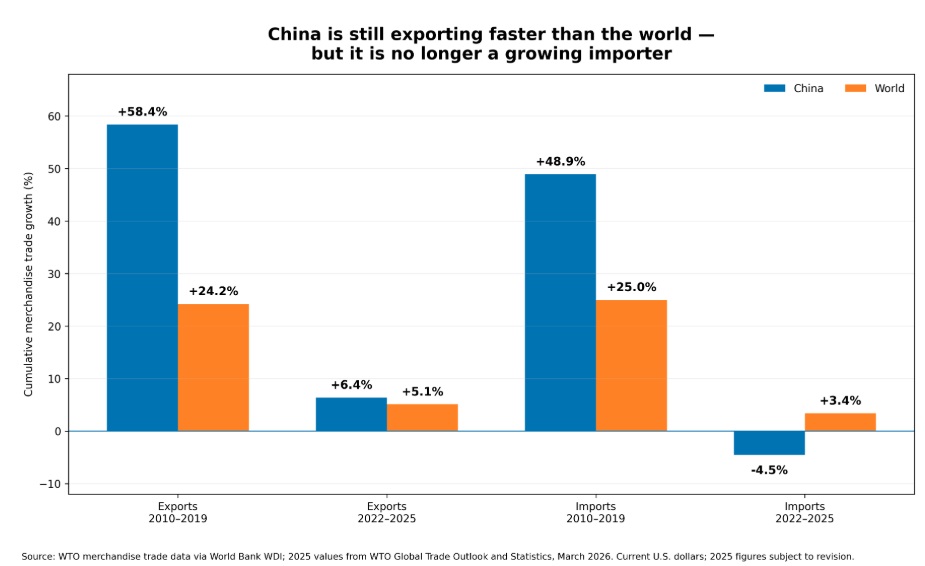
It’s the imports, stupid. Okay, you, dear reader, are not stupid, and China’s exports are an issue but when analyzing today’s China-world geopolitical equation, there is not enough examination of China’s imports, or lack of them. Yes, many parts of the world are worried about China’s dominant exports. And its exports are growing compared to world exports. Since 2022, China’s merchandise exports increased 6.4 percent while world exports grew only 5.1 percent. But China’s merchandise exports from 2010 to 2019 grew 58 percent, which was more than twice the 24 percent growth in global exports. But let’s look at imports. From 2010 to 2019, Chinese imports grew 49 percent, nearly twice the global rate of 25 percent. In other words, China was an important and growing customer for the world. That is no longer the case. Since 2022, even though world merchandise imports increased 3.4 percent, China’s fell by 4.5 percent. Many countries are pushing back against increased China exports. Even if China’s imports were growing, China’s increased exports might still be a worry, especially in strategic industries, but it wouldn’t be nearly so big a concern if China had continued to grow as a market for countries to sell to. Instead, China wants to make everything and anything and have enough capacity to export to the rest of the world. This is not a bargain for the world and it’s not good for Chinese either. In fact, if Chinese were able to buy more stuff, then China likely wouldn’t be exporting as much. However, Xi Jinping cares more about Chinese power than he cares about Chinese people.