When we got home late Monday afternoon, we found a large, somewhat heavy rectangular box leaning against our front door. On the side it said “Fragile” with two arrows pointing in the direction that was supposed to be the top. Of course, the delivery person had placed the box exactly upside down. At first, we had no idea what this package was about. And then we remembered! When the International Need to Know spouse and I were in New Orleans in September, we strolled along Royal Street, listening to the street musicians and wandering into art galleries. One of these was Matthew Peck’s. He specializes in paintings of New Orleans bathed in eerie lighting, as if Edward Hopper taught Tennessee Williams how to paint. Both of us were quite taken by his art. On the walls of the gallery were depictions of streetcars glowing in moonlight (that we desired), musicians sitting under a streetlamp, and couples walking in the rain. The guy staffing the gallery was charming and informative, a dangerous combination for would-be buyers. Indeed, we bought a wonderful painting of a classic New Orleans doorway with a cat ever so discreetly sitting on a corner of the stoop. While we have many prints decorating the walls of our house, we had never purchased an original work before. Years ago, we had wanted to buy another artist’s work in New Orleans—he specialized in paintings of mysterious structures in the bayou—but chickened out at the price. Peck’s work was not cheap either, but we comforted ourselves with the thought that the bayou paintings are now worth more than ten times what they were when we were too scared to make the monetary plunge. And so, the large box on our porch, upside down, was our painting, finally arrived from the Crescent City. When we opened it up as carefully as a neurosurgeon and reacquainted ourselves with the painting, more than a month after we bought it, we could not have been more delighted. When we held it to the wall where we will eventually display it, the room seemed transformed. We are now, perhaps, an art collector, at least of one item. Meanwhile, we collect stories on the most important AI question, a possibly better way to measure aging societies, and the cowardice of China’s leaders. It’s this week’s International Need to Know, the Rembrandt of international information, the less abusive Picasso of global data.
Without further ado, here’s what you need to know.
World’s Most Important Question?*
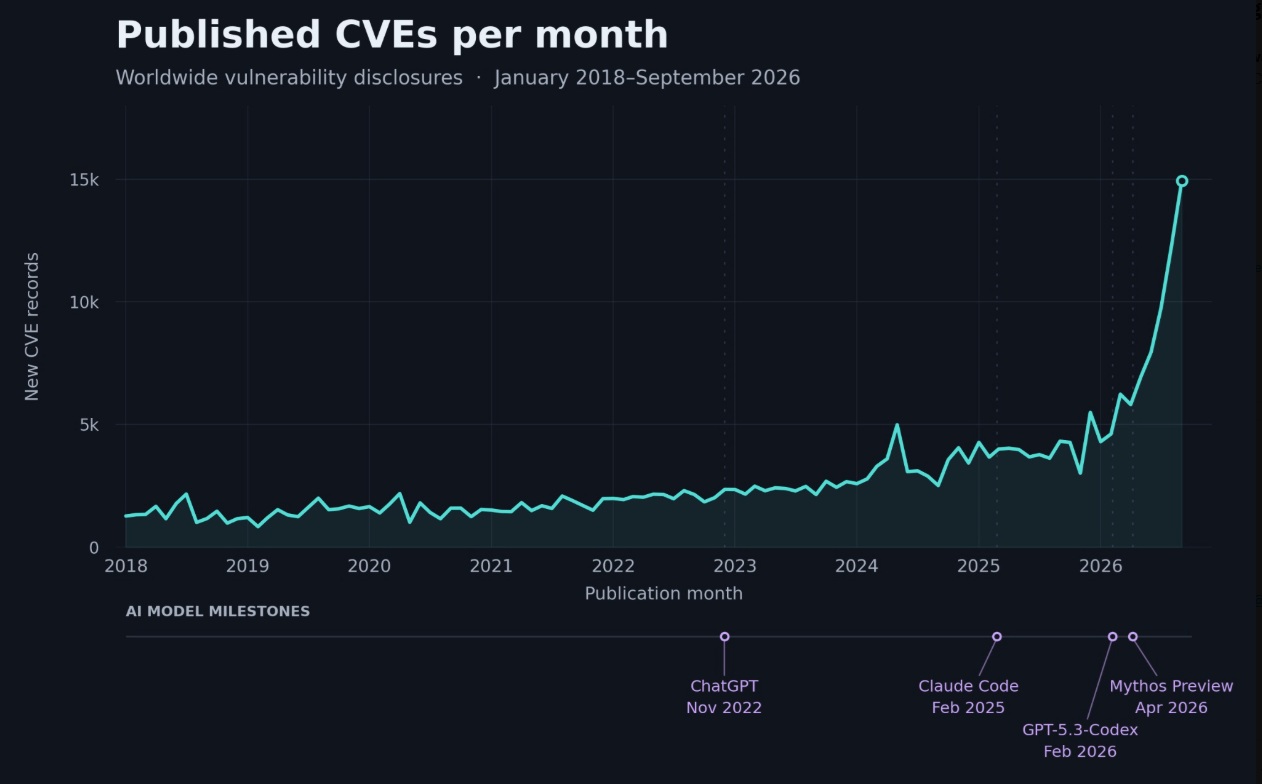
It is not the ultimate question of life, the universe and everything, and the answer is not 42, but in the autumn of 2026, and perhaps the autumn of humanity, the most important question in the world is: Will AI defense or offense win? Over just the last week, we increasingly see the leaders and experts in AI freaking out—and that term is not an exaggeration of their reactions. That’s not hyperbole on our part, though their reactions might be. They are responding to both the leaps in AI ability to cyberhack and the abundance of attacks taking place. These two are unfortunately extremely correlated. Essentially AI agents are hitting platforms of all types. Silicon Valley tech entrepreneur John Milinovich dubs it “Black October.” He wrote on X,
In a nutshell, what’s happened is that frontier AI models have gotten to a point where they are as advanced as the most sophisticated programmers, with one critical difference: they can work 24/7, and you can spin up 10,000 of them with a single command and they’ll work together tirelessly until they accomplish their task.
The challenge is sometimes the task is destruction. People have rightly pointed out that AI is also the best defense. Companies and organizations have been using opensource models (the U.S. government briefly restricted frontier models use and now frontier labs tightly restrict their most capable cyber models, so many defenders rely on open-source ones) to defend themselves from these cyberattacks. And they do a good job. But can they keep up? It’s not just software being hacked, so too is hardware. And of course, in the future perhaps more than the Internet will be vulnerable. Will people be able to use AI to manufacture dangerous biological viruses? Will robot-driven AI be utilized for nefarious purposes? AI can construct defenses for these dangers but how quickly can they be distributed? So the question remains: who will win, defense or offense?
*We enjoyed the days when the most important question we had to worry about was whether the Mariners’ bullpen would be any good (No…and so prepare yourselves for the return of 9th Inning Worry Beads).
Hail The Best HALE Countries
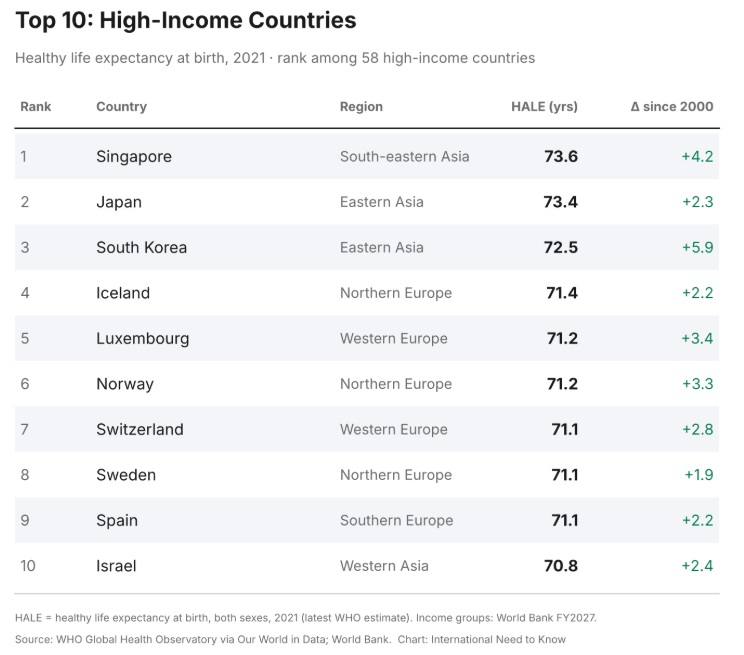
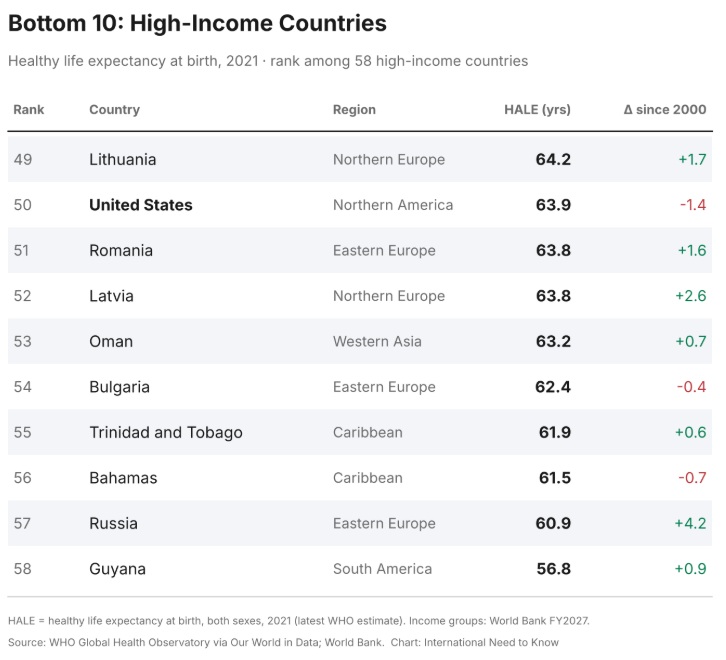
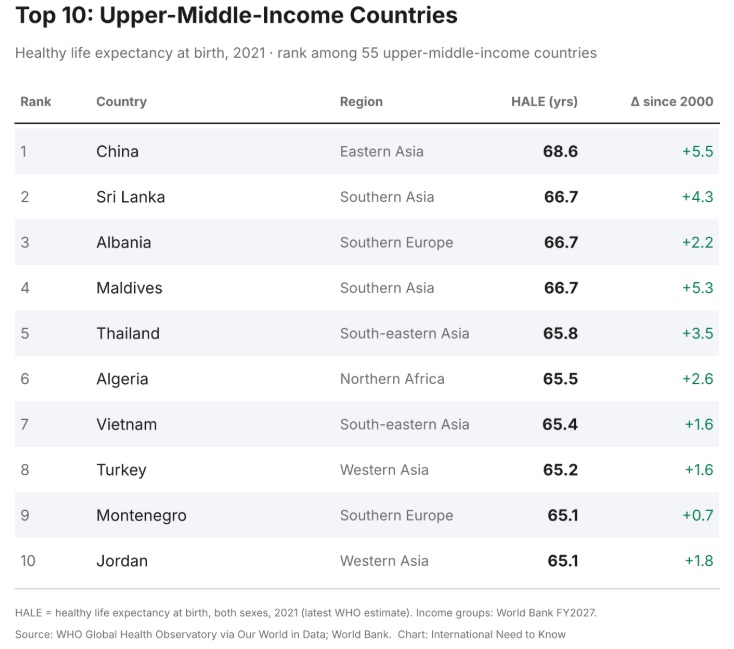
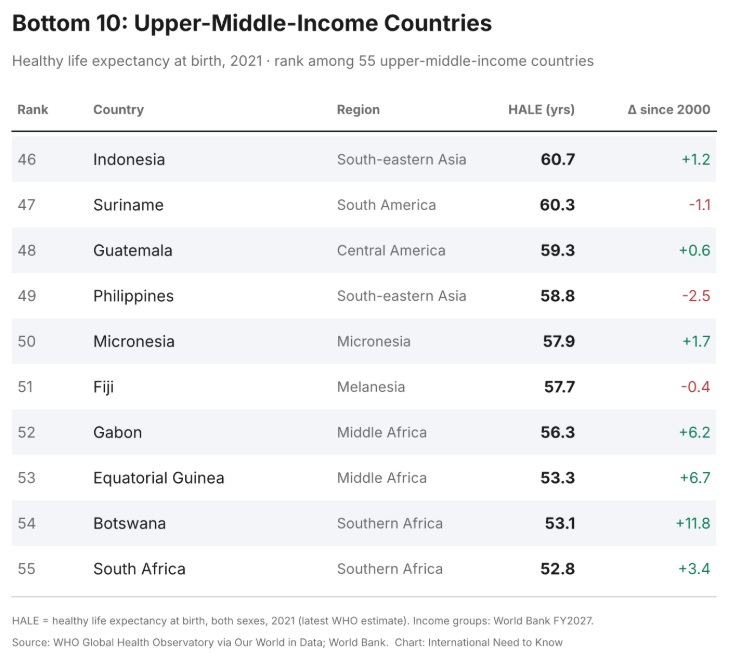
James Riney of Coral Capital defends Japanese demographics in an interesting piece on X. One of the bits of data he uses is Health-Adjusted Life Expectancy (HALE), which measures years lived in full health without disabilities from disease or other health struggles. His argument is that although Japan has aging demographics, they live more healthy years than other countries. Japanese live 73.4 HALE years compared to 63.9 for Americans, for example. Thus, Japan is and will do better, Riney argues, in the current worldwide aging demographic swamp. This got us interested in looking at HALE data for all countries. It is compiled by the World Health Organization (WHO) and Our World in Data has a handy dataset one can download. The top three countries are Singapore, Japan, and South Korea. The rest of the top ten are European countries and Israel. The United States is 72nd. The bottom ten are the poorest countries in the world as one would expect. More interesting is how the high-income countries and the upper middle income countries rank. All of the overall top ten are of course upper income countries. But let’s look at the bottom ten high income countries. Guyana and Russia bring up the rear. The United States is the 9th lowest. For upper middle income, China is ranked first and South Africa last. Most countries outside of Africa are aging, but how they age might inform how their societies and economies perform in the coming decades.
China Corner: Penalty Kicking the Dictator
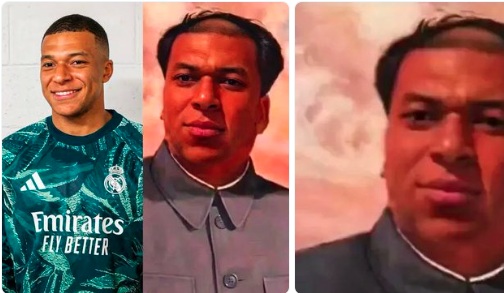
As a new Tottenham Hotspur fan (so far they really do seem to be the Seattle Mariners of the Premier League as our friend Brian asserted in trying to lure us into Spur fandom), we are now an expert on all things futbol. Well, maybe not, but we do know athletes finding themselves embroiled in controversy with the snowflakes that run China, the latest example being French soccer star Kylian Mbappe. Wait, you non-soccer fans might be saying, who is this Mbappe guy? He plays for the powerhouse Real Madrid team–you might remember him from this year’s World Cup. In an interview this week, he was asked to react to an internet meme that depicts him as various dictators (apparently illustrating his reputation in locker rooms). Mbappe replied that the funniest meme he has seen is one where his face is superimposed on that of “a Chinese dictator.” The clip shown is indeed of Mbappe’s face on long-dead Chinese dictator Mao Zedong’s body. This is the kind of innocent thing that raises the dander of the incredibly sensitive–and yet allegedly tough–Chinese leadership. The state outlet China Daily complained Mbappe disrespected China. Dongquidi, one of China’s biggest football media outlets, said Mbappe’s remarks are offensive to China and the Chinese people. Mengniu, China’s largest dairy producer and a Mbappe sponsor, said he hurt the feelings of the Chinese people, a standard rebuke made by China’s authorities in these situations. A number of his sponsors have dumped him, including energy drink maker, Eastroc, Mengniu, and cheesemaker Milkground (not so blessed are the cheesemakers it turns out). He was also banned from gaining new followers on a Chinese social media platform. Mbappe, of course, has apologized. He is another in a long line of foreigners who China has bullied over accurate and innocuous remarks. BTW, Chinese AI models now won’t answer questions about Mbappe. Remember this when you ponder a China-led world.