Humans learned to talk around 150,000 years ago, or so those who study the issue believe. Before then we likely communicated the way other primates do. Vocal calls, physical gestures, facial expressions and touching each other. We wonder who was the first person to use their new oral communications skills to tell a lie, and what did they lie about? We thought about this and how human evolution led us to where we are today while watching the new movie You Can See Everything which we saw on opening day last week. It is a documentary ostensibly about Elizabeth Holmes, the con artist who founded and ran the fake blood testing company, Theranos. But the film is about much more than that. The movie is co-made by Nathan Fielder, who is a neurotic, Philip Marlowe-like character in the movie: hard boiled, prone to making wisecracks, but ultimately a romantic at heart. Indeed ultimately, he is George Shultz, Carlos Slim or one of the other Theranos investors…or is that the part he is playing? Our guess is different people will react to different parts of the movie completely differently. Who they are will reflect what they see. Ah, but the title of the movie is misleading. You don’t see everything. Or maybe you do, and sometimes more than you want. You are seeing what the filmmakers show. One of the themes of the movie is performance. People are putting on a show, including, of course, the filmmakers themselves. Now we are in a new age of communication with machine intelligence—a whole new era. And people are freaking out about how we will distill reality from the fake world. You don’t, you can’t, you never will, see everything. And yet we try to show you Russia is at war with Europe, the costs of the Iran war and China’s new love of export controls. It’s this week’s International Need to Know, making documentaries on international information, creating global data epics.
Without further ado, here’s what you need to know.
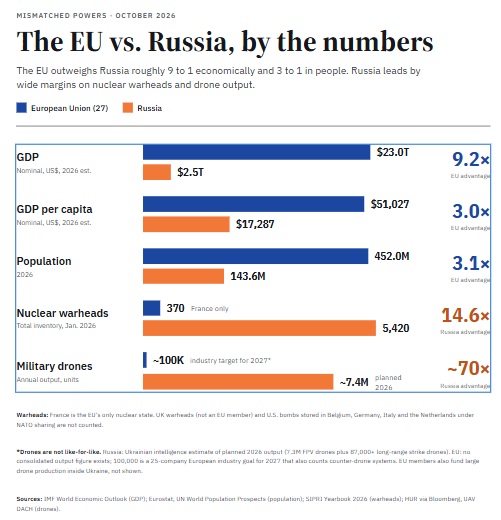
Russia is at War with Europe
Russia continues its war against Ukraine, increasingly murdering civilians in obvious war crimes. Less obvious but true nonetheless, is that Russia is at war with Europe. Russia has targeted three Starlink facilities in EU countries in the last three weeks. 1) Polish prosecutors are investigating the fire at the Wola Krobowska ground station as sabotage and a terrorist-related crime. They suspect it may have been ordered by Russian secret services. 2) In Bulgaria, two masked intruders broke into a facility near Sofia and set fire to 11 of its 17 Starlink antennas. 3) Lithuanian Prime Minister Sinkevičius said Russia was probably behind the attempted arson at a company storing Starlink equipment used by Ukraine. But these are far from the only Russian attacks on Europe. By one report, there have been at least 151 reported Russian operations from February 2022 to March 2026. In August in Leipzig, Germany, an explosive quadcopter struck the wing of an An-124 cargo plane near its fuel tank. In September, a Russian drone entered Estonian airspace. Also in August, in Romania an explosive-laden Russian sea drone was found near the Neptune Deep offshore gas project in the Black Sea. Europe and Russia are at war though many, including some of its leaders, do not realize it. Meanwhile the United States has chosen sides…and it did not choose Europe.
The Costs of the Iran War
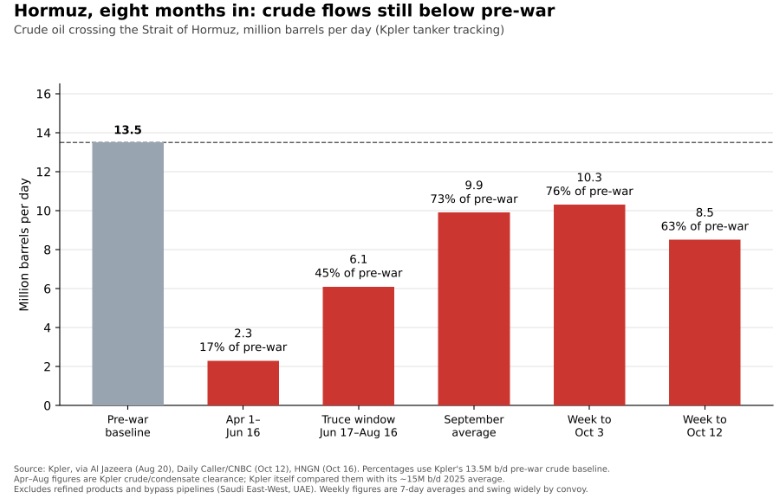
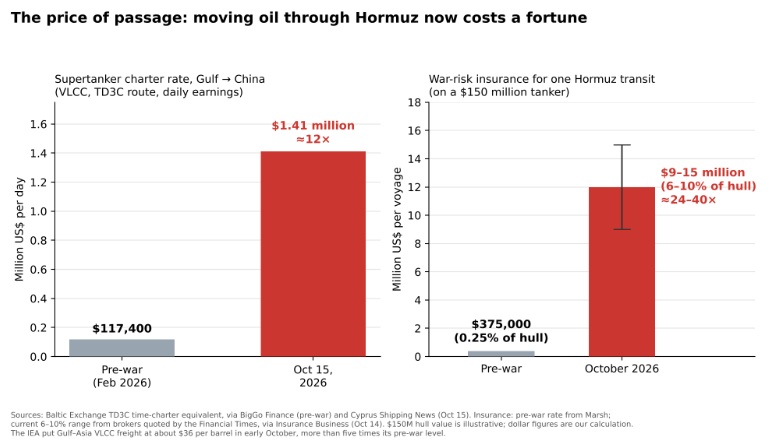
Another war—the U.S. (and Israel) war against Iran–drags on like a television show the U.S. President wishes had been canceled after a rocky season one. We’re essentially in season 6 of Lost. Trump administration officials have been claiming that oil is now flowing through the Strait of Hormuz. The global trade analytics company, Kpler, finds that crude exports through Hormuz average 8.5 million barrels a day in the week to Oct. 12. That’s still nearly 40 percent below the pre-war norm. It has increased since the worst days of the war. However, refined products (think diesel) shipped through the strait are at a seven-day average of 677,000 bpd as of last week. That compares with 3.6 million bpd before the war. Then you look at the cost of getting these ships through the Strait of Hormuz. As you can see from the second chart below, it is far more expensive then pre-war. Charter rates are $1,412,594/day in the week to October 15. Before the war, the same rate was $117,400. And the insurance they are paying—thank your lucky stars you own a Toyota Camry and not an oil tanker—risk premiums are way up. Thus far, the Iran War is costing the global and U.S. economies. Meanwhile, those in charge of Iran seem more radical and secure than ever.
China Corner: Chinese Export Controls
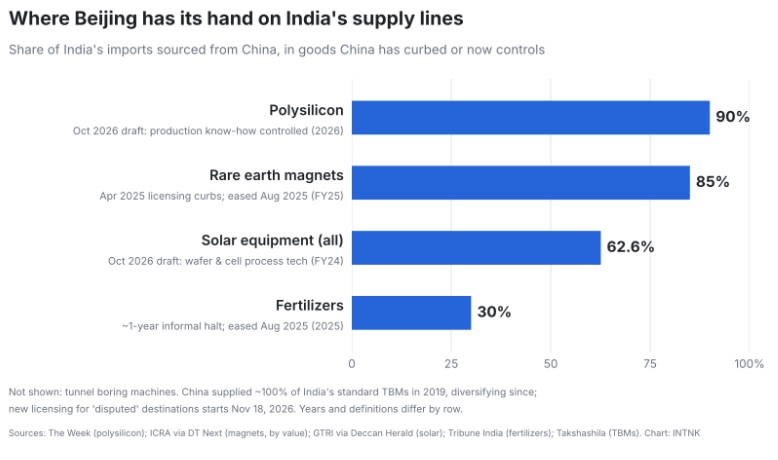
Decades ago, we were ensconced in U.S. export control policy, mainly from the perspective of trying to loosen them. The U.S. continues to have export controls but there is a new emperor in town. China increasingly institutes controls over key technologies that it makes, including recommending many more in just the last week. Earlier this year China used its control of critical minerals to exact concessions from the U.S. in trade talks. It has also used this same lever with Europe and others. This week China rolled out more export controls. On October 16, China released draft legislation that would add 40 more technologies that it would ban or restrict for export. Many of these technologies have to do with AI, including chips. Lots have to do with solar technologies, a sector that China dominates, including polysilicon, wafer and cell manufacturing. On October 19, China announced even more export controls. These cover drones, tunnel boring machines (TBMs), dredgers and customs procedures for dual-use items. After this announcement, some folks wondered how much of this is targeted on India. We’ve previously covered China’s efforts to prevent India from rising up the value chain. As you can see in the chart below, many of these export controls will very much affect India. Of course, places like Vietnam and elsewhere are also affected. Again, as we’ve noted previously, China often acts in ways that will make it difficult for other countries to develop economically like it did. China is increasingly an economic hegemon.