Take a look at this photo and tell us what is wrong. We’ll wait patiently.

Sure, sure, yes those are speed bumps on a major arterial in Seattle. Greenwood Avenue to be specific. And certainly those barriers to driving speedily likely drive—every pun intended—some entrepreneurial Seattleites to take side streets to avoid them, which sort of defeats the purpose of arterials and side roads. We covered that in passing a few weeks ago. That’s old news. But what about those speed bumps do you notice? Oh yes, that’s right, they are in the bike lane as well as in the road. In fact, the gap they leave for bicycles is in the road itself. So apparently the brilliant idea of Seattle’s transportation experts is that bicyclists should ride in the designated bike lanes safely away from cars EXCEPT every 60 feet or so they should veer into the road where said transportation planners have placed the gap for them to avoid having to go over a speed bump. Far be it for us, who have no expertise or experience in urban transportation planning, to dare to question the superior intellect and expertise of the city’s transportation department. Clearly we are missing some key insight that would lead one to install speed bumps in both the road and the bicycle lane but provide a gap for bicyclists in the road. It is some sort of 12-dimensional transportation chess we mere car drivers and bicyclists could hardly hope to comprehend. We can think of three explanations for how such brilliant planning and execution came to be. Maybe four. Despite all protestations to the contrary, the City of Seattle actually abhors bicyclists and is actively planning their violent eradication. A transportation planner accidentally brought drug-laced brownies to the meeting where they designed the Greenwood Avenue speed bumps. Construction workers were especially drunk the day they installed the speed bumps and misread the blueprint. And fourth, oh, never mind—we have to go buy Kevlar armor to bicycle down Greenwood Avenue even as we examine Laos’s EV policy, identify electricity sources, and never forget the Uyghurs. It’s this week’s International Need to Know, neither the Jane Jacobs of international information nor the Robert Moses of global data.
Without further ado, here’s what you need to know.
Laosy EV Policy
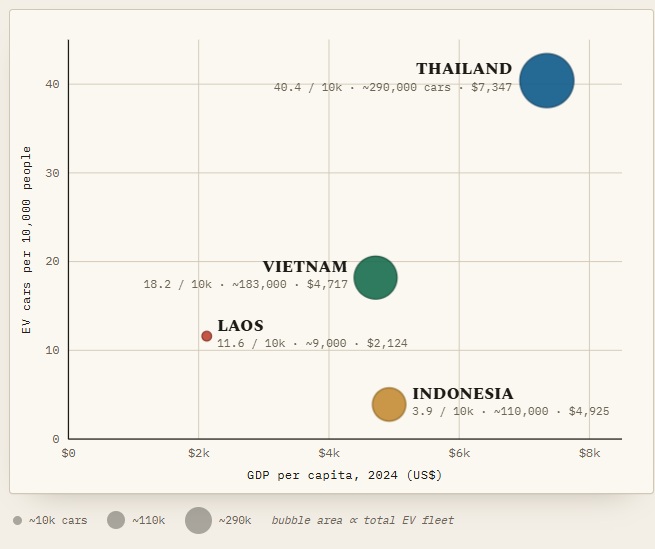
We’ve seen a number of climate-focused websites and organizations trumpet the news that Laos is banning the import of gas-powered passenger vehicles through at least the end of 2026. The idea behind the ban is that Laos imports $1.7 billion in petroleum each year, which is a large percentage of the country’s $17 billion GDP. The oil economic pressure has worsened since January due to the Iran war. You might expect we would be excited about this policy since we have been trumpeting the rise of EVs for quite some time in this space. But the point of our trumpeting is that EVs are winning on the merits. EVs are becoming a more affordable, better technology than internal combustion cars. There is no need for economic distortionary policies to support EVs. Ethiopia, for similar economic reasons, banned the import of fossil-fueled cars in 2024. Like Laos, which has large capacity hydro power, Ethiopia believed the recently opened (expansively named) Grand Ethiopian Renaissance Dam would provide it plenty of energy to power the EV fleet. However, today 40 percent of Ethiopians don’t have access to electricity, so much more is needed for a renaissance. The number of EVs rose from 1 percent of cars on the road to 6 percent. Unfortunately, even today there are only 500 chargers in the county, most of them located in Addis Ababa. Laos is planning on building up its charging infrastructure and maybe its close relationship with China will help make this happen. Laos is a one-party state prone to top-down decision making. There is a reason its GDP is so low. Rather then worrying about the oil import numerator, they should concentrate on the denominator.
Where Electricity Comes From
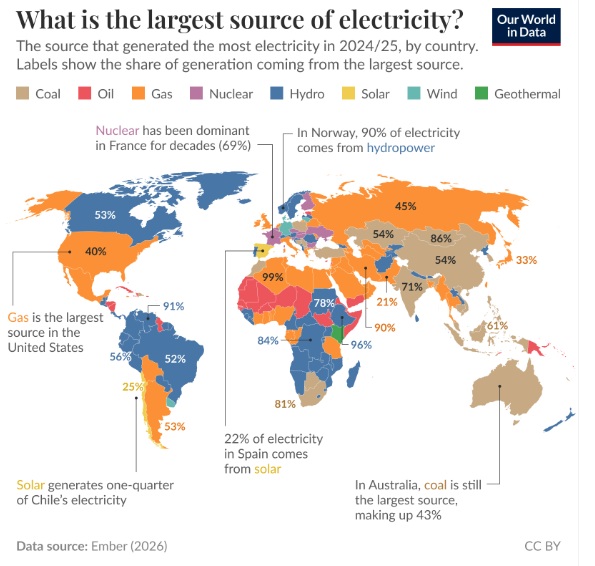
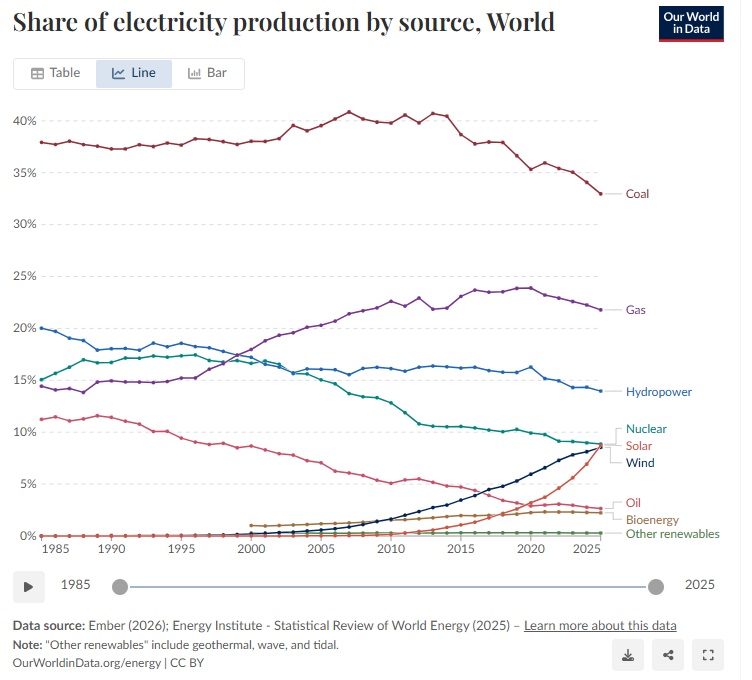
Relatedly, let’s talk about where countries get their electricity. As you can see in the first chart below from Our World in Data, the sources of electricity generation vary widely by country. Coal still generates a third of the world’s electricity. It’s the largest source in Asia, including in large countries like China and India, but also small ones such as, you got it, Laos. But note in the second chart below that coal’s percentage is decreasing, down from 40 percent a decade ago. However, today’s 30 percent is of a larger amount of generated electricity. As countries develop, and recently as new electricity-intensive technologies emerge, the world uses more electricity. Nonetheless, coal’s percentage will likely decrease rapidly in the coming years as solar and batteries outcompete it on price and efficiency. Solar and wind combined are already the largest source of electricity generation in the Netherlands, Portugal, Greece, the United Kingdom, Belgium, and Pakistan. In May, for the first time, Americans got more electricity from solar than coal (HT Mike W). Check back in 2030 and the colors of Our World in Data’s map are likely to change considerably.
China Corner: Persecution of the Uyghurs
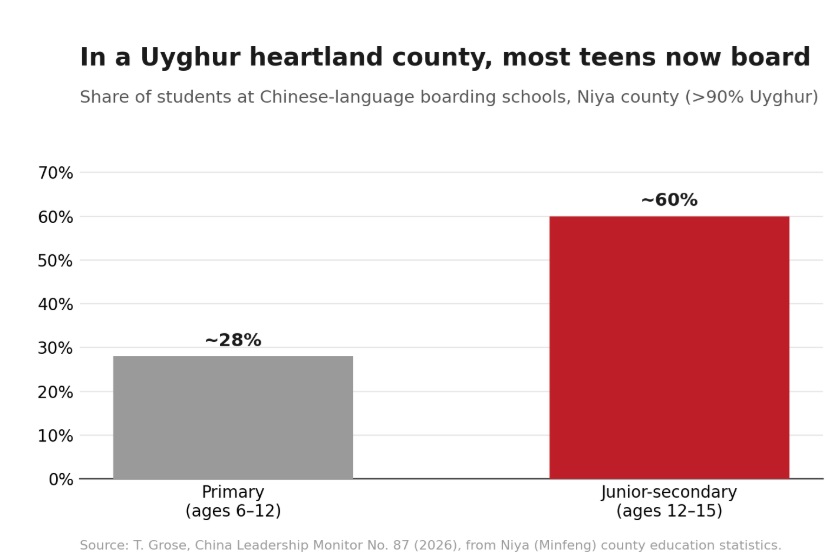
It is easy, amid wars and tariffs and AI, to forget about the Uyghurs. China is counting on it. When Beijing wound down its mass “re-education” camps around 2019, much of the world concluded the crisis had passed. It hadn’t. The repression simply changed clothes—from blood-red spectacle to drab-gray bureaucracy. The Financial Times, to its credit, didn’t forget and recently revisited Xinjiang’s grim arithmetic, and a new China Leadership Monitor study by Timothy Grose details the machinery. The camps gave way to courts. Xinjiang’s own prosecutorial office logged 540,826 prosecutions from 2017 to 2021, in a region where China’s conviction rate is 99.9% and the average 2017 sentence ran 9.24 years. One 2025 estimate puts roughly 459,000 people still imprisoned. A prison, unlike a camp, throws no shadow on a satellite image. The main goal of Xi Jinping and the CCP is to erase Uyghur culture. Children are funneled into Chinese-only boarding schools where Uyghur isn’t the language of the hallway; in Niya county, some 60 percent of middle schoolers now board. Adults are “transferred” to labor far from home—3.17 million in 2021—while Han workers are bused in. The stated aim, in one Chinese research report, is to “reduce the population density of Uyghurs.” Mosques are repurposed, publishers shuttered, a language quietly demoted. This is, well, assimilation by attrition. It makes no headlines because, by design, nothing happens on any given day. The banality of evil someone once said. Which is exactly why we shouldn’t look away.