It was a very special Rewatchables podcast episode this week with Steven Spielberg joining the regular crew to talk about Stanley Kubrick’s 2001: A Space Odyssey. Listening to the episode reminded us that many years ago we bid on and won at a charity auction an evening in the private theater of Magnolia Audio and Video. We could invite ten friends and choose any movie we wanted to watch with them. After much agonizing—we had to pick the perfect movie for such an occasion–we chose 2001. It seemed perfect for taking advantage of a big screen and pitch perfect audio. Plus, 2001 is one of our 11 favorite movies and it is probably the most important film ever made. Interestingly, even though it was made in 1968, it is perhaps more relevant than ever. Yes, of course, the AI components with HAL speak to today’s AI controversies. But Kubrick’s masterpiece is also in conversation with many other aspects of 2020s’ society. Think about surveillance and the loss of privacy—then remember HAL reading the astronauts’ lips through the pod window. We are all being watched by a system we cannot opt out of and can’t fully see.
Then there is the ability to communicate at all times across vast distances but not actually connect—astronaut Heywood Floyd’s video call to his daughter on her birthday is stilted, it is hollow. Floyd—and all of us today—are surrounded by screens and intercoms yet still are essentially isolated. And then there is what people call the singularity, a favorite aspiration of the tech rich, offering the chance to live forever, to become something more than human. The monolith catapults proto-humans to knowledge and in the end of the movie to something beyond human with super intelligence. However, what 2001 did for me when I originally saw it—long before the evening at Magnolia—was provide a sense of mystery about both the universe and humankind. No matter how intelligent we become through AI or other technology, no matter how much knowledge we uncover and absorb, we will never solve some ultimate mysteries…and would we want to? Meanwhile, we open the pod doors to show that recent medical miracles are global, witness even more Ukrainian progress, and investigate China Shock 2. It’s this week’s International Need to Know, the Johann Strauss of international information, the Zarathustra of global data.
Without further ado, here’s what you need to know.
Medical Breakthroughs are Global Miracle
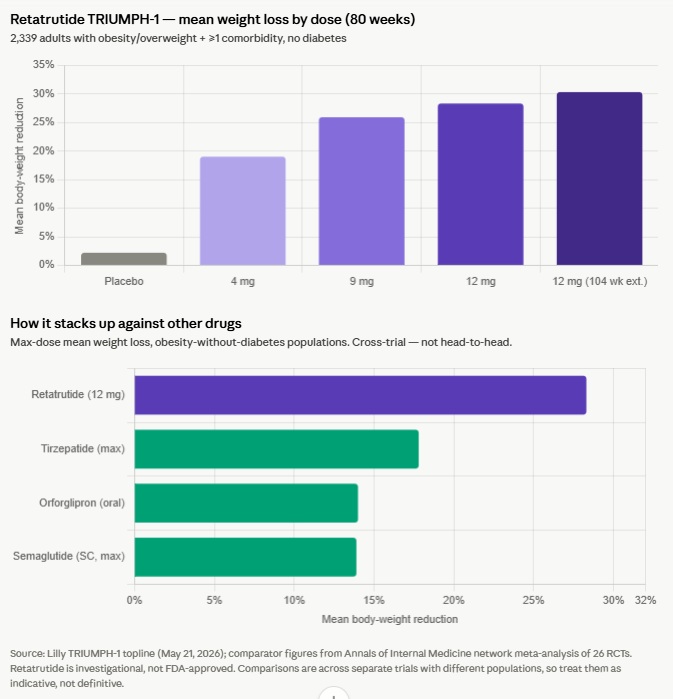
Derek Thompson tweeted that it’s been a “miracle month of medicine.” He cited continued breakthroughs in GLP-1 drugs, stunning progress in treating pancreatic cancer, a new gene therapy permanently treating cholesterol that would obviate the need for statins, and AI helping detect cancer more accurately. Pretty, pretty good. Most people reading the tweet probably thought American research and development is great! And they’re right, but this is really a global miracle. The GLP-1 revolution was kicked off by Novo Nordisk in Denmark. Many of the scientists involved were immigrants, including Svetlana Mojsov, who shared the Nobel Prize for her work. The PCSK9 gene-editing therapy (VERVE-102) came out of Verve Therapeutics, co-founded and led by Sekar Kathiresan, M.D., a cardiologist and geneticist of Indian descent. Notably, Verve was acquired by Eli Lilly, and the pivotal trial was run across the United Kingdom, Canada, Israel, Australia, and New Zealand — almost entirely outside the U,S. We humans will be in perfect health when the AI apocalypse arrives.
Even More Ukrainian Progress
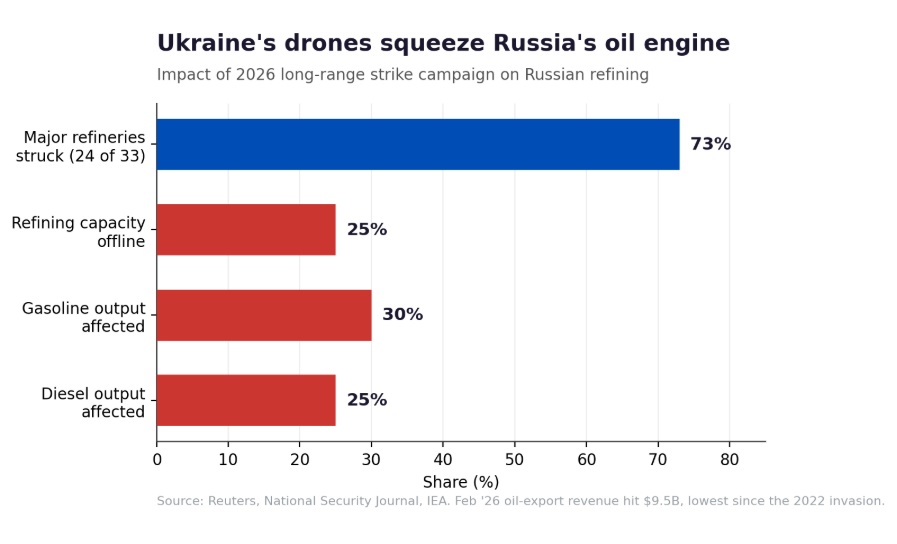
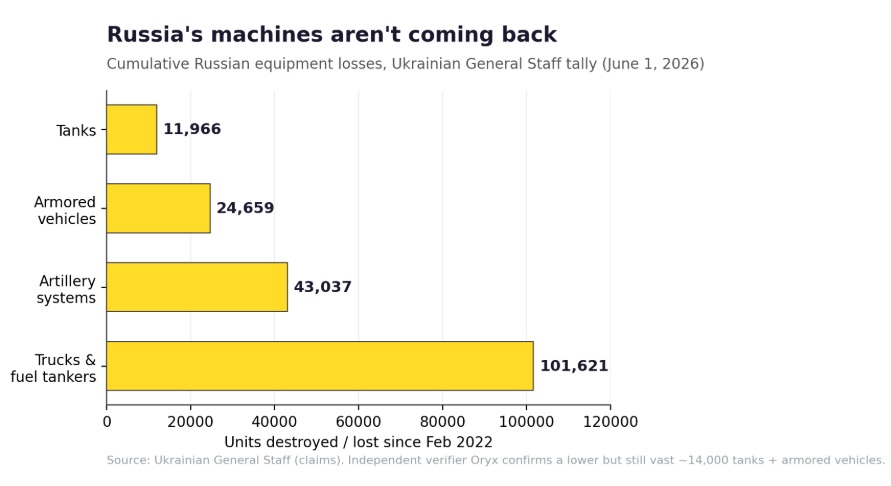
A few weeks ago, we noted that Ukraine has actually gained territory against Russia in the ongoing war. Since then, Ukrainian commanders claim nearly all of Dnipropetrovsk has been liberated and nine towns retaken in Zaporizhzhia (hold on while I request more letters for my keyboard). That’s not the only area where Ukraine is making progress. They’ve struck oil. Specifically, Ukrainian long-range drones have now attacked 24 of Russia’s 33 major refineries, with affected plants representing roughly a quarter of refining capacity and producing over 30 percent of Russia’s gasoline and about 25 percent of its diesel. Russia’s own Rosstat recorded refining output down 9.2 percent year-on-year in April. Meanwhile, Moscow has banned gasoline exports since April and just banned jet-fuel exports through November. February oil-export revenue collapsed to $9.5 billion, the lowest since the 2022 invasion, with about half of Russia’s oil fields reportedly running at a loss. Then there’s attrition. Ukraine’s General Staff tallies cumulative Russian losses near 12,000 tanks, 24,600 armored vehicles, 43,000 artillery systems, and over 101,000 trucks and tankers—numbers so steep Russia is pulling 1950s-era T-54 and T-55 tanks from storage, a bit like me rummaging through my garage looking for an old circular saw to cut a desk post (or maybe not like that at all—but can I borrow your circular saw?). The conservative independent verifier Oryx confirms a lower but still staggering ~14,000 tanks and armored vehicles. Of course, Ukraine is a long way from winning and Russia has been bombarding civilians in Ukraine this week. Russia acts like a boxer trying to achieve a knockout by aiming for the head while it’s opponent continually weakens him with body shots, Russia may eventually crumble to the mat.
China Corner: China Shock, The Sequel!
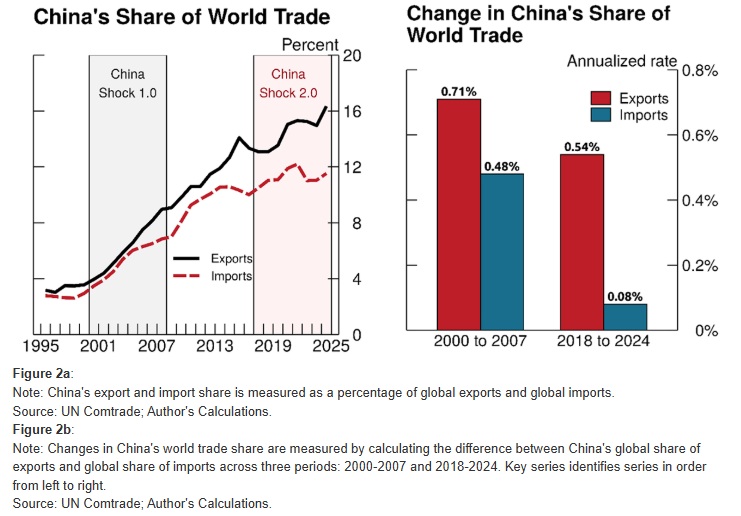
Claude Rains goes to China and is shocked, shocked I tell you, to find its industries heavily subsidized. A new FEDS Note dubs the post-2018 surge in Chinese exports “China Shock 2.0.” China’s trade surplus hit a record $1.2 trillion in 2025, dwarfing the peak surpluses Germany and Japan ever managed. The first China Shock (2000–2007) lifted China’s share of global exports from under 4 percent to 9 percent. The sequel pushed it from 13.1 percent in 2018 to 16.3 percent in 2024. One of the striking characteristics of this China shock is that even as exports surge imports at best crawl. China wants to be the factory for the world and for itself. Indeed, this week also came news of its implementing controls on outward investment. China is like a hyper productive North Korea, increasingly closed but exporting like the rabbits in our yard reproduce. So why does Beijing run such huge surpluses? The Fed credits industrial policy. Much of that industrial policy is built on subsidies of all kinds, including cheap financing from the government. Unlike Claude Rains, however, we don’t think this is the beginning of a beautiful friendship with the world—more than likely quite the opposite.