Official Announcement from International Need to Know
International Need to Know announces it is officially becoming a fan of Tottenham Hotspur. We have long loved the name—Tottenham Hotspur, Tottenham Hotspur, TOTTENHAM HOTSPUR. It’s not just that it rolls off the tongue and lips like staccato pudding. It sounds like the name of an obscure hobbit family living in the Shire, pipe in hand, gossiping about that irresponsible Frodo. Or perhaps it is Wodehousean—an especially reckless friend of Bertie Wooster’s who Jeeves must somehow save. At any rate, the World Cup, and our soccer maven friend Brian, led to this long needed adoption. We became intrigued when Brian told us the Tottenham Hotspur are the Seattle Mariners of the English Premier League. Our fandom was cemented while exploring Youtube and discovering a video compilation of the fans’ chants. We urge you to drop everything and watch them. And then the whole thing was clinched by two pieces of information provided by Brian: a) Tottenham Hotspur’s nickname “comes from Sir Henry ‘Harry’ Hotspur Percy (could it be any more P.G. Wodehouse name-like? Who cares about that Shakespeare fellow), a famous 14th-century English knight…He earned the nickname ‘Hotspur’ because of his speed and eagerness to charge into combat.” And b) The main song of the team is “When the Spurs go Marching in” set to the tune of “When the Saints Go Marching In” so with our love of all things New Orleans, how could we not adopt this team?
Now here is where we should admit that not only are we not a soccer fan but have often been hostile to the sport, and to Americans who become fans of it. We won’t go into the many valid reasons for this attitude. And we probably shouldn’t admit this in public but one minor concern was that the Seattle Sounders, when they returned to town, could hurt Mariners attendance which would harm the Mariners’ ability to win. And to be clear if we ever figure out a way the Tottenham Hotspurs could hurt the Mariners—and believe me we have been doing long investigations into this possibility—we’ll drop them like an E. coli-infected chicken sandwich. But for now we chant “Glory, Glory Tottenham Hotspur” while providing four charts on the Iran War, examining the economic ramifications of the World Cup, and breaking the blade of the old transshipment saw. It’s this week’s International Need to Know, the Jimmy Greaves of international information, the Ledley King of global data.
RIP Ronell Johnson
One of the giants of the New Orleans music scene, but more importantly, one of the most joyous creatures to inhabit our planet, died last Sunday. Ronell Johnson was best known as the trombone player for the Preservation Hall Jazz Band where we were honored to encounter him at a number of concerts, both in Seattle and New Orleans. You could see joy pouring from his trombone as he played, including in the video below. But as nearly everyone who knew him, musician and non, commented after his passing, he was nothing but joyous off stage as well. We could use more of his type in our world, especially now. New Orleans will undoubtedly supply them. In the meantime we wait for what will be an epic second line. RIP.
Without further ado, here’s what you need to know.
Iran War in Four Charts and One MOU
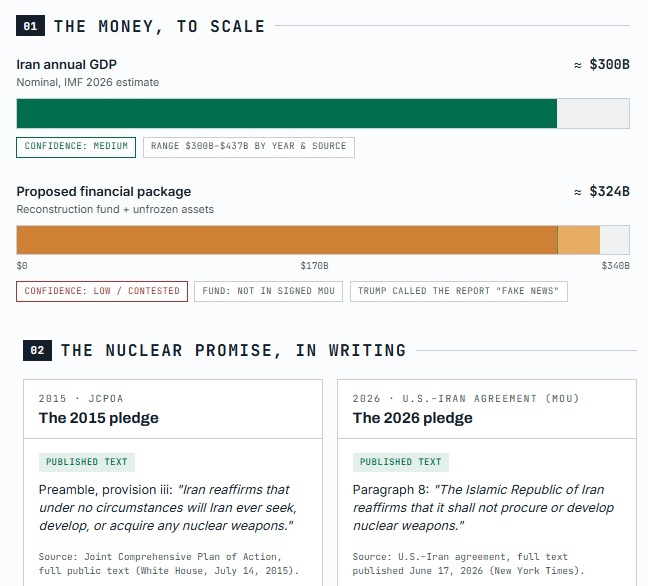
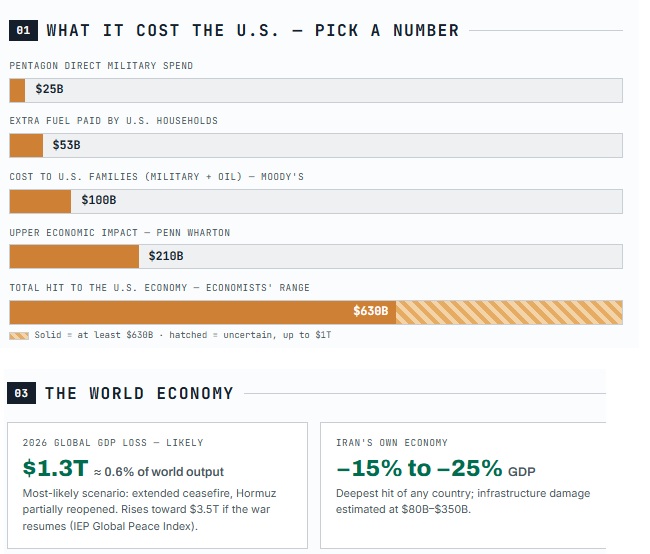
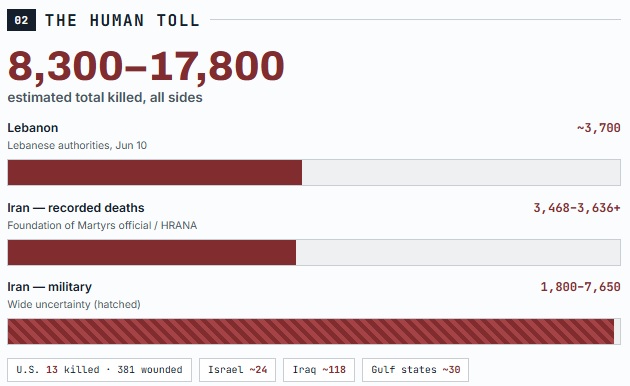
So, how did the war work out? As you can see below, Iran is getting a financial package equal to its annual GDP, the nuclear promise is the same one they’ve always made, the whole war cost the U.S. and the global economy a lot of money…and as with all wars, people, including children, died. USA, USA, USA!
World Cup Hullabaloo
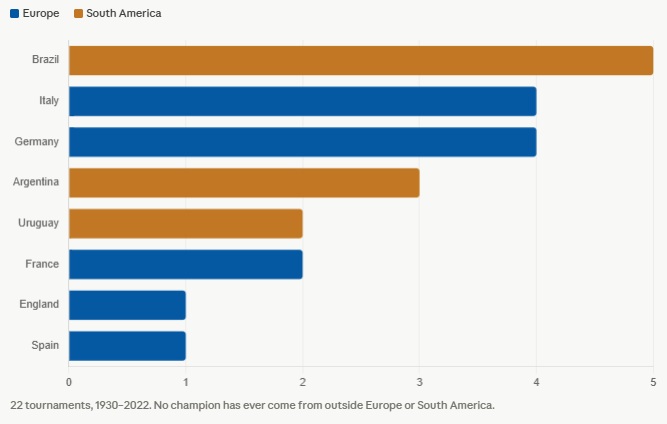
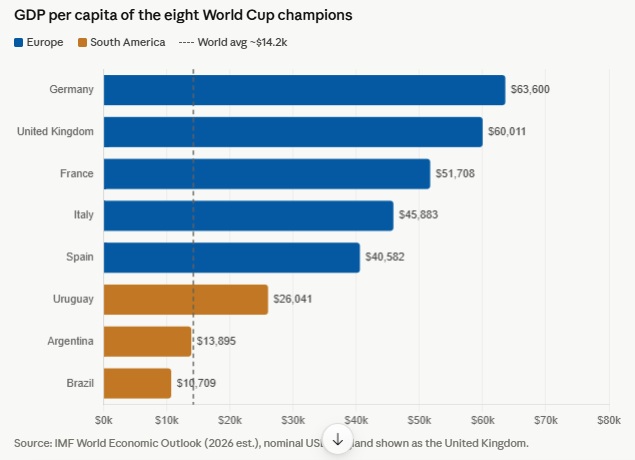
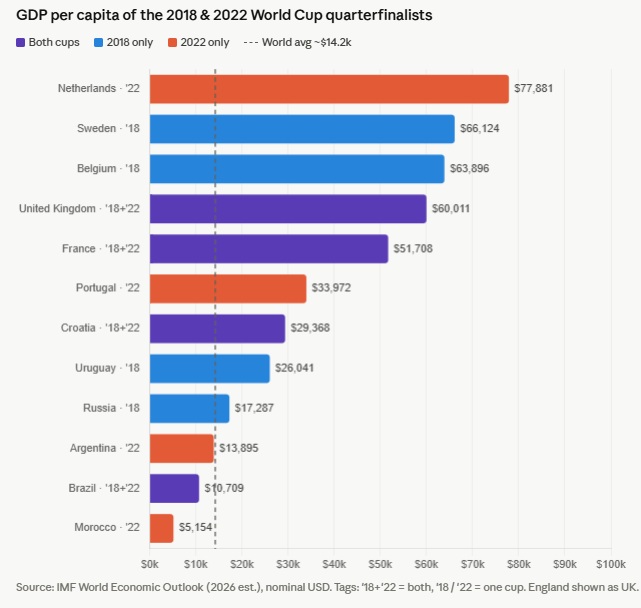
Basically everything we know about the World Cup is from our friend, Brian, who sends daily updates that include spreadsheets. In fact, we learned from Brian that in the history of the World Cup, only eight countries have ever won. This got us interested in the economics of it. Of the eight, five are in Europe and the other three in South America. If you examine these eight, income and wealth don’t seem to have anything to do with being a winner. The eight champions span a roughly five-fold range in GDP per capita — from Brazil and Argentina, (mid-income, ~$10–22k) up to Uruguay, Germany, France, and England (~$45–55k). So if wealth of a country has little to do with success, what does? Turns out what counts is football tradition, according to a variety of research. The eight winners are all places where football is the primary sport, which funnels the best athletes into one pipeline. It’s almost like industry cluster success. What’s also interesting is that players from World Cup-winning countries mostly play in European leagues, even the South Americans. Europe has fallen behind in technology sectors, and its auto industry is currently being swallowed by China. But, as player development globalized, Europe captured the value chain for soccer players. Today essentially every elite South American or African player is employed by European clubs. We’re sure soccer fans in Europe are fine with the tradeoff. (Next week we’ll examine World Cup winners Olympic success and the economy).
China Corner: Old Transshipment Saw Doesn’t Cut It
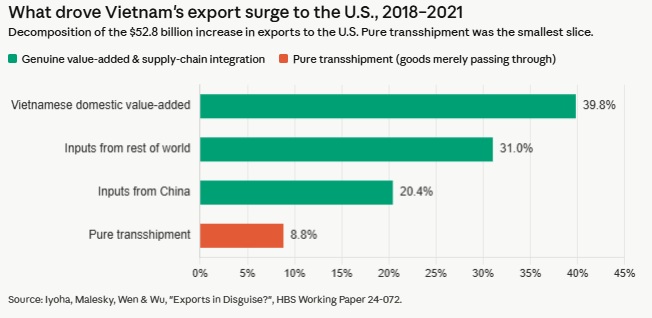
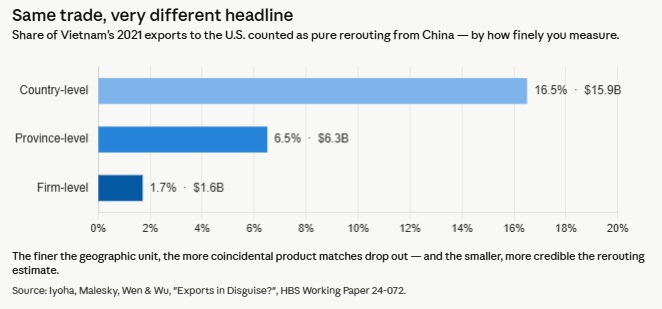
We increasingly see analysts claiming reductions in China exports to the U.S. are due to transshipments through other countries. This is as lazy as us lounging on the back deck on a warm summer day. Very little of this, as we’ve noted before, is merely goods transiting through other countries—there is value being added. That value is often at the lower level of the value chain but it is value nonetheless. The most careful work on this, a study of Vietnam by economists at Harvard, Duke, and Academia Sinica, decomposed Vietnam’s $52.8 billion jump in exports to the U.S. from 2018 to 2021 (these shares cover the first trade war; the same team’s 2026 update finds the pattern recurring). Only 8.8 percent was genuine rerouting, that is goods that merely passed through. Fully 39.8 percent was Vietnamese domestic value-added; another 20.4 percent was Chinese inputs feeding Vietnamese factories, and 31 percent was inputs from elsewhere. Measured at the firm level rather than the product level, pure transshipment in 2021 was a mere 1.8 percent, or $1.7 billion. A fundamental reconfiguration of supply chains is taking place. It is more consequential than the transshipment story for which it is mistaken. China increasingly supplies the components—the steel, plastics, electronics, solar cells—while Southeast Asia assembles them, employs workers, and stamps the final label. ASEAN is not laundering Chinese goods so much as importing Chinese intermediates and building real, if lower-rung, manufacturing capacity atop them. In the past, as countries developed (Taiwan, Japan, South Korea, Malaysia, China), they moved up the value chain. One of the most important questions going forward is will these countries follow the same pattern. The key corollary question: will China allow them (and will the U.S.?)?