For reasons not entirely clear, but undoubtedly unsound and unwise, we decided at the beginning of the World Cup to adopt Senegal as our team for the tournament. Given our history of sports fandom, including and especially being a life-long Seattle Mariners fan, we would like to issue a formal and official apology to the people of Senegal, the Senegal government, the Senegal football association and to all associated with the team. Senegal, you see, was up two goals to nil with five minutes remaining in the match. Victory and advancement to the next round seemed secure. We were texting to friends, again unwisely and unsoundly, links to the Senegal national anthem, when suddenly, and out of nowhere, Belgium decided to show up and quickly scored two goals to send the game into over time. In the second overtime, a horrible, crazily bad call by the referee (and here is where we are compelled to admit we don’t follow soccer and are not overly intimate with the rules but are nonetheless fully confident in our assessment) led to a free penalty kick and Belgium winning the game.
It brought back memories of our staying up until three in the morning to watch the Australian Rules football team St. Kildare Saints play in the championship game in support of a friend in Melbourne, who was a devoted fan. St. Kildare, with very much a Seattle Mariners-like history of stealing defeat from the jaws of victory, was ahead by a lot in the final minutes of the game—and somehow lost, in completely, devastating, horrible, utterly soul-snatching fashion. For days we were scared to text our Australian friend, not sure what to say, not sure if he was alive, admitted to a hospital, or walking the bush like an Australian Caine. It is in times like these that we are thankful for Jennifer Hudson, who pulled off the most clutch performance in musical history, this week again using the perfect instrument that is her voice, at the Clive Davis funeral. As we listen in reverence, and further plan penance to Senegal, we ask if Vietnam is turning Chinese, worry about slower world economic growth, and warily eye the long arm of the Chinese law. It’s this week’s International Need to Know, the Fable of international information, the Mythos of global data.
Without further ado, here’s what you need to know.
Is Vietnam Turning Chinese?
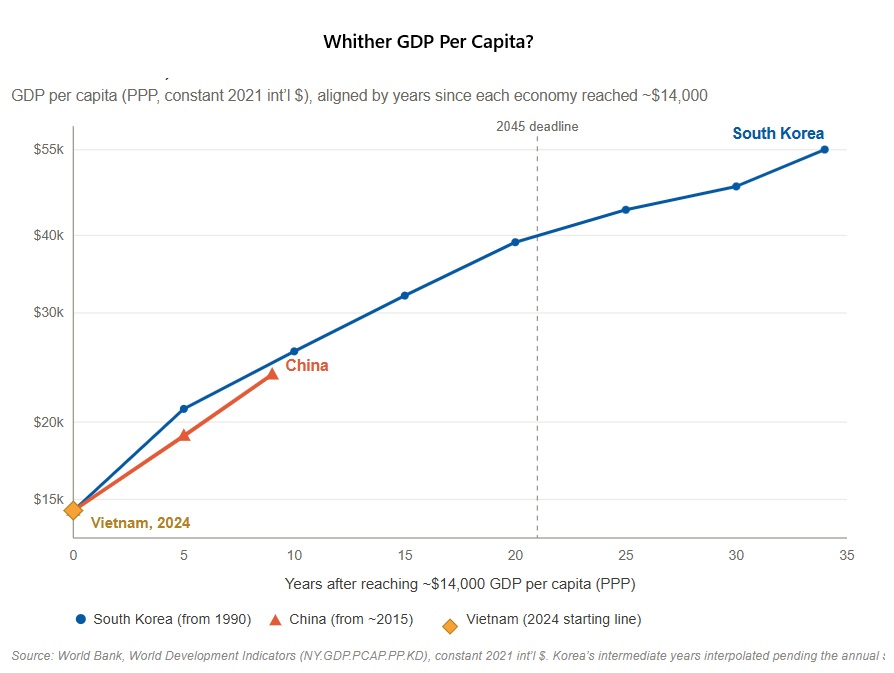
For nearly a decade we’ve been saying Vietnam is one of the five most important countries in the world because as it grows economically it can follow the East Asian path and liberalize politically as Taiwan and South Korea did or it can follow the new China model of becoming more authoritarian even as it grows economically. Bill Hayton, writing in Democracy Asia, lays out the case that Hanoi is modeling itself after Beijing. In April, Vietnam’s National Assembly formally merged the roles of party general secretary and state president, handing both to To Lam—a concentration the party had historically spread across four or five figures. China and Xi Jinping pioneered this move years earlier. Vietnam now is copying that model. State broadcasters were placed under direct Central Committee control, echoing a 2018 Chinese decision. History archives are going dark, mirroring Beijing’s 2014 clampdown. Independent think-tanks fell silent after energy experts were arrested for criticizing Vietnam’s plans to expand coal power. At the same time, To Lam is targeting reaching high-income status by 2045, which would require around ten percent economic growth a year for the next two decades. China itself has said developing countries should adopt the China model. However, as we wrote a few weeks ago, China wants to continue to manufacture everything and import little, which makes it difficult for places like Vietnam to succeed. So is China’s recommended model made out of balsa wood? How long with Vietnam fly it?
No Rules, Lower Growth
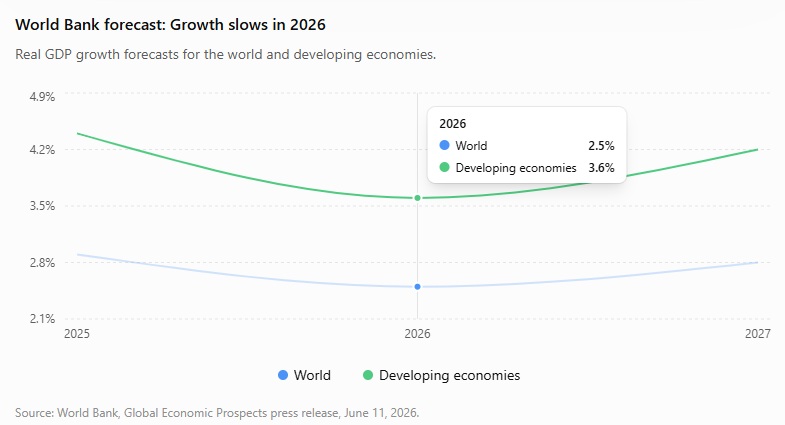
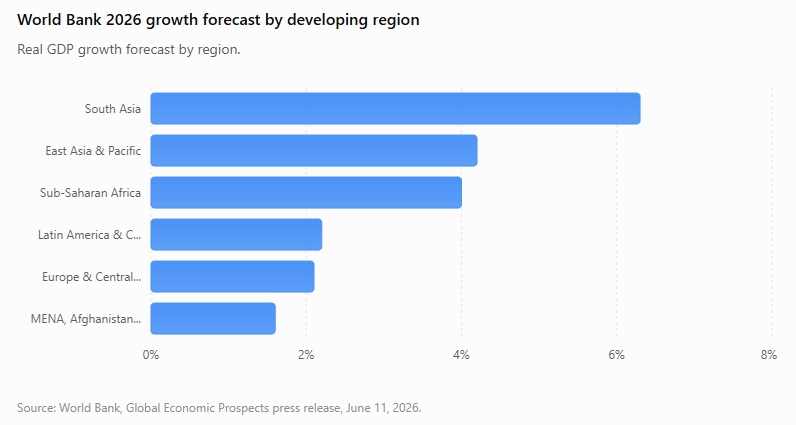
In our book, Challenging China, and in numerous writings since, we warned that the end of the liberal rules-based world order will likely lead to slower growth. Unfortunately, while China wanted to end the old-world order, it is the U.S. who ended up smashing it to smithereens. We have been watching the consequences, including on the economy. The World Bank has issued one of those warnings that sounds dry until you translate it into ordinary life. Global growth is now forecast to slow from 2.9 percent in 2025 to 2.5 percent in 2026. That’s not so bad you might think but it would be the weakest pace since the pandemic. Growth in developing economies is expected to fall even harder, from 4.4 percent to 3.6 percent. And by 2028, developing economies other than China and India will have gone nearly a decade without narrowing the income gap with rich countries. That is World Bank-speak for a lost decade. The immediate cause is the Middle East conflict, higher energy prices, higher inflation, and higher borrowing costs. But the deeper story is a more volatile world, one without a rules-based order and without a relatively benign top banana in the former U.S. The banana, unfortunately, has split. Again, you might ask what’s the big deal if world GDP grows slightly slower? It means fewer jobs, weaker public services, less poverty alleviation, more instability, more migration pressure, smaller export markets, and more openings for China and other powers promising a different model. Everyone worries about economic crashes but more worrisome and realistic is a long slow drift. The world keeps growing, but too slowly for too many countries to catch up. A lost decade does not always look like collapse. Sometimes it looks like ten years in which the future simply fails to arrive.
China Corner: Long Arm of Chinese Law
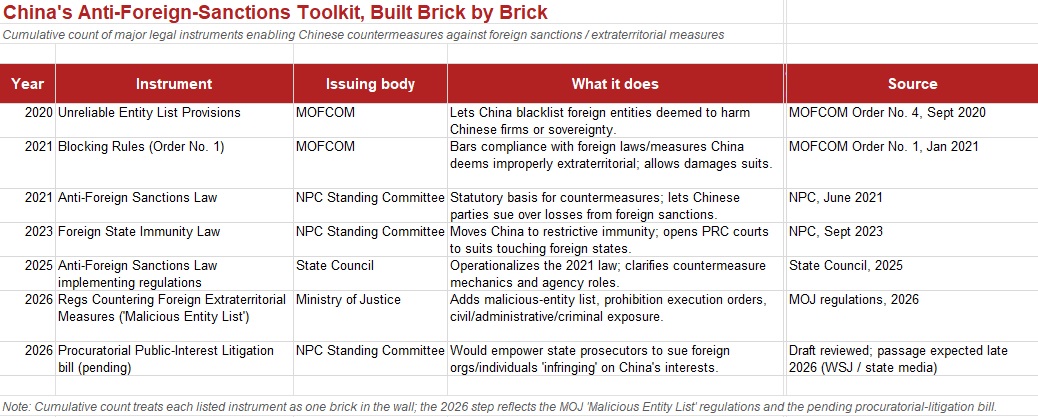
We don’t usually cover stuff currently in the big newspapers but the ramifications of this are too important to ignore and we’ve been warning about a post rules-based China-influenced order for so long we break tradition. This week the standing committee of China’s National People’s Congress gave an early reading to a draft law on “prosecuratorial public-interest litigation” that would empower state prosecutors to sue foreign organizations and individuals whose conduct “infringes on” China’s national and public interests. Two words to pay attention to. The first is individuals. China already lets its companies sue foreign parties for sanctions losses. What’s new is handing the procuratorate—the state’s own prosecutors, not aggrieved firms—a mandate to pursue foreign NGOs, researchers, journalists, and people, on Beijing’s initiative. The second is interests, which the draft pointedly declines to define This gives China maximum-discretion setting. Notice the packaging: “public-interest litigation,” “civil suits,” “prosecuratorial agencies.” This is the vocabulary of rule of law wearing the substance of rule by law. Prosecutorial essays have argued for months that when foreign powers blockade technologies or threaten supply chains, prosecutors can sue for cessation and compensation. In other words, export controls, chip fights, entity lists. This is all part of the battle with the new United States, and other countries, over control of supply chains. Perhaps it was an inevitable fight. It will now be one with few if any rules.